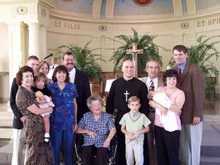
Last evening one of the young Brothers from the house in Carrefour, a “suburb” of PAP (the word itself means "crossroads"), showed up and said that he was taking me to stay at the house at Carrefour for a couple of days. Now, I had not been previously told about this, but whatever, I wanted to go there anyway, and things had been getting a little dull around Canado-Haitian, so I jammed my only clean clothes into my backpack (no electricity and no soap most of the weekend, so laundry has been interesting lately, like “wearing the same pair of pants three days in a row while sweating like a racehorse all day” interesting) and off we went.
So I have mentioned in previous posts that driving in PAP scares me to death, but I should add now that doing so at night is a whole new ball of wax. The good thing is that the passenger (me) can’t see how close we are to getting in a wreck every 5 seconds, so that might take the edge off the terror factor, but the bad thing is, the driver can’t see any of that stuff either. In defense of the drivers here, I should mention that, despite all the crazy driving and the apparent absence of any kind of traffic laws, I haven’t seen a single car get in a wreck, nor a single pedestrian get mowed down, but sometimes it has been a matter of millimeters. Anyway, we made it in one piece and were welcomed by some teenaged security guard carrying a rifle (yeah, I feel safe now) as we drove into the complex. This place is HUGE – high school, grade school, kindergarten, and enough grounds around it all to build all the buildings again. I met the Brothers here, chatted with them for an hour or so, had a ridiculously large meal, and went to bed.
The next morning, today, Br. Robert showed me around the place. Quite impressive, and not just because of the size (although that didn’t hurt). He told me that the auditorium holds 2500 people, and seeing the place, I believed it. On a slightly different note, it’s still a little funny to me to see barnyard animals running around school campuses, but they have plenty of them here: chickens, at least 7 goats, 2 peacocks and a peahen. I accidentally spooked the goats and they all blazed off through a little hole in a concrete wall on the edge of the property, but one of them kinda got stuck. I was going to be nice and pull her out to help her across the wall, but she squeezed through before I could get my hands on her. Sorry, goat. Switching gears, I can understand why the ancient Greeks incorporated peacocks into their mythology because, despite having seen peacocks plenty of times before, they are still fascinating to me. First off, the birds here are very tame, presumably because they have a zillion kids running around them all the time; I could walk within 2 or 3 feet of them without them really reacting to me at all. Second, and I didn’t know this before today, these things make the coolest noise. There was a thunderstorm this afternoon, and apparently the thunder spooks them, because every time there was a thunderclap, these things would make this crying/wailing noise that at first I thought was babies crying, but really really loud. Of course, I haven’t mentioned their plumage, but what can I say – amazing. Whenever one peacock would fan his plumage for the peahen, the other guy would do the same thing, but she didn’t seem to want to have anything to do with either of them. They probably leave their dirty socks lying all over the place and expect her to clean up after them. Still, they are impressive animals. I could almost imagine Hera plucking Argus’ 100 eyes from his corpse and placing them on the tail of her favorite bird. The fact that the French word for peacock is paon, which is pronounced like pah(n) doesn’t hurt either, because I just think that’s a cool word. Paon paon paon.
I do want to mention that the issue of garbage removal has come to mind numerous times since I have been here. The issue is this: there’s no garbage removal. People take it for granted that bottles, cans, paper, plastic, whatever is simply to be tossed in the yard, in the road, in the ditch, wherever. In the bidonvilles, there are huge piles of garbage in the streets, some of which are perpetually burning. Here at the school, the grounds, the soccer field, even the cemetery are half-covered with soda bottles and aluminum cans, and the school itself has that scratchy-throat burning-plastic smell about it from where they burn the trash. We certainly have problems in the U.S. with the amount of waste we generate, but at least we don’t bury our streets or our yards in it (not generally, at least).
Today also happened to be Br. Robert’s birthday, and I’ve already mentioned how big a deal birthdays are here, but I should add that the last party, the one for Br. Norbert, had nothing on this one. Between Brothers and colleagues, there must have been 60 people who showed up for the lunch we had, and there was food to spare. All kinds of people were bringing gifts, and not just some little junky knickknacks – shoes, a cell phone, real stuff. Apparently Br. Robert has been here forever, though, so everyone and their grandmother knows him and loves him (and rightfully so – he is gracious and gentlemanly).
I will be on the road for the next couple of days, and the computer at our house is on the sick list at the moment, so this may be my last post while I am in Haiti; so, although I will certainly keep up the blog with other stuff after I get home, I will offer a few parting shots on my time here. Although I am looking ahead to my time at Notre Dame this summer (and looking forward to getting back to the Brothers, my coworkers, and my students in StL), I’m not really looking forward to leaving Haiti. Apart from the amount of French I have learned in three weeks, which is huge, I sense that there is a lot of life here, that if I were to come on a longer-term basis I could find a real home here with the Brothers. I am struck by their continual graciousness and hospitality and their real love of community life. I wish my language skills were more than they are, but the Brothers have been endlessly patient with my halting French and my nonexistent Creole.
Finally, a few thanks. My thanks to the Brothers at Collège Canado-Haitian, especially the young Brothers there who drove me places, worked on the language with me, and haggled with old ladies over Haitian shirts for me. Thanks to Brs. Bernard Couvillion and Paul Montero for encouraging me to come here in the first place and for preparing me for what I would find. Thanks to Br. Joseph Alexandre, the Haitian provincial, and Br. Francis David, my provincial, for being so open to making this kind of exchange possible. Lastly, thanks to my mom and dad for their support (despite not necessarily being crazy about me going to a place like Haiti), especially my dad pushing and pulling to get my passport from wherever in the ether it was floating all that time. Thanks Dad, thanks Mom, thanks everyone.
Mercy within mercy within mercy...
Wednesday, June 27, 2007


Saturday, June 23, 2007
samedi le 23 juin
So much has happened between yesterday morning and today that I am going to have a hard time fitting it all in one email. To begin, I wrote before that I was going to go on Friday morning to visit the communities in the south with the provincial, Br. Joseph. Thursday evening the director of my house comes home and tells me that I am supposed to stay at the provincial house that evening (Thursday) because we are leaving early the next morning. OK, no problem – throw some things together and go. When I get there, it turns out that Br. Joseph is no longer going south because he has other commitments in town, but the director of the provincial house, Br. Élithère, will be taking me. I never did quite figure out if he actually had business in the south, or if he was just taking me around to be hospitable. Anyway, we get up at some awful hour, 4:30 or so, and we two and a third Brother are on the road by 5. Br. Élithère immediately starts driving like a bat out of hell, which at this point can’t scare me any more than any of the other frightful driving habits I have seen on Haitian streets. We blaze out of Port-au-Prince in what has to be record time, and hit a state road that takes us south. I should say that the roads here are deceptive because they are totally inconsistent; sometimes this “state road” is little different in quality from a normal road in the United States, while at others it is more or less a series of very deep potholes connected by wisps of asphalt. When Br. Élithère hits a patch of good road, he floors the gas pedal, to the point that I almost looked forward to the potholes, except that during those stretches of bad road he takes to swerving and pitching all over the road so as to find the best pieces of road and thereby slow down as little as possible. This whole time, I should add, he regularly acts as if he is driving an automatic transmission instead of a manual, so the engine is screaming at us because we are careening down the road at 90kph in third gear.
Our first stop is the Brothers’ residence at Miragoane, a dusty little one-horse town on the northeast corner of Haiti’s southern peninsula. We pull in at about 7:00 or so, meet the Brothers, eat breakfast, and hit the road again. I should add that this whole time, Br. Élithère is talking to me the same way he is driving: fast and aggressive, and not loudly enough to make up for the noise of the road and the squealing engine. Not that he is being unkind, but when I don’t get his comments and questions the first time, he takes up that tactic that I thought only Americans did with foreigners: he shouts each word at me ridiculously slowly, as if to make sure that I know what an idiot I am for not speaking his French-Kreyol mélange like a native.
I should add at this point that the difference between hearing and listening has never been more acute for me than it is these days here. To listen to one’s own language requires little more than simple hearing – unless we are really distracted by something else, in general if we hear the words, they are instantly meaningful to us and we understand what is going on, even if we aren’t really following the conversation. When someone is speaking a different language, however, it is quite different, at least for a dummy like me. When people around me are speaking French to one another, unless I am actually listening to the words, it easily fades into background noise, just as it would for a language that I don’t know at all. However, we tend to assume that if a person speaks a language beyond his or her native tongue, that he or she has kept up with a conversation by simple fact of being proximate to the speakers. I mention all this because several times Br. Élithère would be speaking to the young Brother in the backseat and suddenly try to get me to join the conversation, and of course I had not been consciously listening, so I didn’t have a clue about what they were saying.
Anyway, after some bumping around on awful roads to get to Br. Élithère’s hometown of Camp-Perrin and seeing some of the sights there, we ended up going to Les Caïes, the third-largest city in Haiti (I think) – the Brothers had a nice house (brand-new) on the outskirts of the city, and a new school under construction, and we spent some time there before going to see their old residence and the school in town. We weren’t there long before blazing off to Port-Salut, a beachfront town not too far south. For me, this was where the real fun began. We got to the house and hung out a bit before deciding to go to the beach, so we went down the road to a local private beach managed by a restaurant/cabana kind of place. I went swimming for an hour or so, and when I got back out of the water, one of the Brothers had ordered dinner for us: cole slaw, fried bananas, tomatoes, and lobster. Let me just say that I love lobster, it’s one of the few things I miss as a vegetarian (but hey, they ordered it, and I don’t want to look ungrateful, right?!) and this was particularly good lobster, even as lobsters go. Sitting there on a beach in the Caribbean, eating a lobster and washing it down with a cold Haitian beer (it’s no Chimay, but somehow I suffered through), it was hard not to laugh at the idea of being in mission territory. After we went back and cleaned up, I happened to mention to one of the Brothers that I had never tasted coconut (there are coconut trees everywhere here, so somehow it came up), and he naturally asked if I would like to try it. Again, who am I to say no, so we went across the yard to one of their coconut trees, and he said he would get someone to climb up to get a coconut for us. Sorry, did you say climb the tree? For those of you whom I don’t know personally, I love to climb trees, so I went ahead and asked if I could do the honors. Long story short, minus shoes and socks, and a quick “Fais attention” (be careful) from the Brothers, and up I go. I admit my technique could have used some work, but I got my coconut, and it was good. A few coconuts later (they cut a pole to shake down another few coconuts so someone else wouldn’t have to climb, but I think mine tasted better for having climbed for it) we got back in the truck and drove back to Les Caïes for the night. The room they gave me was stuffy because of the heat, but like many of the houses here, the Brothers’ place there has a flat roof, so I casually asked if I could sleep up there. Again, long story short, I passed a marvelously cool evening on the roof au clair de lune. A few of the novices came back with us to PAP, and again, Br. Élithère got us up well before dawn. He had us on the road by 5, and home by 10 am, with a few breaks in there to stop back at the house at Miragoane and stop for breakfast. By the by, he drove fast enough and swerved hard enough on the worse parts of the road that one of the novices got carsick and had to get out of the car to throw up. Br. Élithère drove a little more slowly after that...for about 15 minutes.
The Brothers later suggested that, unlike PAP, I would be able to walk around Port-Salut without fear of danger, and the cooler weather and the ready availability of the beach makes that a nice option for future excursions, especially if we wanted to try bringing students. Possibilities…
Our first stop is the Brothers’ residence at Miragoane, a dusty little one-horse town on the northeast corner of Haiti’s southern peninsula. We pull in at about 7:00 or so, meet the Brothers, eat breakfast, and hit the road again. I should add that this whole time, Br. Élithère is talking to me the same way he is driving: fast and aggressive, and not loudly enough to make up for the noise of the road and the squealing engine. Not that he is being unkind, but when I don’t get his comments and questions the first time, he takes up that tactic that I thought only Americans did with foreigners: he shouts each word at me ridiculously slowly, as if to make sure that I know what an idiot I am for not speaking his French-Kreyol mélange like a native.
I should add at this point that the difference between hearing and listening has never been more acute for me than it is these days here. To listen to one’s own language requires little more than simple hearing – unless we are really distracted by something else, in general if we hear the words, they are instantly meaningful to us and we understand what is going on, even if we aren’t really following the conversation. When someone is speaking a different language, however, it is quite different, at least for a dummy like me. When people around me are speaking French to one another, unless I am actually listening to the words, it easily fades into background noise, just as it would for a language that I don’t know at all. However, we tend to assume that if a person speaks a language beyond his or her native tongue, that he or she has kept up with a conversation by simple fact of being proximate to the speakers. I mention all this because several times Br. Élithère would be speaking to the young Brother in the backseat and suddenly try to get me to join the conversation, and of course I had not been consciously listening, so I didn’t have a clue about what they were saying.
Anyway, after some bumping around on awful roads to get to Br. Élithère’s hometown of Camp-Perrin and seeing some of the sights there, we ended up going to Les Caïes, the third-largest city in Haiti (I think) – the Brothers had a nice house (brand-new) on the outskirts of the city, and a new school under construction, and we spent some time there before going to see their old residence and the school in town. We weren’t there long before blazing off to Port-Salut, a beachfront town not too far south. For me, this was where the real fun began. We got to the house and hung out a bit before deciding to go to the beach, so we went down the road to a local private beach managed by a restaurant/cabana kind of place. I went swimming for an hour or so, and when I got back out of the water, one of the Brothers had ordered dinner for us: cole slaw, fried bananas, tomatoes, and lobster. Let me just say that I love lobster, it’s one of the few things I miss as a vegetarian (but hey, they ordered it, and I don’t want to look ungrateful, right?!) and this was particularly good lobster, even as lobsters go. Sitting there on a beach in the Caribbean, eating a lobster and washing it down with a cold Haitian beer (it’s no Chimay, but somehow I suffered through), it was hard not to laugh at the idea of being in mission territory. After we went back and cleaned up, I happened to mention to one of the Brothers that I had never tasted coconut (there are coconut trees everywhere here, so somehow it came up), and he naturally asked if I would like to try it. Again, who am I to say no, so we went across the yard to one of their coconut trees, and he said he would get someone to climb up to get a coconut for us. Sorry, did you say climb the tree? For those of you whom I don’t know personally, I love to climb trees, so I went ahead and asked if I could do the honors. Long story short, minus shoes and socks, and a quick “Fais attention” (be careful) from the Brothers, and up I go. I admit my technique could have used some work, but I got my coconut, and it was good. A few coconuts later (they cut a pole to shake down another few coconuts so someone else wouldn’t have to climb, but I think mine tasted better for having climbed for it) we got back in the truck and drove back to Les Caïes for the night. The room they gave me was stuffy because of the heat, but like many of the houses here, the Brothers’ place there has a flat roof, so I casually asked if I could sleep up there. Again, long story short, I passed a marvelously cool evening on the roof au clair de lune. A few of the novices came back with us to PAP, and again, Br. Élithère got us up well before dawn. He had us on the road by 5, and home by 10 am, with a few breaks in there to stop back at the house at Miragoane and stop for breakfast. By the by, he drove fast enough and swerved hard enough on the worse parts of the road that one of the novices got carsick and had to get out of the car to throw up. Br. Élithère drove a little more slowly after that...for about 15 minutes.
The Brothers later suggested that, unlike PAP, I would be able to walk around Port-Salut without fear of danger, and the cooler weather and the ready availability of the beach makes that a nice option for future excursions, especially if we wanted to try bringing students. Possibilities…
Wednesday, June 20, 2007
mercredi le 20 juin
Lots of odds and ends things coming together these days. I went into town with a couple of the Brothers to buy a shirt at a big outdoor square called Champ de Mars. There were lots of people around the plaza, presumably unemployed and perhaps unemployable. There was a nice amphitheater that looked ready for a band to show up and start playing, but it looked like such a thing hadn't happened in a while. Like many of the places I have seen, Champ de Mars looks like it was once very nice but has not been kept up; in a city in America I could imagine it being a main attraction, but here it is mostly for out-of-work young men and for artisans trying to peddle the few pieces of wood left in the country for a few dollars. When we got to the stand where they were selling shirts, I found something I wanted, and I expected to haggle about the price, because certainly they jack up the price for foreigners, but the Brother who was handling the price war with this woman actually made me uncomfortable by demanding that the vendor go too low on her price. Perhaps that's why American tourists have a reputation for being taken for a ride when they buy local souvenirs: maybe they know the price is raised for them, but they also know that a few dollars' difference to us might mean a lot to the vendor. At any rate, the Brother talked this woman down from 150 Haitian dollars, which is a little over $20, to 100 Haitian dollars. You can do the math. Haitian dollars don't actually exist on paper, mind you -- the real currency here is the gourd, but for some reason people figure costs in Haitian dollars (5 gourdes = 1 Haitian dollar). Whatever.
Today was the birthday of Br. Norbert, one of the older Brothers here, and given the size of the feast we had and the number of Brothers from around the city who showed up, birthdays seem to be quite a big deal around here. Br. Joseph Alexandre, the provincial, came for the meal, and we ended up talking about how things are going, etc., and we made plans for me to go with him to the southern part of the country, to the city of les Caies, for the weekend. Apparently there is some kind of house there built for mission groups, so I definitely want to check it out. I am realizing more and more that language barriers would be a factor here, especially to work with the poorer segment of society, since they would not really speak or understand French, much less English.
I have to change course at this point and say a few things about the food here. First, let me preface by saying that it has almost all been very good. Still, it's different. I have foregone my usual vegetarian ways for the duration of my stay, both to be open to trying things and so as not to be a burden on people with far fewer food choices than we are. Too bad the computer was on the blink a few nights ago; I wanted to write something after we finished our supper, which consisted of onion pie (not good, BTW), banana soup, and potted meat. This evening was banana and tripe soup, to which I added some cassave, a tough crackery kind of thing made from manioc. Several of the things they eat here are the same as back home, just at different times; spaghetti for breakfast, oatmeal for supper, bananas used like we use potatoes. They also really seem to like Manieschewitz, the really sweet Jewish wine they keep at the back of the liquor store. Again, whatever floats your boat. They have few things here that we don't have, but that I really like: a fruit they call veritables, another they call abricots, which is the French word for apricot but which is totally different from our apricots, and a corn-based dish like grits that reminds me a lot of sadza, the staple food in Zimbabwe.
I have been talking with some of the Brothers about the local politics and the history of what has been going on around here, and it's pretty insane. One of the Brothers who came to lunch today was kidnapped and beat up last year, and several students at the school where I am staying were also kidnapped. They say that was going on up until about December. However, they also mentioned that Americans are safer than the locals, because the Haitian government does not tend to do much when Haitians were kidnapped.
Today was the birthday of Br. Norbert, one of the older Brothers here, and given the size of the feast we had and the number of Brothers from around the city who showed up, birthdays seem to be quite a big deal around here. Br. Joseph Alexandre, the provincial, came for the meal, and we ended up talking about how things are going, etc., and we made plans for me to go with him to the southern part of the country, to the city of les Caies, for the weekend. Apparently there is some kind of house there built for mission groups, so I definitely want to check it out. I am realizing more and more that language barriers would be a factor here, especially to work with the poorer segment of society, since they would not really speak or understand French, much less English.
I have to change course at this point and say a few things about the food here. First, let me preface by saying that it has almost all been very good. Still, it's different. I have foregone my usual vegetarian ways for the duration of my stay, both to be open to trying things and so as not to be a burden on people with far fewer food choices than we are. Too bad the computer was on the blink a few nights ago; I wanted to write something after we finished our supper, which consisted of onion pie (not good, BTW), banana soup, and potted meat. This evening was banana and tripe soup, to which I added some cassave, a tough crackery kind of thing made from manioc. Several of the things they eat here are the same as back home, just at different times; spaghetti for breakfast, oatmeal for supper, bananas used like we use potatoes. They also really seem to like Manieschewitz, the really sweet Jewish wine they keep at the back of the liquor store. Again, whatever floats your boat. They have few things here that we don't have, but that I really like: a fruit they call veritables, another they call abricots, which is the French word for apricot but which is totally different from our apricots, and a corn-based dish like grits that reminds me a lot of sadza, the staple food in Zimbabwe.
I have been talking with some of the Brothers about the local politics and the history of what has been going on around here, and it's pretty insane. One of the Brothers who came to lunch today was kidnapped and beat up last year, and several students at the school where I am staying were also kidnapped. They say that was going on up until about December. However, they also mentioned that Americans are safer than the locals, because the Haitian government does not tend to do much when Haitians were kidnapped.
Saturday, June 16, 2007
Today was my first chance to really venture out of my zone or neighborhood, and it was quite an eye-opening experience. This afternoon, we drove from the school over to the Brothers’ postulate/novitiate, which is on the other side of town. Now, I was a little nervous when Br. Joseph drove me from the airport to the school last Sunday, but there weren’t many cars on the road then, and Br. Joseph is a decent driver. Today, we had a long drive, the streets were crowded, and the Brothers who drove were simply not very good behind the wheel. The traffic laws here seem to be reducible to this: whoever can hit their horn first has the right-of-way. People hit their horns constantly, as a way of telling cars at intersections not to race out (which they still do half the time) and telling pedestrians to move. Anyway, truly a harrowing experience. Driving between here and there, though, we had to go through what they call a bidonville, which apparently translates roughly as shantytown, and, speaking as a person who has had the privilege of traveling to some genuinely poor places, I still was not prepared for the squalor of this part of town. There is a sort of base-level poverty that pervades the city, and I expected that, but I did not expect the piles of garbage on the side of the road, the dilapidation of kilometer after kilometer of “shops” and houses. Perhaps it was not that the poverty was worse than that in, say, Zimbabwe, but that so many people were crammed into it so tightly.
Arriving, then, at the novitiate, was a study in contrasts: the sprawling grounds, the two huge houses (one for the postulants and the other for the novices), the partridges and ducks and geese and even a peacock around the garden, it was like entering a totally different world from the filthy, smelly, noisy street we left two minutes earlier. The mango trees were dropping mangoes on us (literally!) – walking around, eating a perfectly ripe mango that was on the tree twenty seconds before, I had to laugh at the idea that I was “roughing it,” but I also had to marvel at the contrast of this place with the city outside those walls.
I will need to come back another time to write about the religiosity of this place, but a couple of examples will serve for now: driving to the novitiate, we passed a series of signs posted by one of the local banks, signs commemorating the feast of the Sacred Heart. On all the roads we see taptaps, which are Haiti’s answer to the concept of public transportation: somewhere between vans and trucks, but rainbow colored and decorated to the nth degree with religious slogans and pictures, everything from pictures of St. Andrew to “In God We Trust” and Kreyol translations of Bible verses.
Oh, the water is back on for now. Apparently being without water three separate times in a week is unusual even for the Brothers who are from here, so perhaps I shouldn’t ask how long it will be on this time.
Mercy within mercy within mercy...
Arriving, then, at the novitiate, was a study in contrasts: the sprawling grounds, the two huge houses (one for the postulants and the other for the novices), the partridges and ducks and geese and even a peacock around the garden, it was like entering a totally different world from the filthy, smelly, noisy street we left two minutes earlier. The mango trees were dropping mangoes on us (literally!) – walking around, eating a perfectly ripe mango that was on the tree twenty seconds before, I had to laugh at the idea that I was “roughing it,” but I also had to marvel at the contrast of this place with the city outside those walls.
I will need to come back another time to write about the religiosity of this place, but a couple of examples will serve for now: driving to the novitiate, we passed a series of signs posted by one of the local banks, signs commemorating the feast of the Sacred Heart. On all the roads we see taptaps, which are Haiti’s answer to the concept of public transportation: somewhere between vans and trucks, but rainbow colored and decorated to the nth degree with religious slogans and pictures, everything from pictures of St. Andrew to “In God We Trust” and Kreyol translations of Bible verses.
Oh, the water is back on for now. Apparently being without water three separate times in a week is unusual even for the Brothers who are from here, so perhaps I shouldn’t ask how long it will be on this time.
Mercy within mercy within mercy...
Friday, June 15, 2007
Vendredi le 15 Juin 2007 – La Fête du Sacré-Cœur
I want to preemptively apologize at the start if this posting is too sarcastic for people’s tastes. I am really tired as I write, and I’m at the end of a day full of weirdness, and those two factors have conspired to bring out my sarcastic streak. So today’s our feast day, but it is also graduation day for the high school where I am staying. (*Before I go any further, for those who didn’t already know, I am currently in Port-au-Prince, Haiti.*) I didn’t sleep terribly well last night because the malaria medicine I am taking has been giving me dreams that are vivid enough for me to wake myself up from laughing in my dreams. (*Weird, I know. More on that some other time.*) Anyway, we had morning prayers at 5:00, the usual time here, and then I went back to bed for another half hour or so. After a Brother came to get me for breakfast, one of the nuns who works here, a tough little Colombian sister named Hermana Gloria came up to the Brothers’ place looking for some guys with muscle to help set up for the graduation, which was going to be in the courtyard of the school. Of course, I’m too dumb to keep from biting that hook, so down I went and got right into it, lugging potted plants, setting up displays, securing decorations and so on. We were quite an odd crew – three sisters from Colombia, another from somewhere in Africa, assorted Haitians, and “le blanc” (that is, me, the name that some of the locals have given me because I’m the only white guy they have seen in a long time). Anyway, we sweated our butts off setting up for the graduation until I had to get ready for the meal the Brothers were having at our house for the faculty. Before I went back up, I noticed a one-eyed worker wearing a shirt that said “I *Heart* Bagels.” Yeah, I know, weird. I asked him if he knew what a bagel is, but he only spoke Kreyol, and I have no idea how to say “bagel” in Kreyol, so I didn’t get an answer.
OK, before I go any further, I just want to say something, and I preface it by saying that I am a Francophile and I am extremely happy that I am here: Spanish is so much easier to understand than French, it’s just silly. I only know a tiny bit of Spanish, but the pronunciation is so much simpler, and they don’t cut half the sounds off their words like French does. Hermana Gloria speaks French, but much prefers Spanish, so she ended up using mostly Spanish with me for the two hours she had me under her thumb, and despite the fact that my Spanish is even worse than my French, I did ok the whole time.
OK, end of tangent. Sorry. Anyway, I went back up to the house and was almost at the shower when I remembered that we still don’t have running water. (*Did I mention the water hasn’t worked for two days? The water hasn’t worked for two days.*) I ended up going to the house next door and using one of their showers, and I get back and get ready in time for the lunch, which was actually extremely nice, but, like so much of what I see here, it would be a little awkward by our standards, even if in a genuine and disarming way. (*Mercifully, our standards do not and should not prevail.*) They played come up-tempo Caribbean music and had a gigantic cake shaped like a heart; it looked more like a wedding cake than something for a faculty luncheon. Some older gentleman who spoke French very clearly but very slowly acted like I was the greatest thing since sliced bread, and when the wine started flowing after the meal, Hermana Gloria started dancing with anyone who couldn’t squirm out of her grasp in time.
After lunch Hermana Gloria somehow roped me into working again, and I ended up helping to pin pennants on the graduating students. Of course, they had no idea who I was, but they were very pliable about it, so whatever. The graduation began with a mass, and the Brothers were going to go together as part of the feast day, so I went back up to the house to meet them, but the time kept changing (*How do you repeatedly change what time a graduation ceremony starts? Anything is possible for people whose God does not hang on a wall and tick.*).
So anyway, the mass starts and all’s well. Apart from the obscene heat, the only thing that really strikes me is the cheesy keyboard music that accompanies every song we sing. Finally, it’s getting a little boring, so one of the musicians passes out in right around the gospel. (*I should mention that it’s so hot that the balloons are popping spontaneously; in one grouping of balloons, they all popped except a random “Walt Disney World” balloon. I’m trying to picture one of those in the decorations at a Catholic High graduation…Um, no.*) Well, Hermana Gloria wants to help to take care of this guy, and she tells me she wants food and alcohol, and I’m thinking I could use some alcohol at this point too, but she meant smelling salts – who still uses smelling salts?! As fate and this weirdo day would have it, we had three little bottles of peppermint spirits in a random cabinet, and I don’t know if that’s what you use this stuff for, but it sure smells (more on that in a minute), so I brought it. As we’re going down to revive and feed this guy (in that order), one of the bottles crushes in my hand. These bottles were positively ancient, so this thing basically crumbled to pieces. Naturally, this peppermint stuff spills all over my hand, arm, and chest, and not only does it make me stink to high heaven, it’s got a tingly sensation, like Ben-Gay or something like that. We get this guy put back together enough for him to go throw up, and then I go back to mass, reeking of peppermint spirits and sweating like a racehorse, just in time for Communion. Just then one of the Brothers comes up and tells me to go up and help distribute Communion – is this them trying to be welcoming toward a guest, or did they not plan out who was going to be Eucharistic ministers? Either way, my slow-speaking bodyguard from lunchtime takes me by the arm across the courtyard to distribute Communion, and everyone is looking at me like I’m handing out poison. Finally one woman came up, but that was it, so I gave my bodyguard the paten and sat down. (*To be fair, just about no one went to Communion, so I don’t think it was anything against me, such as the fact that I smelled like a candy cane.*)
Mass finished relatively uneventfully, and then someone decided that we needed to move a bunch of chairs, pronto, so students and teachers started bustling around, getting nowhere fast, and I decided that my peppermint burns are becoming genuinely uncomfortable, so I made an exit and came back up to find that the water has somehow miraculously come back on, but that stuff doesn’t wash off easily, so I figured I’d come write all this stuff down and go try again. So here it is. Happy feast day, Brothers. Ametur Cor Jesu.
I want to preemptively apologize at the start if this posting is too sarcastic for people’s tastes. I am really tired as I write, and I’m at the end of a day full of weirdness, and those two factors have conspired to bring out my sarcastic streak. So today’s our feast day, but it is also graduation day for the high school where I am staying. (*Before I go any further, for those who didn’t already know, I am currently in Port-au-Prince, Haiti.*) I didn’t sleep terribly well last night because the malaria medicine I am taking has been giving me dreams that are vivid enough for me to wake myself up from laughing in my dreams. (*Weird, I know. More on that some other time.*) Anyway, we had morning prayers at 5:00, the usual time here, and then I went back to bed for another half hour or so. After a Brother came to get me for breakfast, one of the nuns who works here, a tough little Colombian sister named Hermana Gloria came up to the Brothers’ place looking for some guys with muscle to help set up for the graduation, which was going to be in the courtyard of the school. Of course, I’m too dumb to keep from biting that hook, so down I went and got right into it, lugging potted plants, setting up displays, securing decorations and so on. We were quite an odd crew – three sisters from Colombia, another from somewhere in Africa, assorted Haitians, and “le blanc” (that is, me, the name that some of the locals have given me because I’m the only white guy they have seen in a long time). Anyway, we sweated our butts off setting up for the graduation until I had to get ready for the meal the Brothers were having at our house for the faculty. Before I went back up, I noticed a one-eyed worker wearing a shirt that said “I *Heart* Bagels.” Yeah, I know, weird. I asked him if he knew what a bagel is, but he only spoke Kreyol, and I have no idea how to say “bagel” in Kreyol, so I didn’t get an answer.
OK, before I go any further, I just want to say something, and I preface it by saying that I am a Francophile and I am extremely happy that I am here: Spanish is so much easier to understand than French, it’s just silly. I only know a tiny bit of Spanish, but the pronunciation is so much simpler, and they don’t cut half the sounds off their words like French does. Hermana Gloria speaks French, but much prefers Spanish, so she ended up using mostly Spanish with me for the two hours she had me under her thumb, and despite the fact that my Spanish is even worse than my French, I did ok the whole time.
OK, end of tangent. Sorry. Anyway, I went back up to the house and was almost at the shower when I remembered that we still don’t have running water. (*Did I mention the water hasn’t worked for two days? The water hasn’t worked for two days.*) I ended up going to the house next door and using one of their showers, and I get back and get ready in time for the lunch, which was actually extremely nice, but, like so much of what I see here, it would be a little awkward by our standards, even if in a genuine and disarming way. (*Mercifully, our standards do not and should not prevail.*) They played come up-tempo Caribbean music and had a gigantic cake shaped like a heart; it looked more like a wedding cake than something for a faculty luncheon. Some older gentleman who spoke French very clearly but very slowly acted like I was the greatest thing since sliced bread, and when the wine started flowing after the meal, Hermana Gloria started dancing with anyone who couldn’t squirm out of her grasp in time.
After lunch Hermana Gloria somehow roped me into working again, and I ended up helping to pin pennants on the graduating students. Of course, they had no idea who I was, but they were very pliable about it, so whatever. The graduation began with a mass, and the Brothers were going to go together as part of the feast day, so I went back up to the house to meet them, but the time kept changing (*How do you repeatedly change what time a graduation ceremony starts? Anything is possible for people whose God does not hang on a wall and tick.*).
So anyway, the mass starts and all’s well. Apart from the obscene heat, the only thing that really strikes me is the cheesy keyboard music that accompanies every song we sing. Finally, it’s getting a little boring, so one of the musicians passes out in right around the gospel. (*I should mention that it’s so hot that the balloons are popping spontaneously; in one grouping of balloons, they all popped except a random “Walt Disney World” balloon. I’m trying to picture one of those in the decorations at a Catholic High graduation…Um, no.*) Well, Hermana Gloria wants to help to take care of this guy, and she tells me she wants food and alcohol, and I’m thinking I could use some alcohol at this point too, but she meant smelling salts – who still uses smelling salts?! As fate and this weirdo day would have it, we had three little bottles of peppermint spirits in a random cabinet, and I don’t know if that’s what you use this stuff for, but it sure smells (more on that in a minute), so I brought it. As we’re going down to revive and feed this guy (in that order), one of the bottles crushes in my hand. These bottles were positively ancient, so this thing basically crumbled to pieces. Naturally, this peppermint stuff spills all over my hand, arm, and chest, and not only does it make me stink to high heaven, it’s got a tingly sensation, like Ben-Gay or something like that. We get this guy put back together enough for him to go throw up, and then I go back to mass, reeking of peppermint spirits and sweating like a racehorse, just in time for Communion. Just then one of the Brothers comes up and tells me to go up and help distribute Communion – is this them trying to be welcoming toward a guest, or did they not plan out who was going to be Eucharistic ministers? Either way, my slow-speaking bodyguard from lunchtime takes me by the arm across the courtyard to distribute Communion, and everyone is looking at me like I’m handing out poison. Finally one woman came up, but that was it, so I gave my bodyguard the paten and sat down. (*To be fair, just about no one went to Communion, so I don’t think it was anything against me, such as the fact that I smelled like a candy cane.*)
Mass finished relatively uneventfully, and then someone decided that we needed to move a bunch of chairs, pronto, so students and teachers started bustling around, getting nowhere fast, and I decided that my peppermint burns are becoming genuinely uncomfortable, so I made an exit and came back up to find that the water has somehow miraculously come back on, but that stuff doesn’t wash off easily, so I figured I’d come write all this stuff down and go try again. So here it is. Happy feast day, Brothers. Ametur Cor Jesu.
Tuesday, June 12, 2007
Whoa, whoa, whoa...
Another good day of going around Port-au-Prince, meeting people, talking, practicing, writing translations, and so on. This really is the way to learn: my last post, when I mentioned sinking or swimming, I think I felt like I was sinking. Now, I know I'm still not very graceful, but I think my head is above water. I went with one of the other Brothers to the provincial house (about 10 minutes' walk), saw the place, and met a few of the Brothers. BIG HOUSE! 16 guys, or something like that, almost all of them younger than me. I talked for about an hour with the director, and by and large I did ok.
This evening was funny: the Brothers are as interested in learning English as I am in learning French, so they had me help them find some practice materials online. They came across some random page that had an MP3 of the song, "Row, row, row your boat," so the three of us were here singing for a good 15 minutes. They have a song in French that is set to the same tune, so we swapped lyrics and had a good time. The funny thing is that, listening to them singing, it made me wonder if my pronunciation sounds as strange to them as theirs does to me. Creole doesn't really have the "r" sound (they say it like a "w"), so one of the guys kept singing, "Whoa, whoa, whoa your boat," and I couldn't get him to make the "r" sound (maybe I should have told him one of my pirate jokes). I know my French is halting and awkward, but I feel like I say the words the way a Frenchman would -- maybe I can't hear the difference any more than the Haitian Brothers can hear the difference between "r" and "w".
Whoa, whoa, whoa...or as they would say,
"Ramons, ramons donc
Vogue le canot
Joliment, joliment, joliment, joliment,
Attaquons le flot."
This evening was funny: the Brothers are as interested in learning English as I am in learning French, so they had me help them find some practice materials online. They came across some random page that had an MP3 of the song, "Row, row, row your boat," so the three of us were here singing for a good 15 minutes. They have a song in French that is set to the same tune, so we swapped lyrics and had a good time. The funny thing is that, listening to them singing, it made me wonder if my pronunciation sounds as strange to them as theirs does to me. Creole doesn't really have the "r" sound (they say it like a "w"), so one of the guys kept singing, "Whoa, whoa, whoa your boat," and I couldn't get him to make the "r" sound (maybe I should have told him one of my pirate jokes). I know my French is halting and awkward, but I feel like I say the words the way a Frenchman would -- maybe I can't hear the difference any more than the Haitian Brothers can hear the difference between "r" and "w".
Whoa, whoa, whoa...or as they would say,
"Ramons, ramons donc
Vogue le canot
Joliment, joliment, joliment, joliment,
Attaquons le flot."
Sunday, June 10, 2007
en Haiti -- dimanche le 10 juin
To those of you whom I do not know personally, I'm spending about three weeks with our Brothers in Haiti, hoping to "perfectionner" (as they would say) my French. I have only been in Haiti for a few hours now, but already it has been a great experience. I landed about 9 am and was met by the Haitian provincial, who is polite and refined to a tee. He drove me to the "College Canado-Haitian," where I am staying, introduced me around a bit, and left. I will see him again at the end of the week. In the meantime, I got to chit-chat a little with the Brothers who live here, all of whom are quite young, settle in, and sit down to a very nice lunch. They got a cake that had originally said "Joyeuse Anniversaire" (Happy birthday) but to which they added the line "Bienvenu Patrick," so it's happy birthday and welcome at the same time. (*This just in - one of the Brothers stepped in while I was writing this and offered me a local drink called "Malta H" - a malt extract drink that doesn't really taste like anything I can compare it to. It's good in an I-like-it-but-I-wouldn't-want-to-drink-too-much-of-this kind of way*) Anyway, they have been very nice, but they use a lot of slang that I don't know and they aren't accustomed to speaking slowly for the linguistically impaired like myself, so it has been rather overwhelming at times.
My emotions have had a chance to play in such a new environment, so I have stepped back and watched them. The house is like the Brothers' place at Loreto in Zimbabwe, so it feels homey already, but I still need to acclimatize. It's really hot here, and there's not much air conditioning anywhere, so I've been sweating almost continually since I got here. I am lost in admiration of the beauty of this place, despite the obvious poverty - mountains that butt right up to the Caribbean, rolling countryside and big blue skies - but in other quiet moments the thought of three weeks of "sink-or-swim" French has produced that vaguely unpleasant sensation that comes from suddenly realizing that sinking is a possibility. We sat for a while before lunch and watched a French nature documentary, les lions tuant les facaucheres (lions killing wild boars, etc.), and I didn't understand much of it -- documentary commentators must whisper in every language. Later, I completely missed a joke that one of the Brothers made, and by the time he had explained it to me, it was no longer funny. Of course they were nice about it, but I felt like a dummy, and I realized that I have a lot of work to do: pecking out a letter in French with a dictionary in hand is a totally different animal from trying to keep up with six guys in a conversation. Flexibility and humility are certainly going to be the name of the game here, and pretending that I understand something isn't going to take me very far. Still, despite my humble start here, something about it tells me that there is a lot here for myself and the New Orleans province to connect with. This could be the beginning of a beautiful friendship.
My emotions have had a chance to play in such a new environment, so I have stepped back and watched them. The house is like the Brothers' place at Loreto in Zimbabwe, so it feels homey already, but I still need to acclimatize. It's really hot here, and there's not much air conditioning anywhere, so I've been sweating almost continually since I got here. I am lost in admiration of the beauty of this place, despite the obvious poverty - mountains that butt right up to the Caribbean, rolling countryside and big blue skies - but in other quiet moments the thought of three weeks of "sink-or-swim" French has produced that vaguely unpleasant sensation that comes from suddenly realizing that sinking is a possibility. We sat for a while before lunch and watched a French nature documentary, les lions tuant les facaucheres (lions killing wild boars, etc.), and I didn't understand much of it -- documentary commentators must whisper in every language. Later, I completely missed a joke that one of the Brothers made, and by the time he had explained it to me, it was no longer funny. Of course they were nice about it, but I felt like a dummy, and I realized that I have a lot of work to do: pecking out a letter in French with a dictionary in hand is a totally different animal from trying to keep up with six guys in a conversation. Flexibility and humility are certainly going to be the name of the game here, and pretending that I understand something isn't going to take me very far. Still, despite my humble start here, something about it tells me that there is a lot here for myself and the New Orleans province to connect with. This could be the beginning of a beautiful friendship.
Thursday, May 3, 2007
envy and humility
The semester here is almost over, so transitions are going on everywhere. Seniors are about to graduate, looking ahead to jobs or grad school or travel or volunteer programs. Students who have been studying abroad are coming home, and students who will be studying abroad are preparing to be gone for a semester or a year. We're interviewing new people for open positions, and saying goodbye to people who are leaving them open. I am loath to admit it, but one of the emotions I have been feeling in all of it, with some consistency, is envy: envy at the chance to spend a semester touring Europe, to be 24 and done with a master's degree, to be off to El Salvador for school. I can't even figure it out, since I have my own set of enviable blessings this summer and next year: a month of immersion in Haiti, another solid month of reading and thinking at Notre Dame, the conclusion of my master's work, teaching in the fall, openness to doctoral work down the road (whenever I am ready, I suspect). Is this something wrong with me, or is it another part of the tangle of illusions and desires that is the human condition? No matter how much I have, I can always find someone to envy. Lord, save me from my own voracious ego, from my need to be more, have more, do more.
Mercy within mercy within mercy...
Mercy within mercy within mercy...
Monday, April 30, 2007
Into Great Silence
Boy, has it been a long time since I have posted something. I’ve had a few things on my mind to write about, but never enough time! Saturday evening I went to see the film Into Great Silence (Die Große Stille), a sort of meditative look at life in the Grande Chartreuse, the motherhouse of the Carthusian Order. The Carthusians are one of the few orders of hermits in the Catholic Church, and their life is lived almost entirely in silence. The film is nearly three hours long, and it is not a documentary, since no one really speaks to the camera or talks about being a Carthusian. Rather, it is simply a series of prolonged camera shots on different moments in their life – watching them at prayer, or feeding the cats, or sawing firewood. While I have no desire to become a Carthusian, the deep symbols and the earthy simplicity of their lives touches something archetypal in me as a religious, and perhaps in me simply as a human being. The film, like the monastery itself, was very much what the Zen tradition would call shibumi – simple, understated elegance, not beauty in the usual “prettiness” sense of the word, but like the Velveteen Rabbit when he becomes “Real” even though he is worn and threadbare. The director switched back and forth between normal film and some grainy old film that looked like the stuff they used in the 1960s, presumably for symbolic reasons that could be elaborated in several ways. Several scenes and shots of certain scripture texts were repeated throughout the whole affair – the same guy at prayer in his cell a few times, the same bowl of fruit on one of the monk’s tables again and again, the monks ringing the bells calling the brothers to prayer. What a marvelous way to symbolize their lives – repetition, pattern, a sense of eternity in the cycles of their lives. Seeing one of the old men shuffling around the halls, knowing that the young monks will one day be like them, making their creaky way through their daily tasks, the sense of timelessness of the place encompasses and transcends the individuals who are there at any one moment. The monastery itself is apparently centuries old, and the cells have been inhabited by generation after generation of monks, so the wood of the floors has that marvelous, lived-in look of worn-down paths where the monks have walked day after day for decades and centuries. Such a thing reminds me that, more than having lives, we are instantiations of Life, members of a pattern that is lived out in us, and it takes a place that old to remind us that we are part of something that was here long before us and will be around long after we are dust. Coming out of the theater was quite a shock, both getting back into the noise of people and highway, but even the next day at the student mass at SLU: beautiful (in a totally different way), but the film drew out how loud even such a well-done mass can be. As much as I talk about silence and enjoy having stretches of silence during my day, and coming home to a quiet house at night, I found the movie challenging because it was so quiet, and so long; I admit I found myself looking at my watch a couple of times, even though I really didn’t want it to be over. Perhaps that was the subtle prophetic message of a film of this kind: we are deliberately making a long, slow movie, we are deliberately going to linger on places and faces longer than you are comfortable with, to make you a little uncomfortable so hopefully you actually look at what you see.
On another topic, I found out about a month ago that Fr. Steve Duffy, my academic mentor from my days as an undergraduate, passed away. I have come back and back to what it means, and I still can’t figure out quite what to say. Duffy continued to be a mentor for me long after I left Loyola; I went to see him just about every time I came back into town, and I would listen to the same stories I had heard the previous time, and I loved them just as much knowing how they were going to end. It’s not exactly that I am numb with mourning – he meant a lot to me, and I regret that we will never get together for dinner and good wine again, but it simply is what it is. He lived well, the way he wanted to, and he never felt the need to play by other people’s rules, and I suspect he died with his boots on, without making a fuss about dying (he never even told me he had cancer or that he was dying – I wonder when he found out). No philosophizing about “not taking things for granted” or “carpe diem” or anything like that – I simply close by remembering a great man. Here’s to you, Duffy.
On another topic, I found out about a month ago that Fr. Steve Duffy, my academic mentor from my days as an undergraduate, passed away. I have come back and back to what it means, and I still can’t figure out quite what to say. Duffy continued to be a mentor for me long after I left Loyola; I went to see him just about every time I came back into town, and I would listen to the same stories I had heard the previous time, and I loved them just as much knowing how they were going to end. It’s not exactly that I am numb with mourning – he meant a lot to me, and I regret that we will never get together for dinner and good wine again, but it simply is what it is. He lived well, the way he wanted to, and he never felt the need to play by other people’s rules, and I suspect he died with his boots on, without making a fuss about dying (he never even told me he had cancer or that he was dying – I wonder when he found out). No philosophizing about “not taking things for granted” or “carpe diem” or anything like that – I simply close by remembering a great man. Here’s to you, Duffy.
Monday, April 2, 2007
OK, everyone, here's a long post. I wanted to just include a link you could click if you wanted to download it, but I can't figure out how to do that on this thing. If you know, please let me know and I'll post it that way. This is the paper I gave at the SLU Graduate Research Symposium and the Notre Dame Peace Studies Conference. It needs more work, particularly dealing with how Richard Horsley modifies Camara's framework of the spiral of violence.
“Psychic numbing, dehumanization and the spiral of violence”
Br. Patrick Cousins, SC
St. Louis University
In this paper I intend to explore dehumanization of the Other, primarily through linguistic means, and what psychiatrist Robert Jay Lifton calls “psychic numbing” as a primary means of alleviating the guilt of violent action. In particular, I will examine Dom Helder Camara’s notion of the “spiral of violence” and how it plays out at a psychological level as a series of movements of dehumanizations and victimizations. I will examine briefly the notion of the Other as monster or subhuman, concluding with a reassessment of the theological virtue of hope as a primary means of rehumanizing the Other and enabling the cessation of the cycle of violence.
Dom Helder Camara, the late Archbishop of Recife, Brazil, used the term “spiral of violence” to name the following pattern: violence in the form of oppression or injustice tends to prompt a violent response from those who are oppressed, which leads the initiating party to respond with greater force, creating a self-sustaining, escalating progression of violence and counterviolence. Even when one side wins and the conflict appears to have been resolved, typically the winning party is free to impose its will upon the loser, initiating the spiral anew. (Windley-Daoust 290) While upholding the correctness of this image, I would argue that what is happening can be understood as the logical result of a spiral of victimization and dehumanization, which goes on at the individual and communal levels.
In the model of the spiral of violence, the group suffering the latest injustice, seeing themselves as human beings with rights and dignity, feels victimized because the opposing side has brutishly attacked them. Since the victims presumably see themselves as “peace-loving” people who are only doing what they must to defend themselves, the Other must be a true monster, in which case the only appropriate response is absolute destruction. In fact, NOT to destroy the Other is not only cowardly but dangerous, since it places the innocent at risk. Psychiatrist Robert Jay Lifton puts it this way: “Where the threat is so absolute and so ultimate – where the struggle becomes ‘fighting between humans and subhumans,’ in Himmler’s phrase – genocide becomes not only appropriate but an urgent necessity.” (Doctors 477)
Convinced that violence is the only way to respond to the seemingly conscienceless foe, the victim, or rather the side which feels victimized by the latest attack, now strikes back, not out of vengeance, they say, but out of obligation to the innocent of the world to stop this subhuman foe. Thomas Merton uses the Vietnam War as an example of this phenomenon: “The jungles are thought to be ‘infested’ with Communists, and hence one goes after them as one would go after ants in the kitchen back home. And in this process of ‘cleaning up’ (the language of ‘cleansing’ appeases and pacifies the conscience) one becomes without realizing it a murderer of women and children.” (Merton 253) The Other, who has now become the recipient of the aforementioned counterattack, easily realizes that the enemy has become a murderer of women and children and feels victimized by the savage attack of the enemy, who must be without conscience, hence a monster, and the cycle continues. Each side’s latest act of what they would see as self-defense looks like inhumanity to the Other, convincing the Other even more of the monstrosity of their enemy and lengthening the laundry list of reasons why they are justified in using torture, mass killings, and terrorism to destroy the enemy.
It seems obvious that the death of even legitimate combatants in war, whether soldiers or insurgents, provokes renewed hostility and demands for vengeance by their communities, since they almost universally see their fallen loved ones as heroes and martyrs who have fallen for a noble cause. If this is in fact the case, even so-called “legitimate” deaths will continue the spiral of violence as newer recruits are motivated by the memory of their fallen allies not to allow the enemy to continue their evil ways. Each side believes that sufficient force will break the will of the Other; paradoxically, however, each side’s resolve to endure, to never surrender, is typically strengthened by each attack to which they are subjected.
To carry on with the dehumanization of the Other, however, it is essential to avoid anything that would rehumanize the Other and thereby introduce guilt or compassion. In his magisterial psychiatric study The Nazi Doctors, Lifton coins the term “psychic numbing” to refer to means by which the perpetrator of an act of inhumanity is able to avoid experiencing psychologically what he or she is doing. (Doctors 442) In particular, he claims that the bureaucratization and technologization of violence have become the most effective means of psychic numbing. Psychologist Dave Grossman goes so far as to view the history of warfare as “a series of progressively more effective ways to enable combatants to overcome the inherent psychological resistance to killing.” (MacNair 5)
Speaking about bureaucratization, Lifton says, “bureaucracy deamplifies genocide…Central to this process is the dampening of language, the use not only of euphemisms (‘resettlement’ or ‘deportation’ for killing) but also of certain code terms (‘special treatment,’ for instance) that are specific enough in designating murderous acts to maintain bureaucratic efficiency, even to give them special priority, while contributing to a partial sense that one is not murdering people at all but doing something benign.” (Doctors 495) Following World War II, for example, Germans coined the term Schreibtischtäter or “desk criminal” to refer to who gave orders to others to do the dirty work while avoiding feeling that they were themselves guilty of anything (Doctors 60), while those lower in the chain of command could make what is called an “agentic shift,” which moves the individual to “feel responsible to authority rather than for actions.” (MacNair 11) In this kind of framework, the morality of an action is based on such standards as loyalty, obedience, and love for one’s own group, rather than on standards such as justice, compassion or acknowledgement of human dignity.
In his classic anti-poem, “Chant to be Used in Processions Around a Site with Furnaces,” Thomas Merton speaks in the voice of the “efficient” concentration camp commandant who “made improvements” and “remained decent,” pointing up his ability to completely isolate such presumably noble ideals as “efficiency” from the horrific contexts in which they occur. He closes with the line, “Do not think yourself better because you burn up friends and enemies with long-range missiles without ever seeing what you have done,” (Merton 262) a reference to the Vietnam War which echoes Lifton’s own discoveries he made while working with Vietnam veterans, namely, that there is an inverse relationship between the psychic distance from the Other and the level of psychotic problems that emerge upon killing the Other. The bombardier, for example, was able to calculate the effects of his work in terms of technical skill, since there were no faces to connect with the deed done, while the general infantryman in general faced much more psychic trauma as a result of seeing the person whom he killed. (Home 349)
In fact, it is for that same reason that Nazi leaders transitioned from face-to-face killing of Jews by Einsatzgruppen troops to more numbed or distanced means such as the use of Zyklon B to poison them (Doctors 15). Lifton writes about, “a technician involved in bomb preparation [in Vietnam] who later came to oppose the war but, when accused of having been a war criminal, answered simply: ‘I don’t feel like a war criminal. What I was doing is just like screwing fuses into sockets.’…Here is the essence of numbed warfare: killing with a near-total separation of act from idea…avoidance of guilt is built into the technology.” (Home 347)
Even at this numbed distance, euphemism and officialspeak continue to suck the meaning out of a reality: Merton points out that in Auschwitz, for example, the poison gas Zyklon B was referred to as “disinfectants” and “materials for resettlement of Jews.” (Merton 155) Similarly, Lifton says about the Vietnam war, “The various names chosen for the systems and component devices – Sensors, Gravel, Grasshopper, Walleye, Black Crow, Comfy Bee, Puff the Magic Dragon – serve to domesticate them by means of an aberrant mixture of humor and play. They lend an Orwellian character of words meaning their opposites (war is peace), since ‘Generally, the more innocuous the code name, the more deadly the weapon.’” (Home 353)
How, then, to respond to such a numbed and numbing world? In a word: hope. A genuine commitment to nonviolence demands a renewed understanding of the theological virtue of hope, less as waiting for the realization of a set of distant eschatological doctrines, and more as an acknowledgement that God can do more than we are able of accomplishing. The Other in fact does have more conscience than he or she manifests and does in fact have the potential to be converted. Walter Wink puts it this way: “The enemy too believes he or she is in the right, and fears us, because we represent a threat against his or her values, lifestyle, or affluence. When we demonize our enemies, calling them names and identifying then with absolute evil, we deny that they have that of God within them that makes transformation possible.” (Wink 59) An anthropology which lacks that sense of hope in people’s potential to be converted has little hope of avoiding a purely pragmatic morality; if we must accomplish on our own everything that we want to see happen, then we must force the other into submission by any means necessary, because no one else is going to stop them but us. After white racists bombed a church in Birmingham in 1963, killing four adolescent girls, Martin Luther King preached their eulogy, including the following lines (which lost him many supporters for not calling for violence against whites, who had seemingly proved that they didn’t understand anything but force): “We must not become bitter; nor must we harbor the desire to retaliate with violence. We must not lose faith in our white brothers. Somehow we must believe that the most misguided among them can learn to respect the dignity and worth of all human personality.” (King 222) That is, although it is hard at this moment to see the possibility of conversion in those who would do this, hope is our only means of warding off the dehumanizing despair that would demand that, for the sake of our innocents, we must crush those who would crush us.
I would argue that hand in hand with this depth of hope is a renewed theology and sociology of suffering as a primary means of conversion. Modern theology has (rightly) worked so hard to undo the damage done by passivist (as opposed to pacifist) notions of “offering up” sufferings for the sake of spiritual merit that there is often little room left in our modern consciousness for a fair evaluation of Martin King’s oft-repeated statement that “unmerited suffering is redemptive.” (King 221) It seems only realistic that the potential of the Other to be converted by violence, that is, by inflicting suffering on them, is virtually nil; violence, even used justly, can, at best, block the ability of the aggressor to carry on with continued aggression. Rather, the Other has a much more realistic possibility of being converted by those who have the courage and the terrible detachment from self to absorb suffering without striking back, who can actively face suffering without becoming either victims or victimizers, who refuse to dehumanize the Other and thereby continue the spiral of violence. When the aggressor no longer feels threatened or victimized, to strike out against the unarmed, obviously innocent Other can not be psychically justified; the aggressor who expects violence from an Other whom he or she sees as monstrous has the possibility of confronting their own subhuman actions when they are carried out against people who pose them no threat.
At the same time, we must be sober about the reality of human sin and our capacity for evil (cf. Challenge #56), which should both keep us realistic about the Other and call us back to awareness of the depths of our OWN capacity for violence. We spend a lot of energy on creating and sustaining means of psychic numbing and dehumanization, and so it takes a lot of energy to break through and rehumanize the Other. Lifton recounts speaking with a friend about his interviews with former Nazis, and telling the friend that “they were by no means the demonic figures – sadistic, fanatic, lusting to kill – people have often thought them to be,” to which his friend replied, “But it is demonic that they were not demonic.” (Doctors 45) Discussing a Nazi stationed at Auschwitz who was infamous for his ruthless use of a torture device which bore his name (the “Boger swing”), Thomas Merton writes, “Not even Boger can be regarded without qualification as a monster. Auschwitz becomes a little more horrible when we have to admit that Boger too is a human being.” (Merton 157) As long as one group can convince themselves of the subhumanity and absolute evil of the Other, Merton says, “we have no need of monsters: ordinary policemen and good citizens will take care of everything.” (Merton 159) Only when we recall that they are ordinary people, good citizens, responding to threats like we do, do we have a chance of believing that they can change from a path of violence.
Works Cited
Camara, Helder. Spiral of Violence. Denville, NJ: Dimension Books. 1971.
King, Martin Luther. A Testament of Hope: The Essential Writings and Speeches of Martin
Luther King, Jr. Ed. James Melvin Washington. San Francisco: Harper. 1986.
Lifton, Robert Jay. Home From the War: Vietnam Veterans: Neither Victims nor Executioners.
New York: Simon and Schuster. 1973.
---. The Nazi Doctors: Medical Killing and the Psychology of Genocide. New York: Basic
Books. 1986.
Merton, Thomas. The Nonviolent Alternative. New York: Farrar, Straus, and Giroux. 1971.
U.S. Catholic Bishops. “The Challenge of Peace: God’s Promise and Our Response.” Catholic
Social Thought: The Documentary Heritage. Eds. David J. O’Brien and Thomas A.
Shannon. Maryknoll, NY: Orbis, 1992.
Windley-Daoust, Jerry, et. al. Living Justice and Peace. Winona, MN: Saint Mary’s Press,
2002.
Wink, Walter. Jesus and Nonviolence: A Third Way. Minneapolis: Fortress Press, 2003.
Mercy within mercy within mercy...
“Psychic numbing, dehumanization and the spiral of violence”
Br. Patrick Cousins, SC
St. Louis University
In this paper I intend to explore dehumanization of the Other, primarily through linguistic means, and what psychiatrist Robert Jay Lifton calls “psychic numbing” as a primary means of alleviating the guilt of violent action. In particular, I will examine Dom Helder Camara’s notion of the “spiral of violence” and how it plays out at a psychological level as a series of movements of dehumanizations and victimizations. I will examine briefly the notion of the Other as monster or subhuman, concluding with a reassessment of the theological virtue of hope as a primary means of rehumanizing the Other and enabling the cessation of the cycle of violence.
Dom Helder Camara, the late Archbishop of Recife, Brazil, used the term “spiral of violence” to name the following pattern: violence in the form of oppression or injustice tends to prompt a violent response from those who are oppressed, which leads the initiating party to respond with greater force, creating a self-sustaining, escalating progression of violence and counterviolence. Even when one side wins and the conflict appears to have been resolved, typically the winning party is free to impose its will upon the loser, initiating the spiral anew. (Windley-Daoust 290) While upholding the correctness of this image, I would argue that what is happening can be understood as the logical result of a spiral of victimization and dehumanization, which goes on at the individual and communal levels.
In the model of the spiral of violence, the group suffering the latest injustice, seeing themselves as human beings with rights and dignity, feels victimized because the opposing side has brutishly attacked them. Since the victims presumably see themselves as “peace-loving” people who are only doing what they must to defend themselves, the Other must be a true monster, in which case the only appropriate response is absolute destruction. In fact, NOT to destroy the Other is not only cowardly but dangerous, since it places the innocent at risk. Psychiatrist Robert Jay Lifton puts it this way: “Where the threat is so absolute and so ultimate – where the struggle becomes ‘fighting between humans and subhumans,’ in Himmler’s phrase – genocide becomes not only appropriate but an urgent necessity.” (Doctors 477)
Convinced that violence is the only way to respond to the seemingly conscienceless foe, the victim, or rather the side which feels victimized by the latest attack, now strikes back, not out of vengeance, they say, but out of obligation to the innocent of the world to stop this subhuman foe. Thomas Merton uses the Vietnam War as an example of this phenomenon: “The jungles are thought to be ‘infested’ with Communists, and hence one goes after them as one would go after ants in the kitchen back home. And in this process of ‘cleaning up’ (the language of ‘cleansing’ appeases and pacifies the conscience) one becomes without realizing it a murderer of women and children.” (Merton 253) The Other, who has now become the recipient of the aforementioned counterattack, easily realizes that the enemy has become a murderer of women and children and feels victimized by the savage attack of the enemy, who must be without conscience, hence a monster, and the cycle continues. Each side’s latest act of what they would see as self-defense looks like inhumanity to the Other, convincing the Other even more of the monstrosity of their enemy and lengthening the laundry list of reasons why they are justified in using torture, mass killings, and terrorism to destroy the enemy.
It seems obvious that the death of even legitimate combatants in war, whether soldiers or insurgents, provokes renewed hostility and demands for vengeance by their communities, since they almost universally see their fallen loved ones as heroes and martyrs who have fallen for a noble cause. If this is in fact the case, even so-called “legitimate” deaths will continue the spiral of violence as newer recruits are motivated by the memory of their fallen allies not to allow the enemy to continue their evil ways. Each side believes that sufficient force will break the will of the Other; paradoxically, however, each side’s resolve to endure, to never surrender, is typically strengthened by each attack to which they are subjected.
To carry on with the dehumanization of the Other, however, it is essential to avoid anything that would rehumanize the Other and thereby introduce guilt or compassion. In his magisterial psychiatric study The Nazi Doctors, Lifton coins the term “psychic numbing” to refer to means by which the perpetrator of an act of inhumanity is able to avoid experiencing psychologically what he or she is doing. (Doctors 442) In particular, he claims that the bureaucratization and technologization of violence have become the most effective means of psychic numbing. Psychologist Dave Grossman goes so far as to view the history of warfare as “a series of progressively more effective ways to enable combatants to overcome the inherent psychological resistance to killing.” (MacNair 5)
Speaking about bureaucratization, Lifton says, “bureaucracy deamplifies genocide…Central to this process is the dampening of language, the use not only of euphemisms (‘resettlement’ or ‘deportation’ for killing) but also of certain code terms (‘special treatment,’ for instance) that are specific enough in designating murderous acts to maintain bureaucratic efficiency, even to give them special priority, while contributing to a partial sense that one is not murdering people at all but doing something benign.” (Doctors 495) Following World War II, for example, Germans coined the term Schreibtischtäter or “desk criminal” to refer to who gave orders to others to do the dirty work while avoiding feeling that they were themselves guilty of anything (Doctors 60), while those lower in the chain of command could make what is called an “agentic shift,” which moves the individual to “feel responsible to authority rather than for actions.” (MacNair 11) In this kind of framework, the morality of an action is based on such standards as loyalty, obedience, and love for one’s own group, rather than on standards such as justice, compassion or acknowledgement of human dignity.
In his classic anti-poem, “Chant to be Used in Processions Around a Site with Furnaces,” Thomas Merton speaks in the voice of the “efficient” concentration camp commandant who “made improvements” and “remained decent,” pointing up his ability to completely isolate such presumably noble ideals as “efficiency” from the horrific contexts in which they occur. He closes with the line, “Do not think yourself better because you burn up friends and enemies with long-range missiles without ever seeing what you have done,” (Merton 262) a reference to the Vietnam War which echoes Lifton’s own discoveries he made while working with Vietnam veterans, namely, that there is an inverse relationship between the psychic distance from the Other and the level of psychotic problems that emerge upon killing the Other. The bombardier, for example, was able to calculate the effects of his work in terms of technical skill, since there were no faces to connect with the deed done, while the general infantryman in general faced much more psychic trauma as a result of seeing the person whom he killed. (Home 349)
In fact, it is for that same reason that Nazi leaders transitioned from face-to-face killing of Jews by Einsatzgruppen troops to more numbed or distanced means such as the use of Zyklon B to poison them (Doctors 15). Lifton writes about, “a technician involved in bomb preparation [in Vietnam] who later came to oppose the war but, when accused of having been a war criminal, answered simply: ‘I don’t feel like a war criminal. What I was doing is just like screwing fuses into sockets.’…Here is the essence of numbed warfare: killing with a near-total separation of act from idea…avoidance of guilt is built into the technology.” (Home 347)
Even at this numbed distance, euphemism and officialspeak continue to suck the meaning out of a reality: Merton points out that in Auschwitz, for example, the poison gas Zyklon B was referred to as “disinfectants” and “materials for resettlement of Jews.” (Merton 155) Similarly, Lifton says about the Vietnam war, “The various names chosen for the systems and component devices – Sensors, Gravel, Grasshopper, Walleye, Black Crow, Comfy Bee, Puff the Magic Dragon – serve to domesticate them by means of an aberrant mixture of humor and play. They lend an Orwellian character of words meaning their opposites (war is peace), since ‘Generally, the more innocuous the code name, the more deadly the weapon.’” (Home 353)
How, then, to respond to such a numbed and numbing world? In a word: hope. A genuine commitment to nonviolence demands a renewed understanding of the theological virtue of hope, less as waiting for the realization of a set of distant eschatological doctrines, and more as an acknowledgement that God can do more than we are able of accomplishing. The Other in fact does have more conscience than he or she manifests and does in fact have the potential to be converted. Walter Wink puts it this way: “The enemy too believes he or she is in the right, and fears us, because we represent a threat against his or her values, lifestyle, or affluence. When we demonize our enemies, calling them names and identifying then with absolute evil, we deny that they have that of God within them that makes transformation possible.” (Wink 59) An anthropology which lacks that sense of hope in people’s potential to be converted has little hope of avoiding a purely pragmatic morality; if we must accomplish on our own everything that we want to see happen, then we must force the other into submission by any means necessary, because no one else is going to stop them but us. After white racists bombed a church in Birmingham in 1963, killing four adolescent girls, Martin Luther King preached their eulogy, including the following lines (which lost him many supporters for not calling for violence against whites, who had seemingly proved that they didn’t understand anything but force): “We must not become bitter; nor must we harbor the desire to retaliate with violence. We must not lose faith in our white brothers. Somehow we must believe that the most misguided among them can learn to respect the dignity and worth of all human personality.” (King 222) That is, although it is hard at this moment to see the possibility of conversion in those who would do this, hope is our only means of warding off the dehumanizing despair that would demand that, for the sake of our innocents, we must crush those who would crush us.
I would argue that hand in hand with this depth of hope is a renewed theology and sociology of suffering as a primary means of conversion. Modern theology has (rightly) worked so hard to undo the damage done by passivist (as opposed to pacifist) notions of “offering up” sufferings for the sake of spiritual merit that there is often little room left in our modern consciousness for a fair evaluation of Martin King’s oft-repeated statement that “unmerited suffering is redemptive.” (King 221) It seems only realistic that the potential of the Other to be converted by violence, that is, by inflicting suffering on them, is virtually nil; violence, even used justly, can, at best, block the ability of the aggressor to carry on with continued aggression. Rather, the Other has a much more realistic possibility of being converted by those who have the courage and the terrible detachment from self to absorb suffering without striking back, who can actively face suffering without becoming either victims or victimizers, who refuse to dehumanize the Other and thereby continue the spiral of violence. When the aggressor no longer feels threatened or victimized, to strike out against the unarmed, obviously innocent Other can not be psychically justified; the aggressor who expects violence from an Other whom he or she sees as monstrous has the possibility of confronting their own subhuman actions when they are carried out against people who pose them no threat.
At the same time, we must be sober about the reality of human sin and our capacity for evil (cf. Challenge #56), which should both keep us realistic about the Other and call us back to awareness of the depths of our OWN capacity for violence. We spend a lot of energy on creating and sustaining means of psychic numbing and dehumanization, and so it takes a lot of energy to break through and rehumanize the Other. Lifton recounts speaking with a friend about his interviews with former Nazis, and telling the friend that “they were by no means the demonic figures – sadistic, fanatic, lusting to kill – people have often thought them to be,” to which his friend replied, “But it is demonic that they were not demonic.” (Doctors 45) Discussing a Nazi stationed at Auschwitz who was infamous for his ruthless use of a torture device which bore his name (the “Boger swing”), Thomas Merton writes, “Not even Boger can be regarded without qualification as a monster. Auschwitz becomes a little more horrible when we have to admit that Boger too is a human being.” (Merton 157) As long as one group can convince themselves of the subhumanity and absolute evil of the Other, Merton says, “we have no need of monsters: ordinary policemen and good citizens will take care of everything.” (Merton 159) Only when we recall that they are ordinary people, good citizens, responding to threats like we do, do we have a chance of believing that they can change from a path of violence.
Works Cited
Camara, Helder. Spiral of Violence. Denville, NJ: Dimension Books. 1971.
King, Martin Luther. A Testament of Hope: The Essential Writings and Speeches of Martin
Luther King, Jr. Ed. James Melvin Washington. San Francisco: Harper. 1986.
Lifton, Robert Jay. Home From the War: Vietnam Veterans: Neither Victims nor Executioners.
New York: Simon and Schuster. 1973.
---. The Nazi Doctors: Medical Killing and the Psychology of Genocide. New York: Basic
Books. 1986.
Merton, Thomas. The Nonviolent Alternative. New York: Farrar, Straus, and Giroux. 1971.
U.S. Catholic Bishops. “The Challenge of Peace: God’s Promise and Our Response.” Catholic
Social Thought: The Documentary Heritage. Eds. David J. O’Brien and Thomas A.
Shannon. Maryknoll, NY: Orbis, 1992.
Windley-Daoust, Jerry, et. al. Living Justice and Peace. Winona, MN: Saint Mary’s Press,
2002.
Wink, Walter. Jesus and Nonviolence: A Third Way. Minneapolis: Fortress Press, 2003.
Mercy within mercy within mercy...
Tuesday, March 20, 2007
the Bronx...
Below is a letter I wrote after my spring break trip to the Bronx and sent to a few people who might have been interested...
Hi Everyone,
Well, this is a long overdue update, and so much has happened in the past week that just covering that would be a longer-than-usual email. Two weeks ago was midterm week, so the students were running all over the place. Monday night (5 March) I had the students in the service-learning community that I chaplain gather in one of the large meeting rooms in the student center, and we walked a fold-out labyrinth that campus ministry has. None of them had ever done one before, so it was a nice way to both introduce them to an ancient form of Christian prayer and to teach them a form of meditation that could help them de-stress during midterms. I took off from work Wednesday and Thursday, since I was going to be on the Spring Break trip all the next week and wouldn't have a "day off" for over a week. Friday morning my new credit card (finally) came in (the old one expired at the end of February), so after several days of sweating bullets and making increasingly desperate calls to Brenda in the province office, I spent the day running around making purchases that I needed for thetrip. Saturday morning we left for the Bronx, and the trip there was fairly uneventful apart from the usual shenanigans that happen when you cram 8 college students into two SUVs. Sunday we finished thetrip, but my van took an unexpected detour after the navigator failed to point out the exit we needed to take, so we had the adventure of driving through Manhattan to get to the Bronx - no easy feat, as you may know, during the middle of the day. After about an hour and a half of meandering around, we showed up and got the grand tour from the sister who directs the Highbridge Community Life Center. After church we decided to take our evening and go into town, since we wouldn't start work until the next morning, so we figured out the subway system and headed down to Grand Central Station, from which we walked to Times Square, which I can only describe in two words: sensory overload. We found a little local place to eat (I'll be damned if we would drive a thousand miles to eat at a place we could find just as easily in New Orleans or St. Louis!) and headed back to our "accommodations," which were not particularly accommodating: concrete floor, one working shower (no hot water, thank you very much), pipes making weird noises all night, and a couple of rodent neighbors to share the room with. We made do, of course, but I don't recommend it if you are looking for a luxury suite in the Bronx.
The next morning was wild: we walked around the neighborhood visiting all the different sites that Highbridge operates (about 6 different works) before doing a little work and coming back to our home base to participate in a neighborhood activity. It turns out that a couple of days before we got there, a big tenement fire had killed 8 or 9 children from an African family that had just immigrated to the U.S. -you may have seen something in the news - and that was right down the street from where we were staying. We went to the house that had caught fire, where there was a community memorial, and then we walked with a couple of hundred people a few miles into the Bronx to the mosque where the funeral was going to be. The police had closed the streets and laid out tarps for the Muslim community to come and do prayer there, but we were able to watch people pouring in from all over. We stayed about an hour, but we never saw any of the actual service, because we had to get back to work and because the service showed no signs of starting anytime soon. All the way back toHighbridge, we saw people walking towards the thing - I would not be surprised if 10,000 members of the Muslim community showed up for this funeral. That afternoon we worked with kids in the afterschool program that Highbridge runs. You all know me well enough to know that playing with 9-year-olds is not my favorite thing in the world, but it was actually fun - a little tutoring, a little playing with the kids, a little watching them slowly destroy my Frisbee by repeatedly pitching it into the wall. That night, a Lasallian volunteer invited us to the Brothers' house where she lives to eat and sleep over, which was a wonderful change from the previous night. Tuesday we went back to work at our sites, and I got to try my hand at teaching a little ESL. It was actually very challenging, esp. since they didn't want us to use any Spanish - how does one explain in English the words "outhouse" or "cellar" (it was in our reading) to a person who has a very limited grasp of English?
That night (Tuesday) we drove to Goshen, a town about an hour north where Highbridge runs an organic farm. The next two days we were there, and that was really the highlight of the trip for me. The farm manager put us to work on all kinds of manual labor projects, which were much more up my alley than the stuff with the little kids in theBronx. I got to work a chainsaw for a while (if you know me and chainsaws, you know I was in heaven), and then we did all kinds of work, from planting mushrooms and hauling compost to cutting lumber and building birdhouses. Our schedule there was perfect: a few hours of work after breakfast, a simple lunch of sandwiches, fruit, and maybe a cooked dish, an hour or so for a siesta or whatever, and a few more hours in the afternoon for work before dinner, which we all helped to prepare and clean up. In the evening, we had time to go shopping for groceries, watch a film, or just sit around and talk.
Friday morning we drove back to the Bronx (in the beginnings of what would become a serious snow storm) and took the subway back to Manhattan until midafternoon. We got to see the Metropolitan Museum of Art and the site of the World Trade Center before going back to Highbridge for a couple of hours of work with the students. Back to the Brothers' house that evening (I think they just took pity on us because of how rustic our original living conditions were!), and off for home the next morning. We got back about noon on Sunday, ate together, and split up. I did a few unpacking things yesterday, but I was absolutely beat, so I spent much of today cleaning up the mess that was my office. All in all, a marvelous trip, a few stressful moments (mostly related to navigating in the chaos that is New YorkCity) notwithstanding.
Nothing too big is going this week - the usual round of meetings and office work, but next week is the trip to Notre Dame for that PeaceStudies Conference, so I need to finish preparing my paper ("Language, dehumanization and the spiral of violence") and work on my syllabus for the course I'm teaching in the fall (on Thomas Merton, for those of you I haven't emailed in a while). Oh, on that note, the chair of the theo. department bumped into me a couple of weeks ago and mentioned that they have a course on prayer on the books that no one has taught in a couple of years, so would I perhaps think about teaching it in the spring? How on earth do you say no to something like that? That's about it for now, so I hope this letter finds you well, and more to come soon. Let me know how you are all doing when you get a chance.
Yours,
Patrick
Mercy within mercy within mercy...
Hi Everyone,
Well, this is a long overdue update, and so much has happened in the past week that just covering that would be a longer-than-usual email. Two weeks ago was midterm week, so the students were running all over the place. Monday night (5 March) I had the students in the service-learning community that I chaplain gather in one of the large meeting rooms in the student center, and we walked a fold-out labyrinth that campus ministry has. None of them had ever done one before, so it was a nice way to both introduce them to an ancient form of Christian prayer and to teach them a form of meditation that could help them de-stress during midterms. I took off from work Wednesday and Thursday, since I was going to be on the Spring Break trip all the next week and wouldn't have a "day off" for over a week. Friday morning my new credit card (finally) came in (the old one expired at the end of February), so after several days of sweating bullets and making increasingly desperate calls to Brenda in the province office, I spent the day running around making purchases that I needed for thetrip. Saturday morning we left for the Bronx, and the trip there was fairly uneventful apart from the usual shenanigans that happen when you cram 8 college students into two SUVs. Sunday we finished thetrip, but my van took an unexpected detour after the navigator failed to point out the exit we needed to take, so we had the adventure of driving through Manhattan to get to the Bronx - no easy feat, as you may know, during the middle of the day. After about an hour and a half of meandering around, we showed up and got the grand tour from the sister who directs the Highbridge Community Life Center. After church we decided to take our evening and go into town, since we wouldn't start work until the next morning, so we figured out the subway system and headed down to Grand Central Station, from which we walked to Times Square, which I can only describe in two words: sensory overload. We found a little local place to eat (I'll be damned if we would drive a thousand miles to eat at a place we could find just as easily in New Orleans or St. Louis!) and headed back to our "accommodations," which were not particularly accommodating: concrete floor, one working shower (no hot water, thank you very much), pipes making weird noises all night, and a couple of rodent neighbors to share the room with. We made do, of course, but I don't recommend it if you are looking for a luxury suite in the Bronx.
The next morning was wild: we walked around the neighborhood visiting all the different sites that Highbridge operates (about 6 different works) before doing a little work and coming back to our home base to participate in a neighborhood activity. It turns out that a couple of days before we got there, a big tenement fire had killed 8 or 9 children from an African family that had just immigrated to the U.S. -you may have seen something in the news - and that was right down the street from where we were staying. We went to the house that had caught fire, where there was a community memorial, and then we walked with a couple of hundred people a few miles into the Bronx to the mosque where the funeral was going to be. The police had closed the streets and laid out tarps for the Muslim community to come and do prayer there, but we were able to watch people pouring in from all over. We stayed about an hour, but we never saw any of the actual service, because we had to get back to work and because the service showed no signs of starting anytime soon. All the way back toHighbridge, we saw people walking towards the thing - I would not be surprised if 10,000 members of the Muslim community showed up for this funeral. That afternoon we worked with kids in the afterschool program that Highbridge runs. You all know me well enough to know that playing with 9-year-olds is not my favorite thing in the world, but it was actually fun - a little tutoring, a little playing with the kids, a little watching them slowly destroy my Frisbee by repeatedly pitching it into the wall. That night, a Lasallian volunteer invited us to the Brothers' house where she lives to eat and sleep over, which was a wonderful change from the previous night. Tuesday we went back to work at our sites, and I got to try my hand at teaching a little ESL. It was actually very challenging, esp. since they didn't want us to use any Spanish - how does one explain in English the words "outhouse" or "cellar" (it was in our reading) to a person who has a very limited grasp of English?
That night (Tuesday) we drove to Goshen, a town about an hour north where Highbridge runs an organic farm. The next two days we were there, and that was really the highlight of the trip for me. The farm manager put us to work on all kinds of manual labor projects, which were much more up my alley than the stuff with the little kids in theBronx. I got to work a chainsaw for a while (if you know me and chainsaws, you know I was in heaven), and then we did all kinds of work, from planting mushrooms and hauling compost to cutting lumber and building birdhouses. Our schedule there was perfect: a few hours of work after breakfast, a simple lunch of sandwiches, fruit, and maybe a cooked dish, an hour or so for a siesta or whatever, and a few more hours in the afternoon for work before dinner, which we all helped to prepare and clean up. In the evening, we had time to go shopping for groceries, watch a film, or just sit around and talk.
Friday morning we drove back to the Bronx (in the beginnings of what would become a serious snow storm) and took the subway back to Manhattan until midafternoon. We got to see the Metropolitan Museum of Art and the site of the World Trade Center before going back to Highbridge for a couple of hours of work with the students. Back to the Brothers' house that evening (I think they just took pity on us because of how rustic our original living conditions were!), and off for home the next morning. We got back about noon on Sunday, ate together, and split up. I did a few unpacking things yesterday, but I was absolutely beat, so I spent much of today cleaning up the mess that was my office. All in all, a marvelous trip, a few stressful moments (mostly related to navigating in the chaos that is New YorkCity) notwithstanding.
Nothing too big is going this week - the usual round of meetings and office work, but next week is the trip to Notre Dame for that PeaceStudies Conference, so I need to finish preparing my paper ("Language, dehumanization and the spiral of violence") and work on my syllabus for the course I'm teaching in the fall (on Thomas Merton, for those of you I haven't emailed in a while). Oh, on that note, the chair of the theo. department bumped into me a couple of weeks ago and mentioned that they have a course on prayer on the books that no one has taught in a couple of years, so would I perhaps think about teaching it in the spring? How on earth do you say no to something like that? That's about it for now, so I hope this letter finds you well, and more to come soon. Let me know how you are all doing when you get a chance.
Yours,
Patrick
Mercy within mercy within mercy...
Friday, March 9, 2007
Who knows what evil lurks...?
My credit card expired last week, at the end of February, so I called my province secretary in New Orleans to ask about getting the new one. She said that she assumed I would get it in a day or so, but by Monday (March 5), still no card. I called again, a little more urgently, because I’m leading a spring break trip to the Bronx this weekend, and I REALLY need a credit card to do it. She called them, raised a little hell, and called me back: they’re Express Mailing it to me, she says, and they SWEAR it will be there Wednesday. Wednesday comes, no card, so I call again. OK, they’re mailing a second card out, so one or the other should reach you soon, but it might be Saturday. No, I’m leaving Saturday, I say, even more urgently than last time, and I really need that card. Well, you need to be there to sign for it, so be at home and it should come today (Thursday). You guessed it – not only did I not get my card, but I also wasted a day that I should have spent preparing for the trip, because I was at home waiting for this *$@&! card that never came. “More tortuous than all else is the human heart, beyond remedy; who can understand it?” (Jer 17:9) In the reading for today’s mass (8 March 2007), Jeremiah knows well the illusions and falsehoods that we create around ourselves to convince ourselves that we are holy, that we are peaceful or whatever it is that we seek to be. I see in this the old saying, “There, but for the grace of God, go I.” As much as I read and write about nonviolence and reconciliation and so on, I got angrier today than I have been in a long time, all over something stupid like not getting a credit card. What might be hiding within me that could be brought out by something REALLY bad – real injustice, true atrocity, not just getting lost in the cracks of a big corporation’s system?
The gospel for today was the story of Lazarus and the rich man (LK 16:19-31). Appropriate considering that I am getting ready to accompany 9 students on a trip to the Bronx to work with homeless people. The rich man walked over Lazarus every day to get onto his property and chose to make him invisible. How many homeless people in St. Louis or New Orleans or Baton Rouge did I choose to ignore? Why does it seem that we (ok, I) need a special event and a thousand-mile drive to pay attention to homeless people? How much energy would we really have to expend here at home to find homeless people, or better, how much energy do we have to expend to consciously avoid seeing them? It is great to go to the Bronx or wherever to be with people for spring break, but maybe it would be even more important for us to come back with a new vision of the needs of people here, that we don’t need to drive a thousand miles to notice poor people. Abraham warns the rich man that if his family would not listen to Moses and the prophets (i.e. the Old Testament, the tradition of the people) they won’t listen even if someone returns from the dead. For us who DO have someone who has returned from death, will the message sink in?
The gospel for today was the story of Lazarus and the rich man (LK 16:19-31). Appropriate considering that I am getting ready to accompany 9 students on a trip to the Bronx to work with homeless people. The rich man walked over Lazarus every day to get onto his property and chose to make him invisible. How many homeless people in St. Louis or New Orleans or Baton Rouge did I choose to ignore? Why does it seem that we (ok, I) need a special event and a thousand-mile drive to pay attention to homeless people? How much energy would we really have to expend here at home to find homeless people, or better, how much energy do we have to expend to consciously avoid seeing them? It is great to go to the Bronx or wherever to be with people for spring break, but maybe it would be even more important for us to come back with a new vision of the needs of people here, that we don’t need to drive a thousand miles to notice poor people. Abraham warns the rich man that if his family would not listen to Moses and the prophets (i.e. the Old Testament, the tradition of the people) they won’t listen even if someone returns from the dead. For us who DO have someone who has returned from death, will the message sink in?
Friday, March 2, 2007
Last night I gave a lecture on Thomas Merton as part of a lecture series that campus ministry offers. It went fine, I think, and after another campus minister said, "It was cool to see you in teacher mode." Her comment made me reflect on how much I do miss the classroom setting. As much as I delight in the kind of work I get to do in campus ministry, I am so excited that I will be able to teach a class in the fall, in particular since it is on Merton.
I had dinner this evening with a Jesuit theologian friend here at SLU. Most of his work has been in anthropology and issues concerning Native American religions. We went all over the place, but we kept coming back to enculturation and what it means to talk about the gospel living in cultures other than the European framework in which it has been nestled for so long. I mentioned a class I had taught to lay ministers, etc. while I was in Arizona, and discussing sacramental theology and the adage "grace builds on nature." What can we say about what happens theologically in, say, a sweatlodge or a pipe ceremony? The lodge in particular is so rich in symbol, has such a deep sense of liminal space, of transformation and rebirth and transition, that the grace it manifests is undeniable. That says nothing against the official sacraments, of course, but just like the Apologists drew on Platonism and Aquinas did theology through the lens of the "pagan" philosopher Aristotle, how might Christianity look through the lenses of the genuinely graced symbols and rituals of a Native American religion? I mentioned to my Dad yesterday on the phone that I love having the time in this job to do a little research and write a bit, but the problem is that, with so many brilliant people around, they all point me to books I should read and areas of research that I would love to pursue! As they say, you can do ANYTHING you want, but you can't do EVERYTHING you want.
Mercy within mercy within mercy...
I had dinner this evening with a Jesuit theologian friend here at SLU. Most of his work has been in anthropology and issues concerning Native American religions. We went all over the place, but we kept coming back to enculturation and what it means to talk about the gospel living in cultures other than the European framework in which it has been nestled for so long. I mentioned a class I had taught to lay ministers, etc. while I was in Arizona, and discussing sacramental theology and the adage "grace builds on nature." What can we say about what happens theologically in, say, a sweatlodge or a pipe ceremony? The lodge in particular is so rich in symbol, has such a deep sense of liminal space, of transformation and rebirth and transition, that the grace it manifests is undeniable. That says nothing against the official sacraments, of course, but just like the Apologists drew on Platonism and Aquinas did theology through the lens of the "pagan" philosopher Aristotle, how might Christianity look through the lenses of the genuinely graced symbols and rituals of a Native American religion? I mentioned to my Dad yesterday on the phone that I love having the time in this job to do a little research and write a bit, but the problem is that, with so many brilliant people around, they all point me to books I should read and areas of research that I would love to pursue! As they say, you can do ANYTHING you want, but you can't do EVERYTHING you want.
Mercy within mercy within mercy...
Sunday, February 25, 2007
"these people"
I wrote this a few months back, and I keep fiddling with it. It is based on a letter I read on the website for the Center for Theology and Social Analysis here in St. Louis. The letter, part of which I reproduce in the first paragraph, is by Barbara Lubin, who quotes Allen Ginsburg:
"F… hope,” he yelled. 'It’s not about hope…. You don’t do what you do because you hope things will get better. It’s about getting up every morning and asking yourself what’s the right thing to do and doing it.' Allen Ginsberg taught me a great lesson that night. He was right. It is wonderful if one is hopeful in life, but I will not wait around trying to feel hopeful about what is happening to the children in Palestine, Lebanon and Iraq, or in poor communities here in America. I will continue to be angry and I will get up every morning and ask myself 'What is the right thing to do?' and do it."
I think I understand what Lubin and Ginsberg mean, but hope isn’t mere optimism; it isn’t saying, “Maybe today people will just magically stop fighting.” Without hope that real transformation is possible, it seems to me there is little left but stopping the unredeemable adversary by any means necessary. That is, if we have no hope that those who kill children in Palestine, Lebanon, and Iraq can be brought to conversion by afflicting their consciences, how else can those children’s lives be spared than by crushing those who would (and do) crush them? Those who follow that path can easily find a justification, a reason why they have to torture or kill, just as President Bush was willing to sign a bill that functionally legalizes torture, and that justification would probably sound something like this: “These people don’t understand anything but force.”
Variations on that theme have held on every side of every major conflict and violent situation I have ever read anything about. Consider a few examples. From an advocate of manifest destiny: “The Indian…is an untamable, carnivorous animal.” From a Nazi doctor: “The annihilation of the Jews was a provision for the recovery of the world, and of Germany.” From the conflict in Vietnam: “The Pathet [Lao] and North Vietnamese are a plague. We have to eliminate them. They have no regard for human life.” From Malcolm X: “Don’t change the white man’s mind. You can’t change his mind, and that whole thing about appealing to the moral conscience of America – America’s conscience is bankrupt.” From the conflict in Israel and Palestine: “Arabs don't understand anything but force. So, it makes all the sense in the world to show them that we aren't afraid to use brute force against them. Only when we do this, will the world respect us, and America follow in our example.” From the tension with North Korea: “These barbarians in the east don't understand anything but FORCE.” From Osama Bin Laden: “Bush and Blair don't understand anything but the power of force. Every time they kill us, we kill them, so the balance of terror can be achieved.” From the Iraq war: “We may need to flatten Fallujah. We may need to destroy it. We may need to grind it, pulverize it and salt the soil, as the Romans did with troublesome enemies.” Also from the Iraq war: “The U.S. should blitzkrieg them with so much force that they realize that their cause is futile. For every one of ours that dies in a terrorist attack, we should kill a hundred of them, without worrying whether the dead were terrorists or innocent bystanders. You can't reason with these people; they don't understand anything but force.” From Donald Rumsfeld: “This is not an enemy that can be ignored, or negotiated with, or appeased.” That is, wiping them out is our only option.
Are all of those voices right? Are any of them? Are those whom we claim as the great moral leaders of human history totally inadequate to meeting the reality of terrorism? Far from it; on the contrary, many of them arose in situations akin to terrorism. Jesus, living under an often-brutal Roman occupation, surrounded by those who screamed for revolt, could still say, “I say to you, love your enemies, pray for those who persecute you, that you may be children of your heavenly Father, for he makes his sun rise on the bad and the good, and causes rain to fall on the just and the unjust. For is you love those who love you, what recompense will you have? Do not the tax collectors do the same? And if you greet your brothers only, what is unusual about that? Do not the pagans do the same?” Mohandas Gandhi, no stranger to the brutalization of his people, could still say, “Hatred can be overcome only by love. Counter-hatred only increases the surface as well as the depth of hatred.” Those who would dismiss such sentiments as pious and unrealistic should consider at once the deep-seated violence and racism he faced and the unparalleled measure of the success such pious sentiments achieved.
After white racists bombed a church in Birmingham, killing four adolescent girls, Martin Luther King preached their eulogy, including the following lines (which lost him many supporters for not calling for violence against whites, who had seemingly proved that they didn’t understand anything but force): “We must not become bitter; nor must we harbor the desire to retaliate with violence. We must not lose faith in our white brothers. Somehow we must believe that the most misguided among them can learn to respect the dignity and worth of all human personality.” That is, although it is hard at this moment to see the possibility of conversion in those who would do this, hope is our only means of warding off the despair that would demand that, for the sake of our innocents, we must crush those who would crush us. Similarly he could say, “To our most bitter opponents we say: ‘We shall match your capacity to inflict suffering by our capacity to endure suffering. We shall meet your physical force with soul force. Do to us what you will, and we shall continue to love you…Throw us in jail, and we shall still love you. Bomb our homes and threaten our children, and we shall still love you. Send your hooded perpetrators of violence into our community at the midnight hour and beat us and leave us half dead, and we shall still love you. But be ye assured that we will wear you down by our capacity to suffer. One day we shall win freedom, but not only for ourselves. We shall so appeal to your heart and conscience that we shall win you in the process, and our victory will be a double victory.’” Wouldn’t he have been justified in calling for vengeance? Don’t people have the right to defend themselves? Yes, but… But would that kind of backlash made them safer, would it have ended violence against blacks, would it have enabled even the very mixed record on race relations that this country currently has?
This is of enormous significance; each of them could have believed, easily and with justification, that they were up against enemies who understood nothing but force, but had they done so, history would have progressed very differently than it has. Before we repeat to ourselves that hope is not what we need now, or that the group at hand is beyond hope, that they are monsters who truly understand nothing but force, perhaps we can ask what it would mean to have the kind of Christian hope that makes possible the transformation of the enemy (and ourselves) through accepting suffering as opposed to inflicting it.
"F… hope,” he yelled. 'It’s not about hope…. You don’t do what you do because you hope things will get better. It’s about getting up every morning and asking yourself what’s the right thing to do and doing it.' Allen Ginsberg taught me a great lesson that night. He was right. It is wonderful if one is hopeful in life, but I will not wait around trying to feel hopeful about what is happening to the children in Palestine, Lebanon and Iraq, or in poor communities here in America. I will continue to be angry and I will get up every morning and ask myself 'What is the right thing to do?' and do it."
I think I understand what Lubin and Ginsberg mean, but hope isn’t mere optimism; it isn’t saying, “Maybe today people will just magically stop fighting.” Without hope that real transformation is possible, it seems to me there is little left but stopping the unredeemable adversary by any means necessary. That is, if we have no hope that those who kill children in Palestine, Lebanon, and Iraq can be brought to conversion by afflicting their consciences, how else can those children’s lives be spared than by crushing those who would (and do) crush them? Those who follow that path can easily find a justification, a reason why they have to torture or kill, just as President Bush was willing to sign a bill that functionally legalizes torture, and that justification would probably sound something like this: “These people don’t understand anything but force.”
Variations on that theme have held on every side of every major conflict and violent situation I have ever read anything about. Consider a few examples. From an advocate of manifest destiny: “The Indian…is an untamable, carnivorous animal.” From a Nazi doctor: “The annihilation of the Jews was a provision for the recovery of the world, and of Germany.” From the conflict in Vietnam: “The Pathet [Lao] and North Vietnamese are a plague. We have to eliminate them. They have no regard for human life.” From Malcolm X: “Don’t change the white man’s mind. You can’t change his mind, and that whole thing about appealing to the moral conscience of America – America’s conscience is bankrupt.” From the conflict in Israel and Palestine: “Arabs don't understand anything but force. So, it makes all the sense in the world to show them that we aren't afraid to use brute force against them. Only when we do this, will the world respect us, and America follow in our example.” From the tension with North Korea: “These barbarians in the east don't understand anything but FORCE.” From Osama Bin Laden: “Bush and Blair don't understand anything but the power of force. Every time they kill us, we kill them, so the balance of terror can be achieved.” From the Iraq war: “We may need to flatten Fallujah. We may need to destroy it. We may need to grind it, pulverize it and salt the soil, as the Romans did with troublesome enemies.” Also from the Iraq war: “The U.S. should blitzkrieg them with so much force that they realize that their cause is futile. For every one of ours that dies in a terrorist attack, we should kill a hundred of them, without worrying whether the dead were terrorists or innocent bystanders. You can't reason with these people; they don't understand anything but force.” From Donald Rumsfeld: “This is not an enemy that can be ignored, or negotiated with, or appeased.” That is, wiping them out is our only option.
Are all of those voices right? Are any of them? Are those whom we claim as the great moral leaders of human history totally inadequate to meeting the reality of terrorism? Far from it; on the contrary, many of them arose in situations akin to terrorism. Jesus, living under an often-brutal Roman occupation, surrounded by those who screamed for revolt, could still say, “I say to you, love your enemies, pray for those who persecute you, that you may be children of your heavenly Father, for he makes his sun rise on the bad and the good, and causes rain to fall on the just and the unjust. For is you love those who love you, what recompense will you have? Do not the tax collectors do the same? And if you greet your brothers only, what is unusual about that? Do not the pagans do the same?” Mohandas Gandhi, no stranger to the brutalization of his people, could still say, “Hatred can be overcome only by love. Counter-hatred only increases the surface as well as the depth of hatred.” Those who would dismiss such sentiments as pious and unrealistic should consider at once the deep-seated violence and racism he faced and the unparalleled measure of the success such pious sentiments achieved.
After white racists bombed a church in Birmingham, killing four adolescent girls, Martin Luther King preached their eulogy, including the following lines (which lost him many supporters for not calling for violence against whites, who had seemingly proved that they didn’t understand anything but force): “We must not become bitter; nor must we harbor the desire to retaliate with violence. We must not lose faith in our white brothers. Somehow we must believe that the most misguided among them can learn to respect the dignity and worth of all human personality.” That is, although it is hard at this moment to see the possibility of conversion in those who would do this, hope is our only means of warding off the despair that would demand that, for the sake of our innocents, we must crush those who would crush us. Similarly he could say, “To our most bitter opponents we say: ‘We shall match your capacity to inflict suffering by our capacity to endure suffering. We shall meet your physical force with soul force. Do to us what you will, and we shall continue to love you…Throw us in jail, and we shall still love you. Bomb our homes and threaten our children, and we shall still love you. Send your hooded perpetrators of violence into our community at the midnight hour and beat us and leave us half dead, and we shall still love you. But be ye assured that we will wear you down by our capacity to suffer. One day we shall win freedom, but not only for ourselves. We shall so appeal to your heart and conscience that we shall win you in the process, and our victory will be a double victory.’” Wouldn’t he have been justified in calling for vengeance? Don’t people have the right to defend themselves? Yes, but… But would that kind of backlash made them safer, would it have ended violence against blacks, would it have enabled even the very mixed record on race relations that this country currently has?
This is of enormous significance; each of them could have believed, easily and with justification, that they were up against enemies who understood nothing but force, but had they done so, history would have progressed very differently than it has. Before we repeat to ourselves that hope is not what we need now, or that the group at hand is beyond hope, that they are monsters who truly understand nothing but force, perhaps we can ask what it would mean to have the kind of Christian hope that makes possible the transformation of the enemy (and ourselves) through accepting suffering as opposed to inflicting it.
Tuesday, February 13, 2007
Sleet and the Rhinoceros
Maybe it's just that I've been reading a ton of Thomas Merton lately, but last night, making the 15-minute walk to my car, the (relative) quiet and the (relative) dark made me think to the opening of his "Rain and the Rhinoceros." Almost no one around at midnight on a Monday, with just enough cold to make me pay attention, but not so bitter as to be miserable. Keeping my head down because of the rain, it all came together to enable an almost monastic quieting; without the usual hustle of things to look around at on campus, a purposely reduced influx of information was possible. The little bit of wind felt clean, like it was clearing out some great inscape, making a space big enough for the quiet to surround me. How much more must it have meant in the woods of Kentucky 42 years ago, miles from the hum of machinery and the glare of light pollution, "all that speech pouring down, selling nothing, judging nobody, drenching the thick mulch of dead leaves, soaking the trees, filling the gullies and crannies of the wood with water."
I came in early to the office today, to meet with a student who is considering taking part in an act of civil disobedience against the war, and I found myself sifting through threads of admiration and a little guilt (or ego-bruising) and peace with the means I have to respond to the war where I am, in the class I am taking (Ethics and War), in what I am writing, in my work with the students in my care. If a possibility of civil disobedience in which I believe comes my way, I am open to taking part, but something tells me that to go looking for it would be about my ego instead of taking a stance on something that I think is worth putting myself on the line for.
mercy within mercy within mercy...
I came in early to the office today, to meet with a student who is considering taking part in an act of civil disobedience against the war, and I found myself sifting through threads of admiration and a little guilt (or ego-bruising) and peace with the means I have to respond to the war where I am, in the class I am taking (Ethics and War), in what I am writing, in my work with the students in my care. If a possibility of civil disobedience in which I believe comes my way, I am open to taking part, but something tells me that to go looking for it would be about my ego instead of taking a stance on something that I think is worth putting myself on the line for.
mercy within mercy within mercy...
Subscribe to:
Posts (Atom)