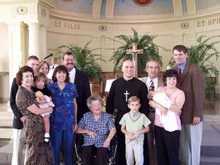
My friend Tobias Winright, who teaches theology here at SLU, is friends with a guy who owns a bar called the Royale, a couple of miles from my house. Tobias has done a few Theology on Tap sessions at the Royale and put them in touch with me about doing one, so this afternoon I talked for a couple of hours about various and sundry issues surrounding the problem of evil. Below are the notes I compiled to keep myself on track.
David Hume – “Is he willing to prevent evil, but not able? Then he is impotent. Is he able, but not willing? Then he is malevolent. Is he both willing and able? Whence then is evil?” (Dialogues Concerning Natural Religion)
Jeremiah – “Why does the way of the godless prosper, why live all the treacherous in contentment?” (12:1)
Br. Patrick – “What do you say about God after Auschwitz, or Rwanda, or Darfur, or Hurricane Katrina? Where is your good God?”
Gottfried Leibniz – theodicy – “the justification of God” – arguments that attempt to show that God is righteous or just despite the presence of evil in the world – God can be omnipotent and perfectly good despite evil. “Everything happens for a reason” is the motto of theodicy in this form.
Much theodicy has been rooted in what is referred to as modern theism – a philosophically rather than biblically based God-image that is generated by contrast with the spectrum of human weaknesses – God as immutable, incorporeal, impassible, omnipotent, omniscient, omnipresent, and utterly simple. If this sounds like what you have understood God to be, you aren’t alone. The God of modern theism loses the possibility of any newness, anything that rationality can’t contain or hold on to, and creates such a static deity as to make contact with this God virtually impossible while also denying divine freedom (at once compromising divine immanence and transcendence). This brand of theism has seen the task of theodicy as rearranging this set furniture so as to come to an equation that makes them all work together.
Perhaps the most textually common thread in the Old Testament is the idea of suffering as a consequence for sin, and we know often enough that bad things do indeed come from our capacity to be stupid, sinful, or selfish. On the other hand, is anyone here comfortable with saying that suffering is inevitably a consequence of sin? I was living in New Orleans when Hurricane Katrina hit in 2005, and it wasn’t long before preachers on the radio came out with statements to the effect that the hurricane was God’s punishment for the immorality of the city – rather like a number of the prophets of the Old Testament. However, if sin was really the reason for the hurricane, how come the French Quarter, which this Mardi Gras weekend is showing the depths of depravity which it is capable of reaching, was virtually untouched?
In the last few centuries before Jesus’ life, Judaism developed categories for thinking about suffering for the sake of others – that by suffering, people could contribute to the good of the world. It’s not hard to see how that got picked up by the early Christians, but it brings its own set of dangers with it. When Martin Luther King says, “Unmerited suffering is redemptive,” what are the potencies and limitations of such a model? Is all such suffering redemptive, or can it simply be destructive, crushing, awful, especially in the degree to which it goes unacknowledged and deprives the sufferer of a voice?
One of the main schools of thought in classical theodicy followed this idea – associated mainly with Irenaeus of Lyons, it is typically referred to as a “soul-building” theodicy: God allows suffering as a means of enabling people to grow by facing struggles. All of us can certainly acknowledge the potency of such a model, while still seeing something deficient in such a claim. What is the growth or “soul-building” that occurs in the child who slowly starves to death in Zimbabwe, the family whose loved ones die horribly in a fire, the inundation by tsunami of hundreds of thousands of people? While unmerited suffering can be redemptive, it seems that it can also simply be crushing and horrible. Dorothee Soelle warns, too, against the danger in Christianity of taking suffering to be a good thing – in imitation of Jesus, she warns, there is a danger of a Christian masochism that seeks out suffering, or a Christian sadism that can revel in inflicting it on others.
An even more common theodicy has traditionally been associated with Augustine, although he did not really hold this model for much of his career. Referred to as “free-will theodicy,” this argues that God’s gift of free will entails the freedom to commit sin, and God’s intervention would subvert that freedom. Still, it isn’t clear what it means to call God “good” in a world in which God stands on the sidelines in the face of atrocity, nor does it say much about the evil in the world which is not rooted in our free choices – addiction, natural evil, social sin.
Both of these models tend to presume the old bumper-sticker theology, “Everything happens for a reason.” However, Jesus’ central symbol, the reign of God, presumes that suffering is not the will of God. As it says in the Lord’s prayer, “thy kingdom come, thy will be done on earth as it is in heaven.” That is, may your will be accomplished here, since it is not being perfectly accomplished now. Jesus does not offer explanations of why it is not being accomplished – he simply overcomes it in his preaching and his healing.
The God of the Biblical tradition is presented as having a rich and complicated inner life, not the static or endlessly simple model of modern theism, which makes God less of a person than us, rather than more. So, one thread in the Bible locates the source of evil in the complicated and at times capricious inner life of God. For example, as much as Christian try to read GN 22, the binding of Isaac, either as a repudiation of human sacrifice or as a Christological prefiguration of God handing his Son over to death, we have to reckon with a story in which God demands the death of Isaac and then jerks Abraham around for three straight days. We have to reckon with a God who punishes the sinfulness of David by killing his newborn son; who hardens Pharaoh’s heart so as to further dismantle the entire Egyptian reality, innocents included; who demands the slaughter of the entire Amalekite people; who acts on behalf of some while far more commonly remaining silent. “God rejects, but not forever.” (O’Connor 51) God is abusive, but not all the time. David Blumenthal’s book Facing the Abusing God argues that God’s relationship with the people is at times like that of an abusing parent to his or her child – an abused spouse may be able to leave the abuser, but Israel is stuck with God like a child is stuck with an abusive parent.
On the other hand, the lament psalms almost never confess guilt – God has been absent or indifferent or neglectful, and this neglect is the reason for the sufferer’s pain – lament psalms often call God back to attentiveness – “How long, O Lord?” is a well-worn question in those psalms – how long until you return to attentiveness to us. Jon Levenson's book Creation and the Persistence of Evil speaks about the ongoing presence of a dangerous, chaotic reality in the world that, if not attended carefully by God, will encroach onto the human situation.
The Book of Job, although perhaps the most heavily contested book in the canon, gives an image of a God who simply overwhelms Job with the grandeur of creation as a means of showing him his inability to understand the reason for suffering. Fr. Robert Barron gives a similar model, like looking at Seurat’s pointillist painting La Grande Jatte from right up close – it only looks like a couple of dots or a blur of color: we are too close to get the big picture. The problem with such a model is that it presumes that this artistic God has put every dot there with some intentionality, and that it all fits together. How far away from the Holocaust do you have to back up to make it fit seamlessly into the picture? Does that not run the risk of looking at life “through the wrong end of the telescope,” making human life and suffering insignificant in the scope of the cosmic endlessness?
Terrence Tilley, who teaches at Fordham, has written about how doing theodicy in this manner, rearranging the pieces while never questioning any of them, is itself the source of a good deal of evil. It quite often blames the victim, presuming that he or she or they must have sinned – think about the Book of Job again for an easy example. Also, as any number of commentators have noted, keeping the problem of evil at the level of an intellectual conundrum is a luxury that scholars have but very few other people do – it can easily become a substitute for trying to overcome evil, especially if the model ends up presuming, as classical theodicies often do, that the way the world is working is fundamentally okay. It is even possible to conclude that working to change such a system is to challenge the will of God who laid the pieces out as they are.
After the Holocaust, a number of Jewish theologians have developed the concept of antitheodicy, literally, the refusal to justify God in the face of evil. Retrieving the sense of God’s responsibility for dealing with evil, whether or not God has caused it, these schools of thought refuse to dismiss the genuinely evil character of their sufferings, while refusing to deny the reality of God. There is a classic folk tale that Elie Wiesel tells of a group of rabbis in Auschwitz who put God on trial for failure to live up to God’s part of the covenant, from the exile through the pogroms and the ghettoization of Jews in Europe through the Holocaust. These rabbis hold this trial with a judge, witnesses, lawyers, testimony, the works; they find God guilty, sentence God to death, and then file out and go to evening prayer to offer praise to this guilty, condemned God. What do Christians do with such a paradoxical image? Is it possible to hold together God as guilty and yet praiseworthy?
Theology in the wake of the Holocaust has revisited the question of God’s capacity to suffer. Modern theism, in its desire to keep God sovereign, “impassible,” again created an image of God that is so static as to be nearly impossible to relate to. Does God’s heart not hurt at the Holocaust, at Rwanda or Darfur or 9/11 or the tsunami or the thousand children who will starve to death during the time we are together today? Is God not moved by our hurts? Dietrich Bonhoeffer, a Lutheran theologian who was eventually hanged by the Nazis, concisely said, “Only a suffering God can help.” Elie Wiesel’s classic book Night has people, while watching the slow death by hanging of a child, ask, “Where is God?”, to which Wiesel answers, “This is where – hanging here from this gallows.” (65) On the other hand, theologians have argued, “I don’t want this God to suffer – I want this God to stop the suffering.” I have no idea how to parse that out except to say that it is an argument that was all but unthinkable under the reign of modern theism.
I would argue that much of what we are doing in our study of the problem of evil indicates that we are less concerned about good and evil, and more concerned about order and chaos. We have a hard time when reality doesn’t work the way we expect it to, but we can negotiate a lot of evil in the world as long as it fits into our scheme of how the world works. We know that some thirty thousand children under five will starve to death today around the world, and yet we aren’t running around screaming. If that were to happen in our psychic backyards, we would go bananas, but instead we get more worked up over the light turning red before we get to it, or a printer not working, or other really, really little stuff that is important to us only because it is in the center of our psychic maps. Walter Brueggemann speaks in this vein of “theodic crises”; the amount or nature of evil crosses a mental threshold, and we are forced to develop new models for comprehending the problem of evil. Below that threshold, we can make sense of it all, but above that threshold is more than my model can accommodate. Think of why the things that cultures tend to remember as threshold moments, as “I’ll always remember where I was when” moments are almost always bad things, or at least really chaotic things – Pearl Harbor, JFK’s assassination, 9/11, Hurricane Katrina. They stand out for us as unexplainable events – our map of the world doesn’t work anymore. Wars happen in other countries, natural disasters happen to other people, but we can keep that at a safe psychic distance. Now, the theodic crisis emerges because it is right in my face, in the middle of my map of meaning. We are forced to come up with new models that better map the reality we are facing. The Babylonian Exile stands as the 9/11 of the Old Testament – a hand grenade into the middle of a map of reality that made sense. The utter chaos of the worldview of the survivors prompted the development of a number of new responses to evil, just as happened after 9/11 and Hurricane Katrina.
Like The Joker says in The Dark Knight, “You know what I noticed? Nobody panics when things go ‘according to plan,’ even if the plan is horrifying. If tomorrow I tell the press that a gangbanger will get shot, or a truckload of soldiers will get blown up, nobody panics. Because it’s all part of the plan.”
Kathleen O’Connor, in her book Lamentations and the Tears of the World, tries to reclaim lament as a legitimate response to the problem of evil – not a logical solution to an intellectual problem, but a gutsy, visceral response for people who are caught in the midst of suffering. Rather than assume that this is my fault, or that I am on my own, she encourages being able to sit in the middle of suffering and scream for a response. While psychologically there may be something very healthy about that, some people would argue that the theological proposition running lament, that God is at the core of my suffering, is problematic. I prefer to think of lament as a means of keeping the mysterious nature of suffering in mind. I mean by mystery not that we just don’t have a big enough perspective to take it all in, like Robert Barron argued, but that we deliberately keep the edges raw on the very idea of having a model. We know that any model is a sort of Procrustean bed, squeezing or truncating reality to fit the model. From this angle, lament, with its insistent cry of “Why?” admits its ignorance, while also holding out the demand that, finally, beyond any model of why it is, evil is to be overcome, suffering is to be alleviated.
Monday, February 23, 2009


Wednesday, February 11, 2009
Reflection for 11 February 2009
The Hebrew word adam means human being, and the word adamah means earth or soil – the adam comes from the adamah, the people come from the dirt, get it? That works the same in our language – the word human comes from the same root as humus, or dirt, which of course comes from the same root as humility or humble. Where the first reading tells us, “Remember where you come from, that you are in fact made of the stuff of the earth,” the gospel reinforces that and undercuts our seemingly inevitable tendency to make ourselves out to be more than we are. We don’t like being reminded of our humble origins, that we are made of dust, that we are all going back to dust, so we try to create an identity for ourselves, typically by comparing ourselves to other people, distancing ourselves from what is not as holy, not as pure as we are. Jesus warns that situating uncleanness or impurity outside of ourselves is a dead end, is a cover story for trying to create our own righteousness. You may avoid eating unclean foods, but still be loaded down with hard-heartedness, violence, self-importance, and above all, major blind spots about your own need for the divine mercy. The stuff that comes out of us, rather than the stuff that goes into us, should give us pause. I may want to present myself as a relatively well-educated, more or less competent professional, but the Joker puts it this way in The Dark Knight: “Madness is like gravity – all it takes is a little push.” I know how easily my own capacity for violence or self-aggrandizement can come to the fore, most likely when that image of myself as competent, respectable, in control is under attack. None of us want to be reminded that under all the personas we create (persona means “mask,” by the way), we’re made of dirt and we’re naked. On my own steam, I’m nothing – I cannot create a mask big enough to undo my screwiness, my self-centeredness, and my own finitude. That’s the bad news – we twist ourselves into knots trying to forget our own messiness, trying to forge personas that we can take pride in. The good news is that we don’t have to do any of that stuff. Who we really are is already established before we can do anything about it. Yes, I come from dust and I’m returning to dust, but I’m made a little less than the angels, and my name is written in heaven. There is nothing for me to boast about, because I had nothing to do with it, but that is fundamentally the only identity that can give me any satisfaction – who I am is who I am in God, and nothing more. Even if I could create myself like that, it’s all disappearing – how much stuff I know, how tight my waistline is, how nice my hair looks (ha), how much respect I can get out of other people.
Sunday, February 8, 2009
The Sparrow
Last weekend NPR's program "Speaking of Faith" interviewed Mary Doria Russell, focusing on her two novels The Sparrow and Children of God. I had heard of those two before, but never read them, so on a whim I picked up The Sparrow from the library last Sunday night and finished it yesterday morning. Without giving too much away, it deals with the reception of radio signals from another planet and the Jesuit mission sent to that planet to find the source of those signals. The potential for things to go wrong, the uncertainties involved with interacting with another culture, let alone another planet and multiple other species, are all rendered in a story that is at once beautiful and terrible. It holds serious resonances for me at the moment, given that I am teaching a class on evil. An article by Terrence Tilley (theology prof at Fordham) that we are reading right now asks of the protagonist of the Book of Job, but could just as easily ask of the protagonist of The Sparrow: "Does he undergo that most terrible experience for a victim: 'to believe himself exposed to the personal hostility of the divinity'?" We have spent a fair amount of time in class examining Biblical texts in which God is presented as a fairly ambivalent character - the Akedah (the binding of Isaac), for example, and now Job. Is it possible for Christians to hold a God-image such that they feel crushed by the whim of an ambivalent (if not malevolent) deity? I see so much denial and self-loathing arising from the conception that whatever happens to me happens for a reason, or is my fault, or that God is somehow justified in letting it be, but is the alternative (a morally questionable deity) any better?
Wednesday, February 4, 2009
Reflection for 4 February 2009
Anyone else notice that in the gospel for today, the people in Nazareth “took offense” at Jesus when he goes home? It isn’t “how dare he claim to be mighty or wise,” because they don’t deny that the deeds are mighty or that the words are wise, but that they can’t accept something new where all they expect is the ordinary – he’s just a carpenter, he’s just Mary’s kid or Judas’ brother. They have a hard time tolerating the fact that the ordinary can be the place of encounter with the extraordinary. We do the same thing with people that we want to not be challenged by, so we domesticate them (think Martin Luther King, once “the most dangerous man in America,” and now, for one day a year, the darling of business luncheons and 24-hour news coverage across the nation.) We also do the same thing with space and time – it’s hard to see the extraordinary in the ordinary, so we keep looking around for special times and places – the retreat coming up later in the semester, the trip to the Vatican or on a spring break mission, hearing a speech from a famous theologian.
It's ordinary time in the liturgical calendar, of course, and the danger of ordinary time is that it can be reduced to being, well…ordinary. We look ahead to the next big season, say, Lent, or to some big feast day, like last week’s feast of Thomas Aquinas. Today is the feast of people I never heard of, like Saint John de Britto and Saint Rembert of Torhout. I only saw those names because I literally Googled February 4th in hopes of finding some big event that happened on this day in history, some major feast day, something to give me a big topic to bounce my ideas off. Well, there aren’t any. But there are. Any of you ever Google or Wikipedia a date and just see all the stuff that happened on that day? It’s the birthday of Johann Ludwig Bach, second cousin of Johann Sebastian Bach (how’s that for living in someone else’s shadow), and of Dietrich Bonhoeffer and Rosa Parks, but mostly of people I never heard of. It’s the 5th anniversary of the founding of Facebook, the 150th anniversary of the discovery of the Codex Sinaiticus, and so on. But far and away the stuff that happened, the deaths and births that Wikipedia lists for February 4, are things I never heard of. Even then, of course, 99½ percent of the stuff that happens in our world won’t show up on Wikipedia or Google or anywhere else, but those places, events, people are precisely our points of encounter with the divine - the grandfather who will never be famous, the wedding anniversary, the family's favorite picnic spot.
Do we just look to go from one big event or feast to the next, one major saint to the next? Is “ordinary time” just a holding pattern between Christmas and Lent? That seems to me like a recipe for not being here now, not paying attention to the normal, quotidian, uninteresting bits of our lives which is where most of us in fact live most of our lives. Simone Weil puts it this way: “Absolutely unmixed attentiveness is prayer.” However, most of us live in various grades of unattentiveness, whether because of the noise of all the pacifiers we have in our lives, the expectation that only big things have anything good to offer us, or whatever. The Incarnation, the sacramental nature of our lives, means that it is exactly in the ordinary that we encounter the extraordinary – history can’t be split into a history of the sacred and the profane. There is no place, no time, where we can’t encounter the divine reality. In the Zen tradition, it goes this way: "After enlightenment, the dishes." True enlightenment puts us in contact with the real world, rather than letting us escape the real world.
We make a big deal about sacred places to remind us that every place is sacred. We highlight sacred times to recall that all time is sacred time. We hold up sacred people as symbols for us that all people are sacred, no life is trivial, no person can be swept under the carpet. Unfortunately we tend to miss most of those chances to see it, often enough because we pay so much attention to the “special” that we miss what it is pointing out to us, like the old Zen adage: “When the wise man points at the moon, all the idiot sees is the finger.”
It's ordinary time in the liturgical calendar, of course, and the danger of ordinary time is that it can be reduced to being, well…ordinary. We look ahead to the next big season, say, Lent, or to some big feast day, like last week’s feast of Thomas Aquinas. Today is the feast of people I never heard of, like Saint John de Britto and Saint Rembert of Torhout. I only saw those names because I literally Googled February 4th in hopes of finding some big event that happened on this day in history, some major feast day, something to give me a big topic to bounce my ideas off. Well, there aren’t any. But there are. Any of you ever Google or Wikipedia a date and just see all the stuff that happened on that day? It’s the birthday of Johann Ludwig Bach, second cousin of Johann Sebastian Bach (how’s that for living in someone else’s shadow), and of Dietrich Bonhoeffer and Rosa Parks, but mostly of people I never heard of. It’s the 5th anniversary of the founding of Facebook, the 150th anniversary of the discovery of the Codex Sinaiticus, and so on. But far and away the stuff that happened, the deaths and births that Wikipedia lists for February 4, are things I never heard of. Even then, of course, 99½ percent of the stuff that happens in our world won’t show up on Wikipedia or Google or anywhere else, but those places, events, people are precisely our points of encounter with the divine - the grandfather who will never be famous, the wedding anniversary, the family's favorite picnic spot.
Do we just look to go from one big event or feast to the next, one major saint to the next? Is “ordinary time” just a holding pattern between Christmas and Lent? That seems to me like a recipe for not being here now, not paying attention to the normal, quotidian, uninteresting bits of our lives which is where most of us in fact live most of our lives. Simone Weil puts it this way: “Absolutely unmixed attentiveness is prayer.” However, most of us live in various grades of unattentiveness, whether because of the noise of all the pacifiers we have in our lives, the expectation that only big things have anything good to offer us, or whatever. The Incarnation, the sacramental nature of our lives, means that it is exactly in the ordinary that we encounter the extraordinary – history can’t be split into a history of the sacred and the profane. There is no place, no time, where we can’t encounter the divine reality. In the Zen tradition, it goes this way: "After enlightenment, the dishes." True enlightenment puts us in contact with the real world, rather than letting us escape the real world.
We make a big deal about sacred places to remind us that every place is sacred. We highlight sacred times to recall that all time is sacred time. We hold up sacred people as symbols for us that all people are sacred, no life is trivial, no person can be swept under the carpet. Unfortunately we tend to miss most of those chances to see it, often enough because we pay so much attention to the “special” that we miss what it is pointing out to us, like the old Zen adage: “When the wise man points at the moon, all the idiot sees is the finger.”
Wednesday, January 28, 2009
Reflection for 28 January 2009 - the Feast of St. Thomas Aquinas
Shortly after Thomas Aquinas entered the Dominican order, his family, dismayed that instead of becoming a Benedictine, which would have held a good chance of becoming an abbot or bishop, he had chosen to become a Dominican. The Dominicans were still a new order at that point, and still flush with the poverty of their mendicant origins, so the family could not see for their son the prospects for status or influence they desired for a person of his noble birth. The story goes that they were so dismayed that they locked him up in the tower of the family castle for almost two years, to the point that they even sent prostitutes up to him to try to dissuade him from pursuing the life of a ragged friar (the story says he chased her out of the room with a hot poker from the fire).
I feel very fortunate that my parents never went to those kinds of lengths to keep me from joining my community, that in fact they were and still are very supportive of my vocation. On the other hand, the gospels so far this week have looked at the resistance Jesus faced from the beginning of his ministry – being accused of having an unclean spirit, being thought crazy even by his own family, and today being so badly misunderstood by his own disciples. The image he uses in the parable today, of the sower and the seed, is fitting, not only because they don’t get what he is trying to say, but because the farming image used seems to us to be so wasteful. As opposed to our modern method of farming, where we plow up the soil and plant seeds in it, the method being laid out here was to throw seed out indiscriminately and then plow to turn the seeds down into the soil. What that meant was that you couldn’t see what kind of soil you got until after you had already put the seeds out there – like Forrest Gump, “You never know what you’re gonna get.” Any teacher knows that even with the most objective of subject matter, but certainly with the work of the gospel, this is a lot like how teaching works – in a sense, it’s wasteful, because you keep working with whoever shows up, but you can’t tell what the end results are going to be. Sometimes maybe you can tell right up front if a person, like the footpath, is so thick that the seed never has a chance to get through, but just as likely, you just can’t predict it. Like with the rocky soil that has no depth to it, sometimes people can get all fired up at first, either because it sounds good on paper or because people want to win Brownie points with the teacher. Other times people have all the right stuff, but the world they live in is a mindkiller – I think of the talented, enthusiastic students I had in Zimbabwe or the Navajo Nation who could really have gone places, but because of the disaster they lived in or the environmental forces working against them, their potential got squelched. Finally, I have known a few students that I NEVER thought listened to a word I said, who have turned out years later to have put the pieces together, just like seeds going in the ground take a while before they show any signs of life and don’t just look wasted.
In his book New Seeds of Contemplation, Thomas Merton writes, “Every moment and every event of every person’s life on earth plants something in his or her soul. For just as the wind carries thousands of winged seeds, so each moment brings with it germs of spiritual vitality that come to rest imperceptibly in the minds and wills of people. Most of those unnumbered seeds perish and are lost, because we are not prepared to receive them: for such seeds as these cannot spring up anywhere except in the good soil of freedom, spontaneity and love.” (14) The need for a renewal of attentiveness as central to the discipline of discernment, of not going through life functionally asleep -- as Simone Weil puts it, "Absolutely unmixed attention is prayer."
I feel very fortunate that my parents never went to those kinds of lengths to keep me from joining my community, that in fact they were and still are very supportive of my vocation. On the other hand, the gospels so far this week have looked at the resistance Jesus faced from the beginning of his ministry – being accused of having an unclean spirit, being thought crazy even by his own family, and today being so badly misunderstood by his own disciples. The image he uses in the parable today, of the sower and the seed, is fitting, not only because they don’t get what he is trying to say, but because the farming image used seems to us to be so wasteful. As opposed to our modern method of farming, where we plow up the soil and plant seeds in it, the method being laid out here was to throw seed out indiscriminately and then plow to turn the seeds down into the soil. What that meant was that you couldn’t see what kind of soil you got until after you had already put the seeds out there – like Forrest Gump, “You never know what you’re gonna get.” Any teacher knows that even with the most objective of subject matter, but certainly with the work of the gospel, this is a lot like how teaching works – in a sense, it’s wasteful, because you keep working with whoever shows up, but you can’t tell what the end results are going to be. Sometimes maybe you can tell right up front if a person, like the footpath, is so thick that the seed never has a chance to get through, but just as likely, you just can’t predict it. Like with the rocky soil that has no depth to it, sometimes people can get all fired up at first, either because it sounds good on paper or because people want to win Brownie points with the teacher. Other times people have all the right stuff, but the world they live in is a mindkiller – I think of the talented, enthusiastic students I had in Zimbabwe or the Navajo Nation who could really have gone places, but because of the disaster they lived in or the environmental forces working against them, their potential got squelched. Finally, I have known a few students that I NEVER thought listened to a word I said, who have turned out years later to have put the pieces together, just like seeds going in the ground take a while before they show any signs of life and don’t just look wasted.
In his book New Seeds of Contemplation, Thomas Merton writes, “Every moment and every event of every person’s life on earth plants something in his or her soul. For just as the wind carries thousands of winged seeds, so each moment brings with it germs of spiritual vitality that come to rest imperceptibly in the minds and wills of people. Most of those unnumbered seeds perish and are lost, because we are not prepared to receive them: for such seeds as these cannot spring up anywhere except in the good soil of freedom, spontaneity and love.” (14) The need for a renewal of attentiveness as central to the discipline of discernment, of not going through life functionally asleep -- as Simone Weil puts it, "Absolutely unmixed attention is prayer."
Monday, January 26, 2009
Defiance
On Friday evening I went with a group of students to see the film Defiance, about 4 Polish brothers' resistance to the Nazi regime. Although it is hardly an "enjoyable" film, they wanted to process it afterwards, so we went back to my house and stewed about it for a while. I kept going back to a question that I have been working over in my head for a long while, in particular, was nonviolence possible against the Nazis? Of course the Danes and the Norwegians managed to pull off campaigns of nonviolent resistance, but those were rather atypical situations because of the Nazi position in the war at the time and the relative importance of those two countries in the Nazi vision (with requests for corrections and apologies for whatever inaccuracies come from my all-too-partial knowledge of the topic). Looking at the forest camps or the liquidated ghettoes, could a large-scale nonviolent resistance have been genuinely possible?
For the past few years I have done an activity with the Micah program freshmen around MLK Day, which includes talking about the way his nonviolent campaigns worked. We pass around the picture I have included below, talk about what was going on there, ask how the nonviolent strategy worked and what it might have been like to be in that situation, and I typically close by asking, "What would have happened if these three people and others with them had come to that street corner in Birmingham with rifles and shotguns to respond to the fire hoses, batons, tear gas and police dogs that were waiting for them?" Our history would certainly have been quite different if the spiral of violence had carried on. Yet, as brutal as Bull Connor's reaction was, he didn't simply mow people down with machine guns. On the other hand, Robert Jay Lifton talks extensively about the amount of psychic barriers necessary to keep German soldiers from having psychotic episodes: the development of the gas chambers as means of mass killing, extensive euphemistic reshaping of the German language, the enormous psychic weight of the bureaucracy, and so on. That all signifies the human conscience beneath the brutality that needs those psychic barriers to be able to carry on. Still, I can't imagine the kind of mentality it would demand to be in the belly of the beast, in Germany or Poland and trying to create and maintain some kind of nonviolent pressure, nor how slim the odds of surviving such an effort would be... I think I understand Reinhold Niebuhr's "realist" stance that would have us read the Sermon on the Mount as a judgment upon us who are unable to live up to it, but the fact that the folks in the picture ARE living up to it won't leave me alone...

Tuesday, January 20, 2009
it can't be this long since I have posted something...
A few regulars came by the office this afternoon, and we somehow got talking about the implications of placing religion so in criticism of culture that it loses its perspective. I guess I never really thought about it quite this way, but from certain angles a prophetic model (Christ against culture) stands in opposition to a sacramental model (Christ in culture). Liturgically this model can easily end up viewing sacraments as means of “recharging” the batteries that get worn down by contact with the outside world so that we can go back out there and keep banging away at it. There is certainly something to that insofar as the gospel has both the ability and the need to stand in critique of a culture which all too often seems to have truly gone insane. On the other hand, this can end up being anti-incarnational and sectarian. A more broadly sacramental view would hold that the sacraments are not about recharging our batteries but about celebrating and bringing to conscious awareness the presence of Christ in the world. The danger is that it can lose its critical edge if it hunkers down into an “I’m ok, you’re ok” kind of relationship with the world. On the other hand, it reminds that Christ is found precisely in the messiness of the world, that grace is not a scarce commodity. It also avoids the dangerous tendency of the prophetic or “Christ against culture” model to see itself as a bastion of righteousness, holding at bay “the world” which exists out there. In a more sacramental model, just as Christ is in the world out there, so is “the world” in here, in my own self-centered and violent heart. Ironically, the inflated and twisted ego can easily enough inhabit the prophetic mind that believes that, having shunned “the world” outside the community, it has shed its own ego once and for all. That does not mean the abdication of the call to stand against a dehumanizing and self-aggrandizing culture, but to realize that saying no to the culture is not quite the same as exorcising its spirit from my heart.
Wednesday, October 1, 2008
I've been the advisor for Habitat for Humanity at SLU for a year or so, and it's one of the best parts of my job (although I admit, there are a lot of best parts to my job). This year, we had an incredible number of freshmen sign up to join Habitat (120 or something ridiculous), and we have been really lucky that the St. Louis Habitat affiliate has had lots of spaces on builds for us to get involved, so we have been bringing a ton of students out every weekend. I haven't been able to go every time, but below are a few shots from two weekends I have spent with them so far.


Friday, September 19, 2008
Reflection for 18 September 2008
In the first reading today, Paul is dealing with people who, like us, don’t understand what “resurrection” means. We say “we believe in the resurrection of the body” every Sunday at church, but do we know what that means? Like the Christians in Corinth, our mental furniture comes from a Greek worldview that separates body and soul, leaving the body at death to decay while the soul is “saved,” that is, goes to heaven. Many of us may well be thinking, “Yeah, what’s the problem with that?”, but Paul has to combat that model in favor of what resurrection is really pointing to. That kind of body-soul dualism has lurked at the edges, and sometimes at the center, of Christianity from the beginning, originally in Gnosticism, then in Manichaeism, later Albigensianism, and on into neo-Thomism in our times, but always fearful that our physicality, with all of its urges and weaknesses and messiness is taking us away from what really matters, that is, the spiritual stuff. The whole point of the Incarnation, though, is that God is to be encountered precisely in this messy world, not out there in a cosmos that tries to leave this world behind.
The Jewish anthropology that Paul, as a Jew, is using sees the person as an integral unit, not splittable into body and soul, so that it is the totality of the person who is to be raised on the last day. He realizes the dangers of taking any image too literally, so he goes on later in this chapter to anticipate people’s questions: “But someone may say, "How are the dead raised? With what kind of body will they come back?"” He asserts that this resurrected body will not simply be a resuscitated corpse, any more than Jesus’ resurrection was simply resuscitation. Rather, it is a transformation, but it is a transformation of the entire person, even as he struggles to find analogies that make any sense.
Why is any of this important for us? Resurrection as a symbol points us beyond any overspiritualizing notion of salvation being something that only happens to our souls. We know how easily such a model can lead us to denigrate the tangible world around us – if only people’s souls are to be saved, perhaps their bodies and their world don’t matter so much. This kind of model, which has had a fair amount of traction through the centuries, is behind much of Marx’s infamous critique that religion kept people from striving for the kind of social change that needed to happen. We know from reading the news that our world in all its physicality is crying out, “groaning” as Paul puts it, for redemption, and that’s what resurrection points to for us: the renewal, the transformation, of all of creation. We can’t ignore people’s bodily needs, the unjust political and economic forces that impact their lives, the use of torture or sexual assault, the damage we are inflicting upon the natural world – all of that is part and parcel of the salvation that Paul makes clear has come. Our faith demands that we anticipate and participate in a transformation of all of reality, which makes salvation a truly social and cosmic reality, not an individualistic or self-concerned one.
The Jewish anthropology that Paul, as a Jew, is using sees the person as an integral unit, not splittable into body and soul, so that it is the totality of the person who is to be raised on the last day. He realizes the dangers of taking any image too literally, so he goes on later in this chapter to anticipate people’s questions: “But someone may say, "How are the dead raised? With what kind of body will they come back?"” He asserts that this resurrected body will not simply be a resuscitated corpse, any more than Jesus’ resurrection was simply resuscitation. Rather, it is a transformation, but it is a transformation of the entire person, even as he struggles to find analogies that make any sense.
Why is any of this important for us? Resurrection as a symbol points us beyond any overspiritualizing notion of salvation being something that only happens to our souls. We know how easily such a model can lead us to denigrate the tangible world around us – if only people’s souls are to be saved, perhaps their bodies and their world don’t matter so much. This kind of model, which has had a fair amount of traction through the centuries, is behind much of Marx’s infamous critique that religion kept people from striving for the kind of social change that needed to happen. We know from reading the news that our world in all its physicality is crying out, “groaning” as Paul puts it, for redemption, and that’s what resurrection points to for us: the renewal, the transformation, of all of creation. We can’t ignore people’s bodily needs, the unjust political and economic forces that impact their lives, the use of torture or sexual assault, the damage we are inflicting upon the natural world – all of that is part and parcel of the salvation that Paul makes clear has come. Our faith demands that we anticipate and participate in a transformation of all of reality, which makes salvation a truly social and cosmic reality, not an individualistic or self-concerned one.
Monday, September 8, 2008
The scariest place in the world...
Today's gospel (7 September) is the old classic from MT 18 about dealing with someone who hurts you - start by going to that person, then take a few other people if that doesn't work, then go before the church if THAT doesn't work, then treat them like a tax collector if even that doesn't work. How on target is this gospel? How often do we actually talk to the person who hurts us? Not often, actually - at least I don't. Confronting someone you respect, whose opinion matters to you, or even just someone you have to see all the time is about the scariest thing in the world for most of us. Jordan Peterson, a professor of psychology in Toronto, talks in his book and lecture series Maps of Meaning about the immportance of learning to face that which most frightens us, because inevitably there is to be found that which we most need. He talks about working with people with garden-variety phobias like claustrophobia or something similar, say, fear of elevators. The therapy he outlines is to have the person get as near to the elevator as possible without fear, then stand there until they get bored, then move a little forward as they realize that nothing has destroyed them, and so on, gradually nudging them toward and into the elevator until finally they have gone up or down in the thing. Often, he says, the person will go home after conquering that fear and get in an argument with his/her spouse about something that has been brewing for a long time. The situation is not, as Freud thought, that the elevator symbolically represents the marriage, but that the person has learned that he/she can confront the scariest place in their psychic world and not be destroyed by it. The elevator continues to be scary, getting into the fight continues to be scary, because it upsets the stability that we so often prefer to change, even if the stable situation is terrible. Again, that which we most need is found in the place we least want to go - the scariest place in the world. And if that isn't the Cross, I don't know what is...
Thursday, September 4, 2008
Maps of Meaning
Somehow or another in my THEO 100 class last Friday, we got talking about the problem of evil – something about the limitations and potential of theological language about God. Anyway, at one point one of the guys in the class told a story about a soccer coach from his high school who died at age 38 – great guy, a couple of kids, loved his students, the works. This student explained that part of him clung to the old saw about “God wanted him in heaven” because he couldn’t handle the idea that such a great guy died for nothing. We went on with the discussion, but after class, this guy stayed around and asked me about how guilt factors in to bad things happening in the world. I asked him what he meant, and he launched into how some part of him in his guts feels guilty for this coach’s death, even though his brain tells him that there is no connection at all. This little voice tells him that he wasn’t playing very well in the last few games before this coach died, and maybe his part in losing those last games added to the coach’s stress that led him to have a cardiac arrest, and so on. I told him that he had absolutely nothing to do with his coach’s death, and of course he said he knew, but I could tell that some part of him wasn’t hearing it. By this point this guy was starting to break down, and was doing his best to keep a stiff upper lip, so it was clear that this is still a live issue for him. He actually remarked that it was a Good Will Hunting moment – knowing “It’s not your fault,” but not really believing it. I guess I write this out of amazement that our gut desire for order would prefer such an awful and painful explanation for evil over the possibility that there is no “reason” (i.e. predetermined meaning) behind why bad things happen; even if it would indict this kid’s psyche with guilt, in a way such a scheme was better to his psyche than everything just being meaningless.
Thursday, August 14, 2008
Carl Starkloff, SJ -- R.I.P.

I have mentioned a few times in this blog the directed readings I took last year on "Anthropological Issues in Theology." The instructor, Carl Starkloff, would meet with me every few weeks to talk through a book and develop ideas for the paper I was working on. At the end of last semester, Carl developed a recurrence of cancer in the stomach, which he had dealt with once before years ago. He did chemotherapy, a stem cell transplant, and so on all summer, and I emailed regularly to see how he was doing. As soon as I got back into St. Louis last week, I went to see him in the nursing wing at Jesuit Hall, the main Jesuit residence at SLU. It was a bit of a shock to see him at first - Carl was a tall, robust man of 75 with a full head of dark hair, but because of the surgery and the therapy, he had lost his hair, and he looked shrunken and frail. He was on oxygen because he was having trouble breathing, and his legs were too weak for him to walk far. He was a bit depressed when I talked to him because he couldn't work, couldn't even write the book he wanted to work on because the medicine he was on made him drowsy and nauseous. The doctor told him that he should be fine, but it would take a while. He told me it would have been easier if the doctor had told him to prepare himself to die, because the uncertainty of his health, the feeling of helplessness (uselessness?), and the frailty and weakness he was dealing with were taking a toll on his spirits. I asked him if we could get together during the semester to read a few books, partially because I really did want his help, but partially because I thought it might make him feel more productive. Yesterday one of my co-workers told me that Carl was back in the hospital with fluid in the lungs, and I was actually planning on calling today to see if I could visit him, but when I got to the office this morning, a Jesuit who works in campus ministry told me that Carl died during the night.
Carl was a giant of a theologian, and worked for years in Toronto and here in St. Louis. He also spent a long time working with several Native American communities in the Pacific Northwest, which provided the initial impetus for my desire to work with him because of his expertise in both theology and anthropology. At the time of his death, he was working on an ambitious project with a tribe near St. Louis on the history of the Jesuits' interactions with that tribe. Above and beyond his profound intellect and teaching ability, Carl was a wise and good man with a great love for SLU and the students. He had been involved with campus ministry, saying weekday masses in residence halls and directing students on Ignatian retreats. I was fortunate to call Carl my teacher, my mentor, and (if I may be so bold) my friend, and his death is a great loss to the Society of Jesus, to SLU and to me personally.
Thursday, July 10, 2008
El Salvador - Day 3
Sunday, 22 June 2008
An amazing day again, combining the tragic side of El Salvador's history with the festive. We started the day at the cathedral in San Salvador, in the crypt below the main sanctuary for a "people's mass." We got there early enough to see Romero's tomb, over which is a huge bronze representation of him lying in state. There are multiple bishops and archbishops buried there in the cathedral basement, but Romero occupies center stage; athough it seems that the current bishop there is resisting the canonization process for Romero, he is definitely already a saint by popular acclaim in the minds of a sizeable part of El Salvador's population. The standard concept of martyrdom for a long time has been that a person dies for his or her faith, but what happens when someone is killed by another person who in theory comes from the same faith tradition? Some people argue that Romero was killed because of his political involvements rather than because of the faith, but I genuinely don't understand how his political concerns can be separated from the implications of the gospel for politics and economics. Vatican II itself says that the Church's sole concern is that the reign of God come, and if the reign of God includes, at a minimum, the will of God being accomplished for the well-being and peace of humanity, then the faith, the Church, is inevitably tied up with the social order.
But I digress...After the mass, which lasted a couple of hours and was presided over by a priest who had worked with Romero, we headed out to a town (can't remember the name right now, it's in my notes somewhere) that was having a cultural festival this weekend. We feasted on shrimp and chocolate-covered strawberries and so on, and the students took the opportunity to look at the usual spate of knickknacks that were being sold. A couple of the more fearless students rented horse rides while the rest of them shopped.
Joe Cistone, the CEO of International Partners in Mission, joined us this morning, and he will be with us for the rest of our time in El Salvador. What an interesting guy -- lived in Rome for 7 years or so, ran a refugee center, now spends half his year traveling all over the world -- Africa, Asia, South America -- with groups like ours. Not a bad job if you can get it (although he says he has caught just about every tropical disease out there in his travels!).
(*NOTE*) I'm still in Klagetoh as I write this, and I spent the day on the Hopi reservation, which is actually landlocked by the Navajo Nation. I spend most of my time on two of the three primary mesas, fittingly enough named First Mesa and Second Mesa. The silence, the view, everything was just amazing. The Hopis don't let people take photographs or video within their reservation, so even when I get back to non-dialup Internet access I won't be able to post any pictures, but take my word, it took my breath away.
An amazing day again, combining the tragic side of El Salvador's history with the festive. We started the day at the cathedral in San Salvador, in the crypt below the main sanctuary for a "people's mass." We got there early enough to see Romero's tomb, over which is a huge bronze representation of him lying in state. There are multiple bishops and archbishops buried there in the cathedral basement, but Romero occupies center stage; athough it seems that the current bishop there is resisting the canonization process for Romero, he is definitely already a saint by popular acclaim in the minds of a sizeable part of El Salvador's population. The standard concept of martyrdom for a long time has been that a person dies for his or her faith, but what happens when someone is killed by another person who in theory comes from the same faith tradition? Some people argue that Romero was killed because of his political involvements rather than because of the faith, but I genuinely don't understand how his political concerns can be separated from the implications of the gospel for politics and economics. Vatican II itself says that the Church's sole concern is that the reign of God come, and if the reign of God includes, at a minimum, the will of God being accomplished for the well-being and peace of humanity, then the faith, the Church, is inevitably tied up with the social order.
But I digress...After the mass, which lasted a couple of hours and was presided over by a priest who had worked with Romero, we headed out to a town (can't remember the name right now, it's in my notes somewhere) that was having a cultural festival this weekend. We feasted on shrimp and chocolate-covered strawberries and so on, and the students took the opportunity to look at the usual spate of knickknacks that were being sold. A couple of the more fearless students rented horse rides while the rest of them shopped.
Joe Cistone, the CEO of International Partners in Mission, joined us this morning, and he will be with us for the rest of our time in El Salvador. What an interesting guy -- lived in Rome for 7 years or so, ran a refugee center, now spends half his year traveling all over the world -- Africa, Asia, South America -- with groups like ours. Not a bad job if you can get it (although he says he has caught just about every tropical disease out there in his travels!).
(*NOTE*) I'm still in Klagetoh as I write this, and I spent the day on the Hopi reservation, which is actually landlocked by the Navajo Nation. I spend most of my time on two of the three primary mesas, fittingly enough named First Mesa and Second Mesa. The silence, the view, everything was just amazing. The Hopis don't let people take photographs or video within their reservation, so even when I get back to non-dialup Internet access I won't be able to post any pictures, but take my word, it took my breath away.
Tuesday, July 8, 2008
El Salvador Day 2 - Saturday, 21 June 2008
NOTE: As I type this, I am in Klagetoh, AZ, deep in the heart of the Navajo Nation. I'm here for about 10 days, visiting the Brothers out here and retreating in this sacred land. I can't post pictures at the moment because the dial-up Internet access would take until Thanksgiving to upload them, but later...
I can’t believe it’s only 9:20 as I write this – I feel like we did about 3 days worth of stuff today, even though it was actually a very relaxed pace. 7:30 was breakfast, and my kind of breakfast – refried beans, plantains, eggs, juice, while people talked about the day ahead and about the rooster that woke everyone up at 4 am. From there we drove out to Aguilares, then to El Paisnal to visit the church where Rutilio Grande, SJ worked and is now buried. As luck would have it, a new priest was being assigned to the church that day, so what looked like half the town was there cleaning, decorating, and so on to prepare for his arrival. We managed to swing some time to talk with two young men who work as catechists and leaders in the base communities there in El Paisnal. It turned out to be better than one of us adults giving the students a talk on liberation theology, because these men talked about what life actually looks like to the people, and the role of the church in their lives. As excited as they were about their new priest coming, the church there obviously has a strong and very active laity – this is not just a place that people go on Sunday morning. Afterwards, the students peppered me with more “scholarly” questions about liberation theology, its pros and cons, but that was only possible because of what they had seen and heard from those two young men.
From there we went for lunch at a place way up in the mountains called Suchitoto, to a restaurant overlooking a huge artificial lake. Again, we took our time and had a wonderful, relaxed meal – the folks from IPM seemed to have no need to herd us along too quickly, and I like their flexibility in giving us input about the whens and wheres of our day. The students asked if we could walk down to the lake, and no problem, then a few of them asked if we could take a boat ride around the lake, and again, no problem. After that, our guide, Julieta, insisted it was time for coffee; never mind that it was 90 degrees out – the local custom is to drink hot beverages in hot weather because it makes you sweat more, so you stay cooler. Whatever you say… Anyway, we went back to Suchitoto and were able to walk around the plaza for a good long time, checking out the vendors’ booths, sampling the foods and beverages, and so on. Of course, some of the more caffeine-addicted students got their coffee, but then went looking for Salvadoran coffee beans because they like the local coffee so much that they want to take it back with them. For dinner that evening we went to another pupuseria, and a few of the students actually asked the women making the pupusas if they could try making a few, and they managed to do a pretty good job, at least to my untrained eye. People were pretty wiped out by the time we got back to the house at 8:30, but I wanted to get them to reflect on the day, so I just asked them about what they had seen that was sticking with them, and they ran with it for 45 minutes. They are coming to appreciate that even though we aren’t “working” like we would have if we had gone to Haiti, immersion is an important task for us, to be present, to listen, to hear about what is going on here without the need to rush in and assume that we can fix everything (or anything) with a week’s worth of unskilled labor. On a side note, the one student who had been in the theology 100 class I taught in the spring kept bringing up things we talked about in class; it gives me a new gratitude for the kind of formation that is possible in that kind of class.
I can’t believe it’s only 9:20 as I write this – I feel like we did about 3 days worth of stuff today, even though it was actually a very relaxed pace. 7:30 was breakfast, and my kind of breakfast – refried beans, plantains, eggs, juice, while people talked about the day ahead and about the rooster that woke everyone up at 4 am. From there we drove out to Aguilares, then to El Paisnal to visit the church where Rutilio Grande, SJ worked and is now buried. As luck would have it, a new priest was being assigned to the church that day, so what looked like half the town was there cleaning, decorating, and so on to prepare for his arrival. We managed to swing some time to talk with two young men who work as catechists and leaders in the base communities there in El Paisnal. It turned out to be better than one of us adults giving the students a talk on liberation theology, because these men talked about what life actually looks like to the people, and the role of the church in their lives. As excited as they were about their new priest coming, the church there obviously has a strong and very active laity – this is not just a place that people go on Sunday morning. Afterwards, the students peppered me with more “scholarly” questions about liberation theology, its pros and cons, but that was only possible because of what they had seen and heard from those two young men.
From there we went for lunch at a place way up in the mountains called Suchitoto, to a restaurant overlooking a huge artificial lake. Again, we took our time and had a wonderful, relaxed meal – the folks from IPM seemed to have no need to herd us along too quickly, and I like their flexibility in giving us input about the whens and wheres of our day. The students asked if we could walk down to the lake, and no problem, then a few of them asked if we could take a boat ride around the lake, and again, no problem. After that, our guide, Julieta, insisted it was time for coffee; never mind that it was 90 degrees out – the local custom is to drink hot beverages in hot weather because it makes you sweat more, so you stay cooler. Whatever you say… Anyway, we went back to Suchitoto and were able to walk around the plaza for a good long time, checking out the vendors’ booths, sampling the foods and beverages, and so on. Of course, some of the more caffeine-addicted students got their coffee, but then went looking for Salvadoran coffee beans because they like the local coffee so much that they want to take it back with them. For dinner that evening we went to another pupuseria, and a few of the students actually asked the women making the pupusas if they could try making a few, and they managed to do a pretty good job, at least to my untrained eye. People were pretty wiped out by the time we got back to the house at 8:30, but I wanted to get them to reflect on the day, so I just asked them about what they had seen that was sticking with them, and they ran with it for 45 minutes. They are coming to appreciate that even though we aren’t “working” like we would have if we had gone to Haiti, immersion is an important task for us, to be present, to listen, to hear about what is going on here without the need to rush in and assume that we can fix everything (or anything) with a week’s worth of unskilled labor. On a side note, the one student who had been in the theology 100 class I taught in the spring kept bringing up things we talked about in class; it gives me a new gratitude for the kind of formation that is possible in that kind of class.
Wednesday, July 2, 2008
Notes from El Salvador - part 1
Hi everyone,


A group of 6 SLU students and I just got back from a trip to El Salvador, sponsored by campus ministry and hosted by International Partners in Mission, a group that partners with local businesses around the world.
Friday, June 20
In a way quite different from when I arrived in Haiti last summer, I am again confronted by a myriad of responses to this first day in El Salvador. Different, because I don’t have to worry about the “sink or swim” stakes with the language, but now, instead of the constant effort of working in a second language, being the adult in charge of a group of students brings a certain constant low-level awareness of all of the things that could go wrong.
Everyone met in Miami without incident, although the last member of our group showed up at the gate during boarding for the flight to San Salvador, so I had sufficient time to wonder what I would have done if one (or more) of the students’ flights had been delayed. Nevertheless, everything went off without a hitch until we landed in San Salvador. I expected that our guides would have a sign saying “IPM” on it or something, but no luck, and of course I, being the poor planner that I am, realized that I had the number for IPM in the United States, but not for our contact person in San Salvador. Of course, my cell phone didn’t work in El Salvador, so I couldn’t even use it to call the number I did have. Long story short, I was able to find a phone booth that let me connect to the United States, and the IPM representative got me through to one of their people in El Salvador, but by the time she could put a call in to find out where the people who were supposed to meet us were, they met up with the students. It turned out that they had been there the whole time, and they even had a sign with them, but they just didn’t have it out. (*In hindsight, that was the biggest problem we had to deal with all week. After that, IPM was completely on the ball.*) Halfway to the guest house, we stopped for a late lunch at a little roadside restaurant that served pupusas, the local Salvadoran staple, which are like small tortillas stuffed with anything from meat to cheese to beans to vegetables to all of the above. Every table in this place (and in every pupusa restaurant in El Salvador, it seems) had a gigantic glass jar full of spicy pickled cabbage that goes with the pupusas.
In a way quite different from when I arrived in Haiti last summer, I am again confronted by a myriad of responses to this first day in El Salvador. Different, because I don’t have to worry about the “sink or swim” stakes with the language, but now, instead of the constant effort of working in a second language, being the adult in charge of a group of students brings a certain constant low-level awareness of all of the things that could go wrong.
Everyone met in Miami without incident, although the last member of our group showed up at the gate during boarding for the flight to San Salvador, so I had sufficient time to wonder what I would have done if one (or more) of the students’ flights had been delayed. Nevertheless, everything went off without a hitch until we landed in San Salvador. I expected that our guides would have a sign saying “IPM” on it or something, but no luck, and of course I, being the poor planner that I am, realized that I had the number for IPM in the United States, but not for our contact person in San Salvador. Of course, my cell phone didn’t work in El Salvador, so I couldn’t even use it to call the number I did have. Long story short, I was able to find a phone booth that let me connect to the United States, and the IPM representative got me through to one of their people in El Salvador, but by the time she could put a call in to find out where the people who were supposed to meet us were, they met up with the students. It turned out that they had been there the whole time, and they even had a sign with them, but they just didn’t have it out. (*In hindsight, that was the biggest problem we had to deal with all week. After that, IPM was completely on the ball.*) Halfway to the guest house, we stopped for a late lunch at a little roadside restaurant that served pupusas, the local Salvadoran staple, which are like small tortillas stuffed with anything from meat to cheese to beans to vegetables to all of the above. Every table in this place (and in every pupusa restaurant in El Salvador, it seems) had a gigantic glass jar full of spicy pickled cabbage that goes with the pupusas.
From there to the guest house and a brief orientation to the place and the trip before heading back out, this time to a nearby park to see a memorial to those who were killed or disappeared during the civil war. In some ways it reminded me of the Vietnam War Memorial in Washington: a long black stone wall with thousands of names inscribed in it. On one hand, I appreciated it because it acknowledges what happened, but the danger is that there are so many names, it can cause a kind of sensory overload, with all those names blurring into a massive background of death and missing the point that each of those names was a real person, not just part of a statistic.
From there we drove up into the mountains and got a panoramic view of the city before hitting another local restaurant and heading back to the guest house to collapse.
I was very surprised at how “Americanized” much of the city is – Burger King, Subway, road crews using the same equipment they would in the United States. I guess I expected it to be more like Port-au-Prince, where I saw NO American franchises and only the shoddiest of upkeep. Our guides tell us that the gap between the wealthy and the poor will be wildly evident when we go out of the city, but at least from what we have seen, globalization is in full swing here.
Friday, June 6, 2008
June 6 -- last day in St. Louis
I just got back in from an exciting day working with Habitat for Humanity here in St. Louis. I’m technically done with work, but I don’t leave for New Orleans until tomorrow, so I decided to put in a couple of days with them since we didn’t get to build all semester (except spring break in New Orleans, of course). Yesterday the temperature was in the 90’s, and we spent all day hauling lumber, swinging the hammer, and finding other ways to make ourselves sweat even more. I honestly couldn’t drink water fast enough to keep up with what I was losing in sweat. We finished about 3:00, and I came home and crashed for an hour or so before going to SLU for the evening. A little group of my students convinced me to cook dinner for them – black-bean spinach burritos, which is about the only thing I know how to cook, and then we got gelato at a new place that opened up in my neighborhood. Nice.
Anyway, this morning I went back to Habitat (partially dreading it, I admit, because yesterday wiped me out so much) but it ended up being much cooler (more on that in a moment). I ended up spending most of the day lugging windows out of an 18-wheeler, some to the houses, others to a flatbed so we could move them to the Habitat warehouse. We did that through mid-afternoon until the heavens opened up on us, and we would have kept working except that the city alerts came out that there was a tornado alert (warning? watch? whichever one means they have actually spotted a tornado). Then we had to pick up the pace to load the last few palettes of windows onto the flatbed so we could get out of there. The guy driving the Bobcat forklift was in a hurry and ended up driving onto my foot – it was my fault too, because I wasn’t paying attention either, but he certainly got my attention when he rolled onto my foot! Anyway, no big deal; it doesn’t hurt much, but I may have broken a toe. Tomorrow morning I’m headed to New Orleans, with a couple of days to spare before our provincial chapter starts. Quiet stretches like these past few weeks remind me how much I miss home, so I really can’t wait to get back. When I was there at spring break, I felt like I want to take a vacation in my own hometown and just go to restaurants and places that I never go to.
Finally, we just got the good news that we have a young man named Kevin Piper joining our province in the fall as a candidate. He has been in seminary for a couple of years but has discerned that his call is to Brotherhood, so he will be moving to our formation house in Syracuse, NY to finish school and do his candidacy. Hooray to Chris Sweeney, our vocation man and my friend, for all the work he has done to help Kevin with his discernment.
Anyway, this morning I went back to Habitat (partially dreading it, I admit, because yesterday wiped me out so much) but it ended up being much cooler (more on that in a moment). I ended up spending most of the day lugging windows out of an 18-wheeler, some to the houses, others to a flatbed so we could move them to the Habitat warehouse. We did that through mid-afternoon until the heavens opened up on us, and we would have kept working except that the city alerts came out that there was a tornado alert (warning? watch? whichever one means they have actually spotted a tornado). Then we had to pick up the pace to load the last few palettes of windows onto the flatbed so we could get out of there. The guy driving the Bobcat forklift was in a hurry and ended up driving onto my foot – it was my fault too, because I wasn’t paying attention either, but he certainly got my attention when he rolled onto my foot! Anyway, no big deal; it doesn’t hurt much, but I may have broken a toe. Tomorrow morning I’m headed to New Orleans, with a couple of days to spare before our provincial chapter starts. Quiet stretches like these past few weeks remind me how much I miss home, so I really can’t wait to get back. When I was there at spring break, I felt like I want to take a vacation in my own hometown and just go to restaurants and places that I never go to.
Finally, we just got the good news that we have a young man named Kevin Piper joining our province in the fall as a candidate. He has been in seminary for a couple of years but has discerned that his call is to Brotherhood, so he will be moving to our formation house in Syracuse, NY to finish school and do his candidacy. Hooray to Chris Sweeney, our vocation man and my friend, for all the work he has done to help Kevin with his discernment.
Friday, May 30, 2008
Today is the Feast of the Sacred Heart, and I suppose I am feeling a little homesick at the moment, wishing I could be celebrating our feast with other men in my own order. The Marianists in my local community offered our liturgy this morning for Brothers of the Sacred Heart around the world, which was a really nice touch, but I wish I could sing the old songs and celebrate our community with my confreres in person.
The school year ended a couple of weeks ago, nicely capped off with a weekend trip to South Bend with the parents for my graduation ceremony (yes, I got the piece of paper in the mail back in September, but summer graduates don’t have a ceremony until May. Go figure.). Nice, easy weekend up there, apart from a few glitches related to driving between Chicago and South Bend (I took a bus every summer, so I never learned the roads!), and back to St. Louis just in time for…not much. Mind you, I’ve been very productive in the past couple of weeks since school let out, but there’s only so much campus ministry stuff that we can actually do at this point. My dorm is completely empty apart from the building coordinator (whom I never see), so I have spent some wonderful days in near-total silence – almost a paid retreat!
Now that I’m not in my office with students until midnight every evening, I’m able to get back to some of the stuff I have missed during such a busy year – catching a film with some of the Bro’s (Indiana Jones was fun but kinda hokey at the end, No Country for Old Men was brilliant but downright disturbing), a little rock climbing, plowing through a fraction of the backlog of books I have on my desk.
On that note, I am sure this one will come up again, but I have been working through a book called On Killing, by Lt. Col. Dave Grossman, a psychologist and former Army Ranger. He discusses the incredibly low percentage of soldiers in World War II who actually fired their weapons (15-20%) compared with the percentage in later wars – roughly 50% in Korea, around 90% in Vietnam – to point to what he claims is an innate resistance people have to killing, even if their own lives are in danger, and how much of what is going on psychologically in modern military indoctrination is overcoming that innate resistance. What fascinates me about this guy is that he isn’t coming out of the agenda one might expect, given those claims. He is by no means a pacifist or a military-basher: he’s a career military man, believes in a strong military and the necessity and rightness of warfare in some circumstances. He believes that violence is sometimes a necessary thing and that soldiers can use it for good reasons, but he still claims that it causes well-adjusted people all kinds of psychic trauma to engage in it and that our culture is eroding that resistance to killing by flooding our media with violence. It would be fascinating to get him and Robert Jay Lifton to sit down and talk about psychology and violence – Grossman as a military man, Lifton as a pacifist, but both trained in psychology and examining the effects of violence upon the human psyche.
At the same time, I just started another one called (God) After Auschwitz by Zachary Braiterman. I am hoping to teach a class next spring on the problem of evil, and I would like to do something on post-Holocaust Jewish theology, so I’m reading through a few things looking for possible textbooks. I’m just at the beginning, but I go in with a sense that even though this book is written by a Jewish thinker, basically for a Jewish audience, using Jewish thinkers like Rubenstein, Heschel, and Fackenheim, theology after Auschwitz is a solidly Christian problem as well. What can we say about God after Auschwitz? What can we expect from God viz. horrific evil? Whether it happened to Christians is really immaterial – it happened, and the God whom Christians claim did not put on the emergency brakes and stop it. Hardly “enjoyable” reading, but intensely important.
On that note: Mercy within mercy within mercy…
The school year ended a couple of weeks ago, nicely capped off with a weekend trip to South Bend with the parents for my graduation ceremony (yes, I got the piece of paper in the mail back in September, but summer graduates don’t have a ceremony until May. Go figure.). Nice, easy weekend up there, apart from a few glitches related to driving between Chicago and South Bend (I took a bus every summer, so I never learned the roads!), and back to St. Louis just in time for…not much. Mind you, I’ve been very productive in the past couple of weeks since school let out, but there’s only so much campus ministry stuff that we can actually do at this point. My dorm is completely empty apart from the building coordinator (whom I never see), so I have spent some wonderful days in near-total silence – almost a paid retreat!
Now that I’m not in my office with students until midnight every evening, I’m able to get back to some of the stuff I have missed during such a busy year – catching a film with some of the Bro’s (Indiana Jones was fun but kinda hokey at the end, No Country for Old Men was brilliant but downright disturbing), a little rock climbing, plowing through a fraction of the backlog of books I have on my desk.
On that note, I am sure this one will come up again, but I have been working through a book called On Killing, by Lt. Col. Dave Grossman, a psychologist and former Army Ranger. He discusses the incredibly low percentage of soldiers in World War II who actually fired their weapons (15-20%) compared with the percentage in later wars – roughly 50% in Korea, around 90% in Vietnam – to point to what he claims is an innate resistance people have to killing, even if their own lives are in danger, and how much of what is going on psychologically in modern military indoctrination is overcoming that innate resistance. What fascinates me about this guy is that he isn’t coming out of the agenda one might expect, given those claims. He is by no means a pacifist or a military-basher: he’s a career military man, believes in a strong military and the necessity and rightness of warfare in some circumstances. He believes that violence is sometimes a necessary thing and that soldiers can use it for good reasons, but he still claims that it causes well-adjusted people all kinds of psychic trauma to engage in it and that our culture is eroding that resistance to killing by flooding our media with violence. It would be fascinating to get him and Robert Jay Lifton to sit down and talk about psychology and violence – Grossman as a military man, Lifton as a pacifist, but both trained in psychology and examining the effects of violence upon the human psyche.
At the same time, I just started another one called (God) After Auschwitz by Zachary Braiterman. I am hoping to teach a class next spring on the problem of evil, and I would like to do something on post-Holocaust Jewish theology, so I’m reading through a few things looking for possible textbooks. I’m just at the beginning, but I go in with a sense that even though this book is written by a Jewish thinker, basically for a Jewish audience, using Jewish thinkers like Rubenstein, Heschel, and Fackenheim, theology after Auschwitz is a solidly Christian problem as well. What can we say about God after Auschwitz? What can we expect from God viz. horrific evil? Whether it happened to Christians is really immaterial – it happened, and the God whom Christians claim did not put on the emergency brakes and stop it. Hardly “enjoyable” reading, but intensely important.
On that note: Mercy within mercy within mercy…
Monday, May 19, 2008
Imagining Argentina
I took a social work class this semester entitled "Foundations of Nonviolent Peacemaking." I spent most of my research energy on the kind of stuff I have already been working on -- psychic numbing, dehumanization, that kind of thing -- but in the process of reading for those topics, I stumbled upon the book Imagining Argentina, which I mentioned in my previous post, and I got hooked. What follows is a paper I produced on that book for this class.
My old professor Walter Brueggemann, in his book The Prophetic Imagination, mentions in passing a book by Lawrence Thornton, Imagining Argentina. On a whim, I finally picked it up at the library, more than 5 years after I first studied under Brueggemann, and have been fascinated by Thornton’s quasi-mystical theme as well as Argentina’s “Guerra sucia,” which is the setting for the book. This will not simply be a book report, but given the manner of response that the book offers to the events of the war, I will engage Thornton’s model of imagination as well as the historical happenings of the dirty war itself.
Some months after the abduction of his wife Cecilia by government kidnapping squads, Carlos Rueda, the director of the Argentine National Children’s Theater, begins to see in his imagination people who have been “disappeared.” These imaginative scenarios, although they have the power to shape reality, are beyond his control; whereas at times he sees people being freed or escaping through holes that appear “miraculously” in brick walls, or babies returned to the mothers from whom they have been taken, at other times he sees people being tortured, raped, or killed, and he is powerless to change it. Although he had been apolitical, his wife had been a journalist, writing articles about the abuses and terror tactics of the government. Whereas she had been concerned with hard-nosed reporting of the data, says the narrator, a retired journalist and friend of Carlos and Cecilia named Martín Benn, Carlos’ intellectual life “is wholly metaphorical,” (Thornton 18) which at the beginning of the story would have meant “unreal” for Benn. However, Benn’s own awareness of what Carlos’ ability means develops, and he gradually comes to understand, as did Nietzsche, that “truth is an army of metaphors” (Theology of the Old Testament 85); that is, our access to reality is in fact a construct of numerous voices which we try to boil down to one coherent tone, inevitably distorting or silencing those which do not fit our program. Speaking about the silence and complacency of so many Argentines in the face of the disappearances, Benn remarks that they reacted “more or less like the citizens outside Belsen did to the horrors behind the fences, except that we found refuge in a phrase, rather than silence. ‘Debe ser por algo,’ we said, ‘It must be for something.’” (Thornton 20) Thus did the generals’ imagination dominate that of the people – they were willing to accept the generals’ rendering of reality on faith, rather than asking the kinds of questions that might undermine the stasis that the generals’ imaginations inevitably sought. As William Cavanaugh, in his book Torture and Eucharist: Theology, Politics, and the Body of Christ, states, “To refer to torture as the ‘imagination of the state’ as I have done is obviously not to deny the reality of torture, but to call attention to the fact that torture is part of a drama of inscribing bodies to perform certain roles in the imaginative project which is the nation-state.” (Cavanaugh 279)
Despite the quasi-mystical portrait of Carlos’ imagination that pervades the book, it is not primarily a fantasy book, but a defense of the urgency of imagination, understood as the capacity to see reality in a way other than merely the facts on the ground. Carlos spells this out early on by declaring that there were in fact two Argentinas, the one that the generals believed was self-evident, and the one in the people’s hearts. When the soldiers look at the people, he argues, they see sheep and terrorists; on the other hand, the people “remember a time before the regime, but they do not take their imaginations beyond memory because hoping is too painful. So long as we accept what the men in the car imagine, we’re finished…We have to believe in the power of imagination because it’s all we have, and ours is stronger than theirs.” (Thornton 65) This plays itself out in Carlos’ understanding of General Guzman, who serves as a symbol of the government: “He conceives of himself as a patriot who believes that Argentines are a little mad, ungovernable by ordinary means, and capable of thriving again, of realizing our potential only if we accept the strong hand of people like himself.” (Thornton 90)
Carlos begins to march every week in front of the Casa Rosada, the seat of government in Buenos Aires, with the Madres de la Plaza de Mayo, an actual organization which was founded during the dirty war to make visible the faces and names of those who had been disappeared. In response to their signs with names and pictures of disappeared loved ones, Carlos makes a sign of his own: “I AM CARLOS RUEDA. THEY HAVE TAKEN MY WIFE. I CAN HELP.” (Thornton 38) From that point forward, every Thursday evening Carlos holds audiences in his garden, and people from all over come to tell him about their loved ones who had been disappeared, hoping that he could tell them what would become of them. Friends and strangers alike come in ever-greater numbers as their loved ones continue to be disappeared, desperate for some bit of information, whether of hope that their loved ones will escape, or of the minimal but real consolation of at least knowing that they are dead, as opposed to the unknowing that gives way to despair.
Carlos’ imagination moves from his garden into his work at the theater, where he produces a new play called Names, which was about the generals’ belief that they could erase history, erase people’s very existence, by removing people from sight, and the need to keep those names alive by and in memory. Carlos repeatedly sees in his imagination what is happening to his wife and daughter (who is also taken in the wake of the performance of Names), including seeing them being tortured, raped, and, in the case of Teresa, eventually murdered. Benn recounts his heartache each time Carlos asks an acquaintance to tell him about what happened to Cecilia, and later Teresa, partially because of the pain it causes Carlos to see with his imaginative gift what they are suffering, but more because he wishes that Carlos would simply accept reality, namely that they are dead. Even after he sees Teresa’s death in his mind’s eye, Carlos repeatedly goes out to find Cecilia, refusing to accept the version of reality that even his friends would have him believe. After Teresa’s abduction, Carlos follows General Guzman to his house, intending to kill him, until Guzman’s daughter comes outside and Carlos finds himself unable to fire; he later reflects to Benn that, “Everything he [Guzman] sees is small, distorted by his preconceptions…He could never comprehend that my stories are more dangerous to him than the Mannlicher, my words more explosive than bombs planted in the Casa Rosada.” (Thornton 136)
Thornton writes about the willful amnesia that appears as the regime in the book is losing its power; the generals themselves tried to disappear, while simultaneously leaving in their wake the message, “It never happened.” (Thornton 191) Unlike the meticulous record-keeping of the Nazis, the generals in Argentina worked to completely efface, not only their crimes, but the very existence of those whom they had disappeared. No such person ever existed to have been taken, tortured, killed. Faced with the reality that, “It’s only a matter of time before there’s silence in Buenos Aires, in all of Argentina, before the records are shredded, before the bodies are buried too deep to find,” (Thornton 197) Carlos steps up the sessions in his garden, knowing that to not bring his new power of imagination would be to allow the imagination of the generals to win. Such was the same logic of the Madres: by marching with signs with the names and pictures of their children, they resisted the fiction that would deny that their children ever existed. Nevertheless, such testimony retains at best an elusive hold on truth. As Robert Jay Lifton points out, “Hannah Arendt, discussing official deceptions revealed in the Pentagon Papers, emphasizes the ‘fragility’ of ‘factual truths,’ their dependence upon ‘testimony to be remembered and trustworthy witnesses.’” (Lifton 360) Cecilia, for example, despite being deprived of means of writing down the story she was experiencing, made use of the swirling patterns etched into the plaster of her walls as mnemonic devices to remember her story (which she eventually collected in a book called, appropriately, The Wall), in a way reminiscent of Aleksandr Solzhenitsyn’s Gulag Archipelago.
Cavanaugh comments, “Confronted with evidence of the miraculous, Carlos’s friends nevertheless remain skeptical, convinced that Carlos cannot confront tanks with stories, helicopters with mere imagination. They can only see the conflict in terms of fantasy versus reality. Carlos, on the other hand, rightly grasps that the contest is not between imagination and the real, but between two types of imagination, that of the generals and that of their opponents.” (Cavanaugh 278) Whereas his friends see imagination as fantasy, the generals themselves know the power of that kind of alternative rendering of reality, even as they are unable to admit their fear as such to one another: “it is inconceivable that a general, or a ranking member of his staff, would admit to colleagues that he was afraid of a storyteller.” (Thornton 162) However, like J. Edgar Hoover’s ironic comment that Martin Luther King was “the most dangerous man in America,” (ironic because Hoover thought King was a communist, whereas King’s truly prophetic imagination was indeed more dangerous than any amount of armed force that could have been brought to bear on American power structures at the time) the power to reclaim reality by speech, which can be misunderstood as mere skill at making rhyme schemes, authorizes living in a different way. It is for this reason that Yale theologian and torture survivor Miroslav Volf argues, “in order to expose crimes and fight political oppression, many writers, artists and thinkers have become soldiers of memory.” (Volf 18) Following Teresa’s death, Carlos notes that the generals “assumed I would follow Teresa into the whiteness, give up on myself as well as Cecilia, and they were very close to being right. But as I was thinking about letting myself go I understood that Cecilia would drown too, that she lived only because I remained to know she lived.” (Thornton 172) This hope keeps Carlos alive, when the fiction of the generals tells him to give in to grief and take his own life; despite all odds, it eventually culminates in Cecilia’s escape and return to him.
Historically, the estimate is that roughly 30,000 people, mostly trade-unionists, students, and activists were disappeared during the dirty war, which the government euphemistically called the “National Reorganization Process,” and which lasted from roughly 1976 until 1983. Whatever the book’s historical inaccuracies may or may not have been, (Thornton is neither a historian nor an Argentine) Thornton communicates something of the nature of living inside a truncated imagination, as most of Argentina did. Although many of them were assaulted, arrested, and even disappeared, the Madres, who continue to exist to this day, were one of the few groups who “successfully countered the military’s calculation that if the terror was absolute enough, no one would dare to complain.” (Sharp 221) The Madres continued to march with signs showing the names and faces of disappeared loved ones until 2006, at which point they said that the government was no longer an enemy, no longer opposing their efforts to find their loved ones.
The scenes in this book that were most horrible to me as the reader were those in which Carlos is forced to see the repeated torture and rape of his wife and his daughter, to know his powerlessness to stop it and the feelings that would accompany such a reality. Is his use of his imaginative gift the appropriate response? Should the sword have joined to the spoken word in efforts to stop the generals’ imagination, even if it would have ended with Carlos sharing the fate of so many of his fellow citizens? Despite having himself been assaulted on several occasions, despite the contemptuous attitude with which Guzman exits the courtroom in which he is eventually found guilty of crimes against humanity, Carlos realized in that moment when the crosshairs of his rifle converged not only on Guzman but on his daughter that to kill Guzman would have made Guzman’s imagination correct; as he puts it, “the bullet would have sent me into exile and silence.” (Thornton 137) However, even though the closing chapter of the book does fast-forward several years after Cecilia’s return, to show the downfall of the generals, it does not linger on the effects on Cecilia of her captivity. Does she ever wake up screaming, feeling the soldiers’ hands on her body, or listening to her daughter scream for mercy? After months or years of captivity and abuse, how damaged is her psyche? Is forgiveness possible? Can she live her life without being consumed by the enormity of trauma she endured? It is one thing to say, as does Walter Wink, “The enemy too believes he or she is in the right, and fears us, because we represent a threat against his or her values, lifestyle, or affluence. When we demonize our enemies, calling them names and identifying then with absolute evil, we deny that they have that of God within them that makes transformation possible.” (Wink 59) It is another to think about the cost to sufferers, to think of the contemptuousness of torturers even when presented with all the evidence of their wrongdoing.
In that vein, psychologist Jordan Peterson talks about a fellow therapist who works with women who have suffered horrific trauma: rape, abuse, torture. Those women who were able to most fully enter in their imaginations into their experiences of trauma, who felt the pain and indignation most completely, got better faster and stayed better longer. Why? Peterson argues that this model of therapy is built on the premise that coming into contact with that which is most terrifying, not running away from it, demonstrates that we can encounter that which frightens us most and not be destroyed; in effect, we can reclaim those lacunae in our “maps of meaning”; even if they remain unfathomable evil, they don’t reduce us to inarticulacy about our own lives. However, it is precisely the effect of torture, says Elaine Scarry, to “unmake” the world: to render the sufferer inarticulate, to shatter the sufferer’s matrix of a coherent world, and, given the unique ability of pain to defy explanation, to deprive them of the ability to describe their experiences.
How, then, does this book and its model of imagination and hope speak to the task of peacemaking? In one way, it clarifies just how painful and tenuous a task peacemaking is: we can get lost in examples of peacemaking that, despite the sufferings of those who participate, make it seem almost “majestic,” to use the term that Martin King used to describe the struggle in Birmingham. Certainly it was atrocious, we say, but it can almost seem to be a mathematical formula: acceptance of suffering leads to the consciences of the oppressors to be stung by seeing the suffering they inflict on the innocent, and the oppressed are upheld as paragons of virtue and selflessness. There is no such formula here: a mother, herself subject to serial rape, is forced to choose which soldier in a group will be the first to rape her daughter, and then forced to listen to it all happen. Those soldiers remain contemptuous, unharmed by guilt, to the very end, while the mother survives but faces a lifetime of trauma, guilt, and terror.
On the other hand, however, the story reinforces the urgency of hope: partially in Wink and King’s sense of the word, that even the most vicious opponents have within them a shred of humanity that contains the seeds of conversion, but also hope in God’s power to make happen more than we are capable of seeing from where we are. This is an awful hope, one that must say that, while everything may well not work out for me, that I may suffer to death, or worse, be left alive to suffer under decades of pain and trauma, hope is still authorized, is in fact essential, for a bigger picture than my own small life.
Similarly, the book points to the need to continually rehumanize those whom oppressors would rather see dehumanized (to justify their violence) or made invisible (to deny their violence ever happened), and the place of the media in fostering the illusion or piercing it with truth. Much of the furor in the book was over the silencing of dissent, often in the form of mass media and artistic expression: critical editorials, dramatic productions in the theater where Carlos worked, intellectuals or students saying the wrong thing. Some people were silent out of fear, while others did so out of ideology, but Thornton’s central point throughout remains consistent: the pen, and by extension the imagination, is genuinely mightier than the sword.
Works Cited
Brueggemann, Walter. The Prophetic Imagination. 2nd Edition. Minneapolis: Fortress Press, 2001.
---. Theology of the Old Testament: Testimony, Dispute, Advocacy. Minneapolis: Fortress Press, 1997.
Cavanaugh, William T. Torture and Eucharist: Theology, Politics, and the Body of Christ.
Malden, MA: Blackwell Publishers, 1998.
Sharp, Gene. Waging Nonviolent Struggle: 20th Century Practice and 21st Century Potential. Boston: Extending Horizons Books, 2005.
Thornton, Lawrence. Imagining Argentina. New York: Doubleday, 1987.
Volf, Miroslav. The End of Memory: Remembering Rightly in a Violent World. Grand Rapids,
MI: Eerdmans, 2006.
Wink, Walter. Jesus and Nonviolence: A Third Way. Minneapolis: Fortress Press, 2003.
My old professor Walter Brueggemann, in his book The Prophetic Imagination, mentions in passing a book by Lawrence Thornton, Imagining Argentina. On a whim, I finally picked it up at the library, more than 5 years after I first studied under Brueggemann, and have been fascinated by Thornton’s quasi-mystical theme as well as Argentina’s “Guerra sucia,” which is the setting for the book. This will not simply be a book report, but given the manner of response that the book offers to the events of the war, I will engage Thornton’s model of imagination as well as the historical happenings of the dirty war itself.
Some months after the abduction of his wife Cecilia by government kidnapping squads, Carlos Rueda, the director of the Argentine National Children’s Theater, begins to see in his imagination people who have been “disappeared.” These imaginative scenarios, although they have the power to shape reality, are beyond his control; whereas at times he sees people being freed or escaping through holes that appear “miraculously” in brick walls, or babies returned to the mothers from whom they have been taken, at other times he sees people being tortured, raped, or killed, and he is powerless to change it. Although he had been apolitical, his wife had been a journalist, writing articles about the abuses and terror tactics of the government. Whereas she had been concerned with hard-nosed reporting of the data, says the narrator, a retired journalist and friend of Carlos and Cecilia named Martín Benn, Carlos’ intellectual life “is wholly metaphorical,” (Thornton 18) which at the beginning of the story would have meant “unreal” for Benn. However, Benn’s own awareness of what Carlos’ ability means develops, and he gradually comes to understand, as did Nietzsche, that “truth is an army of metaphors” (Theology of the Old Testament 85); that is, our access to reality is in fact a construct of numerous voices which we try to boil down to one coherent tone, inevitably distorting or silencing those which do not fit our program. Speaking about the silence and complacency of so many Argentines in the face of the disappearances, Benn remarks that they reacted “more or less like the citizens outside Belsen did to the horrors behind the fences, except that we found refuge in a phrase, rather than silence. ‘Debe ser por algo,’ we said, ‘It must be for something.’” (Thornton 20) Thus did the generals’ imagination dominate that of the people – they were willing to accept the generals’ rendering of reality on faith, rather than asking the kinds of questions that might undermine the stasis that the generals’ imaginations inevitably sought. As William Cavanaugh, in his book Torture and Eucharist: Theology, Politics, and the Body of Christ, states, “To refer to torture as the ‘imagination of the state’ as I have done is obviously not to deny the reality of torture, but to call attention to the fact that torture is part of a drama of inscribing bodies to perform certain roles in the imaginative project which is the nation-state.” (Cavanaugh 279)
Despite the quasi-mystical portrait of Carlos’ imagination that pervades the book, it is not primarily a fantasy book, but a defense of the urgency of imagination, understood as the capacity to see reality in a way other than merely the facts on the ground. Carlos spells this out early on by declaring that there were in fact two Argentinas, the one that the generals believed was self-evident, and the one in the people’s hearts. When the soldiers look at the people, he argues, they see sheep and terrorists; on the other hand, the people “remember a time before the regime, but they do not take their imaginations beyond memory because hoping is too painful. So long as we accept what the men in the car imagine, we’re finished…We have to believe in the power of imagination because it’s all we have, and ours is stronger than theirs.” (Thornton 65) This plays itself out in Carlos’ understanding of General Guzman, who serves as a symbol of the government: “He conceives of himself as a patriot who believes that Argentines are a little mad, ungovernable by ordinary means, and capable of thriving again, of realizing our potential only if we accept the strong hand of people like himself.” (Thornton 90)
Carlos begins to march every week in front of the Casa Rosada, the seat of government in Buenos Aires, with the Madres de la Plaza de Mayo, an actual organization which was founded during the dirty war to make visible the faces and names of those who had been disappeared. In response to their signs with names and pictures of disappeared loved ones, Carlos makes a sign of his own: “I AM CARLOS RUEDA. THEY HAVE TAKEN MY WIFE. I CAN HELP.” (Thornton 38) From that point forward, every Thursday evening Carlos holds audiences in his garden, and people from all over come to tell him about their loved ones who had been disappeared, hoping that he could tell them what would become of them. Friends and strangers alike come in ever-greater numbers as their loved ones continue to be disappeared, desperate for some bit of information, whether of hope that their loved ones will escape, or of the minimal but real consolation of at least knowing that they are dead, as opposed to the unknowing that gives way to despair.
Carlos’ imagination moves from his garden into his work at the theater, where he produces a new play called Names, which was about the generals’ belief that they could erase history, erase people’s very existence, by removing people from sight, and the need to keep those names alive by and in memory. Carlos repeatedly sees in his imagination what is happening to his wife and daughter (who is also taken in the wake of the performance of Names), including seeing them being tortured, raped, and, in the case of Teresa, eventually murdered. Benn recounts his heartache each time Carlos asks an acquaintance to tell him about what happened to Cecilia, and later Teresa, partially because of the pain it causes Carlos to see with his imaginative gift what they are suffering, but more because he wishes that Carlos would simply accept reality, namely that they are dead. Even after he sees Teresa’s death in his mind’s eye, Carlos repeatedly goes out to find Cecilia, refusing to accept the version of reality that even his friends would have him believe. After Teresa’s abduction, Carlos follows General Guzman to his house, intending to kill him, until Guzman’s daughter comes outside and Carlos finds himself unable to fire; he later reflects to Benn that, “Everything he [Guzman] sees is small, distorted by his preconceptions…He could never comprehend that my stories are more dangerous to him than the Mannlicher, my words more explosive than bombs planted in the Casa Rosada.” (Thornton 136)
Thornton writes about the willful amnesia that appears as the regime in the book is losing its power; the generals themselves tried to disappear, while simultaneously leaving in their wake the message, “It never happened.” (Thornton 191) Unlike the meticulous record-keeping of the Nazis, the generals in Argentina worked to completely efface, not only their crimes, but the very existence of those whom they had disappeared. No such person ever existed to have been taken, tortured, killed. Faced with the reality that, “It’s only a matter of time before there’s silence in Buenos Aires, in all of Argentina, before the records are shredded, before the bodies are buried too deep to find,” (Thornton 197) Carlos steps up the sessions in his garden, knowing that to not bring his new power of imagination would be to allow the imagination of the generals to win. Such was the same logic of the Madres: by marching with signs with the names and pictures of their children, they resisted the fiction that would deny that their children ever existed. Nevertheless, such testimony retains at best an elusive hold on truth. As Robert Jay Lifton points out, “Hannah Arendt, discussing official deceptions revealed in the Pentagon Papers, emphasizes the ‘fragility’ of ‘factual truths,’ their dependence upon ‘testimony to be remembered and trustworthy witnesses.’” (Lifton 360) Cecilia, for example, despite being deprived of means of writing down the story she was experiencing, made use of the swirling patterns etched into the plaster of her walls as mnemonic devices to remember her story (which she eventually collected in a book called, appropriately, The Wall), in a way reminiscent of Aleksandr Solzhenitsyn’s Gulag Archipelago.
Cavanaugh comments, “Confronted with evidence of the miraculous, Carlos’s friends nevertheless remain skeptical, convinced that Carlos cannot confront tanks with stories, helicopters with mere imagination. They can only see the conflict in terms of fantasy versus reality. Carlos, on the other hand, rightly grasps that the contest is not between imagination and the real, but between two types of imagination, that of the generals and that of their opponents.” (Cavanaugh 278) Whereas his friends see imagination as fantasy, the generals themselves know the power of that kind of alternative rendering of reality, even as they are unable to admit their fear as such to one another: “it is inconceivable that a general, or a ranking member of his staff, would admit to colleagues that he was afraid of a storyteller.” (Thornton 162) However, like J. Edgar Hoover’s ironic comment that Martin Luther King was “the most dangerous man in America,” (ironic because Hoover thought King was a communist, whereas King’s truly prophetic imagination was indeed more dangerous than any amount of armed force that could have been brought to bear on American power structures at the time) the power to reclaim reality by speech, which can be misunderstood as mere skill at making rhyme schemes, authorizes living in a different way. It is for this reason that Yale theologian and torture survivor Miroslav Volf argues, “in order to expose crimes and fight political oppression, many writers, artists and thinkers have become soldiers of memory.” (Volf 18) Following Teresa’s death, Carlos notes that the generals “assumed I would follow Teresa into the whiteness, give up on myself as well as Cecilia, and they were very close to being right. But as I was thinking about letting myself go I understood that Cecilia would drown too, that she lived only because I remained to know she lived.” (Thornton 172) This hope keeps Carlos alive, when the fiction of the generals tells him to give in to grief and take his own life; despite all odds, it eventually culminates in Cecilia’s escape and return to him.
Historically, the estimate is that roughly 30,000 people, mostly trade-unionists, students, and activists were disappeared during the dirty war, which the government euphemistically called the “National Reorganization Process,” and which lasted from roughly 1976 until 1983. Whatever the book’s historical inaccuracies may or may not have been, (Thornton is neither a historian nor an Argentine) Thornton communicates something of the nature of living inside a truncated imagination, as most of Argentina did. Although many of them were assaulted, arrested, and even disappeared, the Madres, who continue to exist to this day, were one of the few groups who “successfully countered the military’s calculation that if the terror was absolute enough, no one would dare to complain.” (Sharp 221) The Madres continued to march with signs showing the names and faces of disappeared loved ones until 2006, at which point they said that the government was no longer an enemy, no longer opposing their efforts to find their loved ones.
The scenes in this book that were most horrible to me as the reader were those in which Carlos is forced to see the repeated torture and rape of his wife and his daughter, to know his powerlessness to stop it and the feelings that would accompany such a reality. Is his use of his imaginative gift the appropriate response? Should the sword have joined to the spoken word in efforts to stop the generals’ imagination, even if it would have ended with Carlos sharing the fate of so many of his fellow citizens? Despite having himself been assaulted on several occasions, despite the contemptuous attitude with which Guzman exits the courtroom in which he is eventually found guilty of crimes against humanity, Carlos realized in that moment when the crosshairs of his rifle converged not only on Guzman but on his daughter that to kill Guzman would have made Guzman’s imagination correct; as he puts it, “the bullet would have sent me into exile and silence.” (Thornton 137) However, even though the closing chapter of the book does fast-forward several years after Cecilia’s return, to show the downfall of the generals, it does not linger on the effects on Cecilia of her captivity. Does she ever wake up screaming, feeling the soldiers’ hands on her body, or listening to her daughter scream for mercy? After months or years of captivity and abuse, how damaged is her psyche? Is forgiveness possible? Can she live her life without being consumed by the enormity of trauma she endured? It is one thing to say, as does Walter Wink, “The enemy too believes he or she is in the right, and fears us, because we represent a threat against his or her values, lifestyle, or affluence. When we demonize our enemies, calling them names and identifying then with absolute evil, we deny that they have that of God within them that makes transformation possible.” (Wink 59) It is another to think about the cost to sufferers, to think of the contemptuousness of torturers even when presented with all the evidence of their wrongdoing.
In that vein, psychologist Jordan Peterson talks about a fellow therapist who works with women who have suffered horrific trauma: rape, abuse, torture. Those women who were able to most fully enter in their imaginations into their experiences of trauma, who felt the pain and indignation most completely, got better faster and stayed better longer. Why? Peterson argues that this model of therapy is built on the premise that coming into contact with that which is most terrifying, not running away from it, demonstrates that we can encounter that which frightens us most and not be destroyed; in effect, we can reclaim those lacunae in our “maps of meaning”; even if they remain unfathomable evil, they don’t reduce us to inarticulacy about our own lives. However, it is precisely the effect of torture, says Elaine Scarry, to “unmake” the world: to render the sufferer inarticulate, to shatter the sufferer’s matrix of a coherent world, and, given the unique ability of pain to defy explanation, to deprive them of the ability to describe their experiences.
How, then, does this book and its model of imagination and hope speak to the task of peacemaking? In one way, it clarifies just how painful and tenuous a task peacemaking is: we can get lost in examples of peacemaking that, despite the sufferings of those who participate, make it seem almost “majestic,” to use the term that Martin King used to describe the struggle in Birmingham. Certainly it was atrocious, we say, but it can almost seem to be a mathematical formula: acceptance of suffering leads to the consciences of the oppressors to be stung by seeing the suffering they inflict on the innocent, and the oppressed are upheld as paragons of virtue and selflessness. There is no such formula here: a mother, herself subject to serial rape, is forced to choose which soldier in a group will be the first to rape her daughter, and then forced to listen to it all happen. Those soldiers remain contemptuous, unharmed by guilt, to the very end, while the mother survives but faces a lifetime of trauma, guilt, and terror.
On the other hand, however, the story reinforces the urgency of hope: partially in Wink and King’s sense of the word, that even the most vicious opponents have within them a shred of humanity that contains the seeds of conversion, but also hope in God’s power to make happen more than we are capable of seeing from where we are. This is an awful hope, one that must say that, while everything may well not work out for me, that I may suffer to death, or worse, be left alive to suffer under decades of pain and trauma, hope is still authorized, is in fact essential, for a bigger picture than my own small life.
Similarly, the book points to the need to continually rehumanize those whom oppressors would rather see dehumanized (to justify their violence) or made invisible (to deny their violence ever happened), and the place of the media in fostering the illusion or piercing it with truth. Much of the furor in the book was over the silencing of dissent, often in the form of mass media and artistic expression: critical editorials, dramatic productions in the theater where Carlos worked, intellectuals or students saying the wrong thing. Some people were silent out of fear, while others did so out of ideology, but Thornton’s central point throughout remains consistent: the pen, and by extension the imagination, is genuinely mightier than the sword.
Works Cited
Brueggemann, Walter. The Prophetic Imagination. 2nd Edition. Minneapolis: Fortress Press, 2001.
---. Theology of the Old Testament: Testimony, Dispute, Advocacy. Minneapolis: Fortress Press, 1997.
Cavanaugh, William T. Torture and Eucharist: Theology, Politics, and the Body of Christ.
Malden, MA: Blackwell Publishers, 1998.
Sharp, Gene. Waging Nonviolent Struggle: 20th Century Practice and 21st Century Potential. Boston: Extending Horizons Books, 2005.
Thornton, Lawrence. Imagining Argentina. New York: Doubleday, 1987.
Volf, Miroslav. The End of Memory: Remembering Rightly in a Violent World. Grand Rapids,
MI: Eerdmans, 2006.
Wink, Walter. Jesus and Nonviolence: A Third Way. Minneapolis: Fortress Press, 2003.
Thursday, May 1, 2008
teacher vs master
Tonight was the last hall mass of the school year that our regular presider, Fr. Wayne Hellmann, OFM Conv., can attend; we will do mass next week, but we'll have another priest come in for that one evening because he'll be at a conference. Anyway, he and I alternate preaching; one week he gives a homily, the next I do a little reflection. I put a lot of work into the things I come up with, and I pepper them with quotes from theologians, Merton, whoever, and they're ok, I suppose. Fr. Hellmann, on the other hand, speaks extemporaneously, and it is clear that he is a scholar's scholar (he brings in a lot of Francis of Assisi and Bonaventure, two people on whom he is an expert), but even when what he says is earthy, simple stuff, there's a clear difference between my reflections and his homilies. That's the difference between a teacher and a master: I try to make it pertinent and give people something to take away that can feed them, maybe give them something new to think about, but when he talks, it's clear that he is a real master of the tradition. He is full of energy when he preaches, and it's contagious; he does more than just engage our minds (although he does that too); he draws us into sharing his sense of wonder at the richness of God, and that's a gift.
I'm in the middle of reading Lawrence Thornton's book Imagining Argentina at the moment, a book that Walter Brueggemann, my old professor and mentor, mentions in the beginning of his phenomenal little book The Prophetic Imagination. In brief, it is set during the "dirty war" in Argentina, in the 1970s. A man finds himself with a gift for imagination, to see what has happened to those who have been disappeared by the goon squads, and what he imagines comes to be. He can't control it, but things in his imagination that are seemingly impossible in fact come to pass. The mythic framework is something like this: there are two Argentinas, that of the generals, and that which the people carry in their hearts, and their imaginations are in conflict, and the imagination of the people has to be stronger than that of the government. It isn't imagination as fantasy, but imagination as the capacity to picture alternative ways of existing -- it doesn't have to be like this, it shouldn't be like this, and we can create a vision of reality that is other than what they are telling us it has to be like. It is a compelling story, as much for that mythic model of imagination as for the story itself, and the spirit of that kind of imagination runs through Brueggemann's writings.
Lastly, I just started a little book by Robert Waldron called Thomas Merton: Master of Attention, the basic premise of which is that Merton cultivated attentiveness to beauty, to the present moment, as a pillar of his interior life. I'm not very far in it yet, but it so far is compelling, using a lot of stuff from Simone Weil as well as Merton. A couple of days ago I spent a little time outside on a bench, and reading led me into contemplation -- one of those books that you read for a few pages and put down, not because it isn't good, but because it creates a contemplative spirit that lends itself to being read slowly and leading into prayer itself. He quotes Cistercian Michael Casey: "Lectio divina is like reading poetry: we need to slow down, to savor what we read, and to allow the text to trigger memories and associations that reside below the threshold of awareness." (29) Nice. I'm looking forward to having the time to do that, to not just have to plow through readings for the sake of product.
I'm in the middle of reading Lawrence Thornton's book Imagining Argentina at the moment, a book that Walter Brueggemann, my old professor and mentor, mentions in the beginning of his phenomenal little book The Prophetic Imagination. In brief, it is set during the "dirty war" in Argentina, in the 1970s. A man finds himself with a gift for imagination, to see what has happened to those who have been disappeared by the goon squads, and what he imagines comes to be. He can't control it, but things in his imagination that are seemingly impossible in fact come to pass. The mythic framework is something like this: there are two Argentinas, that of the generals, and that which the people carry in their hearts, and their imaginations are in conflict, and the imagination of the people has to be stronger than that of the government. It isn't imagination as fantasy, but imagination as the capacity to picture alternative ways of existing -- it doesn't have to be like this, it shouldn't be like this, and we can create a vision of reality that is other than what they are telling us it has to be like. It is a compelling story, as much for that mythic model of imagination as for the story itself, and the spirit of that kind of imagination runs through Brueggemann's writings.
Lastly, I just started a little book by Robert Waldron called Thomas Merton: Master of Attention, the basic premise of which is that Merton cultivated attentiveness to beauty, to the present moment, as a pillar of his interior life. I'm not very far in it yet, but it so far is compelling, using a lot of stuff from Simone Weil as well as Merton. A couple of days ago I spent a little time outside on a bench, and reading led me into contemplation -- one of those books that you read for a few pages and put down, not because it isn't good, but because it creates a contemplative spirit that lends itself to being read slowly and leading into prayer itself. He quotes Cistercian Michael Casey: "Lectio divina is like reading poetry: we need to slow down, to savor what we read, and to allow the text to trigger memories and associations that reside below the threshold of awareness." (29) Nice. I'm looking forward to having the time to do that, to not just have to plow through readings for the sake of product.
Saturday, April 26, 2008
a quick note or two...
OK, I know I have a lot of stuff to cover, because I have been buried under work and school for a few weeks now, but I have to start out with one of those funny teacher stories that you sometimes get in the email. In my intro theology class a few weeks ago, we had been talking about the Battle of Milvian Bridge and how the sign of Christ became a symbol of military victory, and how within the next few centuries, images of Christ in art started to depict Jesus in Roman garb, holding the accoutrements of power. On the test, one of the students put, “the image of Christ did empirically change after the battle.” Ha!
What else? So much stuff going on of late. All the mob violence in Haiti has forced us to change our plans and go with El Salvador; that’s fine with me, and the organization who is putting together our trip (International Partners in Mission) really has its act together, but switching plane tickets, dealing with students who want to back out, and so on is a real headache. I can’t complain because it’s not me handling all those details, but I feel like I’m in the hotseat with my boss because this is costing her so much energy (and more money than we had hoped).
Yesterday was the conclusion of Iran Aware Week, sponsored by Pax Christi to bring up issues concerning the current escalation with Iran, and they held a panel looking at warfare in a few of the world religions. I did the one on Buddhism, and Doc Winright, one of the profs in the theology department, did the one on Christianity. I’ve got a gigantic paper that I’ve been working on for a while, so putting together the presentation made me a little nervous just because of the time commitment (which is partially why I haven’t been on this blog in a while, but it felt good to get back to doing something on nonviolence instead of just plowing through all of the systematics stuff I’ve been reading for the past month or so.
On another note, it has finally gotten warm enough to want to be outside, and it has stayed that way for more than 24 hours. I finally bit the bullet and got a bicycle – all last year I had used one that belonged to one of the Marianists, but it didn’t really fit me well, so now I’ve been using it to get to and from work just about every day. The fact that gas is around $3.50 per gallon helps make that decision a little easier…
Has it really been two months since I have put anything on this blog? Good grief. I need to get my head out of the books a little more often.
What else? So much stuff going on of late. All the mob violence in Haiti has forced us to change our plans and go with El Salvador; that’s fine with me, and the organization who is putting together our trip (International Partners in Mission) really has its act together, but switching plane tickets, dealing with students who want to back out, and so on is a real headache. I can’t complain because it’s not me handling all those details, but I feel like I’m in the hotseat with my boss because this is costing her so much energy (and more money than we had hoped).
Yesterday was the conclusion of Iran Aware Week, sponsored by Pax Christi to bring up issues concerning the current escalation with Iran, and they held a panel looking at warfare in a few of the world religions. I did the one on Buddhism, and Doc Winright, one of the profs in the theology department, did the one on Christianity. I’ve got a gigantic paper that I’ve been working on for a while, so putting together the presentation made me a little nervous just because of the time commitment (which is partially why I haven’t been on this blog in a while, but it felt good to get back to doing something on nonviolence instead of just plowing through all of the systematics stuff I’ve been reading for the past month or so.
On another note, it has finally gotten warm enough to want to be outside, and it has stayed that way for more than 24 hours. I finally bit the bullet and got a bicycle – all last year I had used one that belonged to one of the Marianists, but it didn’t really fit me well, so now I’ve been using it to get to and from work just about every day. The fact that gas is around $3.50 per gallon helps make that decision a little easier…
Has it really been two months since I have put anything on this blog? Good grief. I need to get my head out of the books a little more often.
Subscribe to:
Posts (Atom)