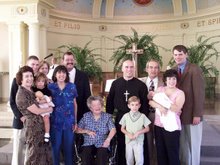
It's the middle of finals week, so I'm up to my eyeballs in paper writing (and enjoying all the snow falling on Mother's Day...), but I did give a little reflection at the masses today, and since it was the last Sunday of the regular school year, I themed it around moving on. More once all the papers are out of the way and I have some time to think about something else...
I suppose it is appropriate that as we are saying farewell to one another, the gospel comes from what is called the “Farewell Discourse” of John’s Gospel. When we return in the fall, it will be a drastically new community – without some old friends, and with a good number of new ones, but one way or another, almost all of us will be away from this place for some time. In today’s gospel Jesus says, “Peace I leave with you; my peace I give to you. Not as the world gives do I give it to you.” Of course I hope you will be active in a community of faith this summer, but wherever you are, I hope that you remember the peace that Jesus is talking about. He says this in the context of facing his death, so he clearly doesn’t just mean that you are happy and content and smooth sailing. “Not as the world gives do I give it to you.” “The world” for John has a very specific meaning – not the physical reality of the planet itself, and not the bodily realm as opposed to the spiritual, but a particular imagination – a vision of how life is supposed to operate. Let’s call it “the worldly” rather than “the world,” so you don’t think I’m saying the world itself is bad.
The worldly vision of peace is more or less about “success,” managing your life well enough to climb above the chaos, to make your life a comfortable and stable one. I presume we all came to SU or ESF for a reason – they have a good reputation, you are likely to get hired quickly and get a good salary, whatever. In brief, you thought it would help you to succeed, to make your life work for you. We have implicitly made a deal: we will make ourselves useful to the world by providing ourselves with valuable skills, and the world will make use of us, and in exchange it will make us more or less comfortable and safe and, we hope, happy. All of you, graduating or not, are already successful people by the sheer fact that you got into SU, ESF, wherever, and of course you are all the kinds of folks who will continue to do noteworthy things as captains of industry, businesspeople, politicians, thinkers, educators, health care providers and so on. Now, of course that’s fine, but I do hope you are getting more than job training in exchange for the sizeable amount of debt you are piling up, and that you expect more than that from your education – more than becoming well-paid operators. Certainly you know more stuff now than you did when you first arrived here, but have you become more genuinely human, in all of its glory and anguish and simplicity and complexity? Are you learning not only how to make a living, but how to live?
In a commencement address to the 1961 graduating class of Columbia University, his alma mater, Thomas Merton had the following to say about university education: “If you have learned only how to be a success, your life has probably been wasted. If a university concentrates on producing successful people, it is lamentably failing in its obligation to society and to the students themselves.” (TMSM 365) Now again, don’t misunderstand me; please learn all you can and bring your gifts to the table. As one of my brothers once told me, “The world is an endless black hole of misery and suffering,” by which he meant that whatever gifts you have, the world needs them badly. What the world does NOT need, though, is more glory-hounds killing themselves to have their picture on the front page of the New York Times or to have someone else think that they are successful. We’ve got more than enough of that. But that’s all the peace that the worldly can give: this Promethean struggle to be successful in the eyes of a world that can at most see you as a useful instrument. I hope you hear the real violence operative in a world like that.
The peace that the world cannot give is based in seeing beyond instrumental value; those people who cannot be squeezed into an imagination based on usefulness are either invisible or dangerous – the elderly, disabled, undereducated, incarcerated, so on. We have come here every weekend this year hoping to challenge that imagination, to be at least a little dangerous – wasting perfectly good work time producing nothing, accomplishing nothing, and trying to align ourselves with the unsuccessful – with the broken body of Christ, the crucified people of our world. We know that the voice of relevance, success, efficiency, is at full volume wherever we go, and it’s alive and well in us too, but this year we as a community have been here to at least whisper something else, to not give the worldly the stage all to itself. Wherever you are going this summer, remember that whisper, hang onto it when the worldly is trying to shout it down. Stay connected with a community of friends who can keep tuning you in to that whisper and reminding you of the peace that is worthy of your life, the peace that the world(ly) cannot give.
Monday, May 10, 2010


Thursday, April 29, 2010
The oasis in my day
It has been a long time, as usual. The end of the semester means lots of things to be read and written, but hopefully also some things emerging that might not be out of place in this forum. A very dear friend just sent me this poem entitled "Ithaca," and it was for me this afternoon a small oasis of reading and rereading and letting the words play on my tongue, with the attentiveness and care of a wine tasting. (*The fact that Ithaca is only about an hour down the road from Syracuse made it all the more relevant for me as I am looking ahead to the chance to get out on the road a bit soon.*) Simone Weil said, prophetically for our sound-bite era, "Absolutely unmingled attentiveness is prayer." I hope these words might be a small oasis of attentiveness for you as well...
Ithaca
When you set out on your journey to Ithaca
pray that the road is long,
full of adventure, full of knowledge.
The Lestrygonians and the Cyclops,
the angry Poseidon---do not fear them;
You will never find such as these on your path,
if your thoughts remain lofty, if a fine
emotion touches your spirit and your body.
The Lestrygonians and the Cyclops,
the fierce Poseidon you will never encounter,
if you do not carry them within your soul,
if your soul does not set them up before you.
Pray that the road is long,
That the summer mornings are many, when,
with such pleasure, with such joy
you will enter ports seen for the first time;
stop at Phoenician markets,
and purchase fine merchandise,
mother-of-pearl and coral, amber, and ebony,
and sensual perfumes of all kinds,
as many sensual perfumes as you can;
visit many Egyptian cities,
to learn and learn from scholars.
Always keep Ithaca in your mind.
To arrive there is your ultimate goal.
But do not hurry the voyage at all.
It is better to let it last for many years;
and to anchor at the island when you are old,
rich with all you have gained on the way,
not expecting that Ithaca will offer you riches.
Ithaca has given you the beautiful voyage.
Without her you would have never set out on the road.
She has nothing more to give you.
And if you find her poor, Ithaca has not deceived you.
Wise as you have become, with so much experience,
you must already have understood what these Ithacas mean.
---Constantine Cuvafy
Sunday, April 11, 2010
mercy and bodies
Fr. Daniel Berrigan, a Jesuit priest who is also a Syracuse native and a well-known peace activist, is famous, or infamous, for having said (and I hope you will pardon the colorfulness of this metaphor), “Faith is not where your head is at, and rarely where your heart is at. Faith is where your ass is at!” Today the church celebrates “Divine Mercy” Sunday – typically celebrated in remembrance of the devotion of St. Faustina – you might recognize the pictures of Jesus with the red and white rays of light coming out of his chest. Anyway, the way she talks about mercy is mostly about getting plenary indulgences and eliminating purgatory time, and believe me, I’m all for forgiveness, but mercy in the life of Jesus is way too focused on people’s bodies to reduce it to something that happens only in your head or your heart, let alone after the grave. When we talk about Jesus as the presence of God, we use the term “Incarnation” – coming in flesh. When we talk about Easter, we don’t say his spirit goes to heaven – we talk about the resurrection of the body, the transformation of this fragile stuff. So today I want to talk to you about bodies; for a church that talks about Incarnation and eating the body of Christ and being the body of Christ, we are awfully good at acting like Jesus just came to save souls. How many of us think that spirituality is about feeling it in our hearts rather than living it with our bodies, or imagine that having faith means believing the right things, or think that religion and politics (which is all about people’s bodily reality) don’t mix? Nothing is more embodied than Christianity done right.
And look at the readings – there are bodies everywhere: What does mercy look like for the disciples in the gospel? It looks like a body – the body of Jesus, three times offering them peace, making himself available to Thomas, breaking up the fear that has paralyzed this group of people since his death. What does mercy look like for the people in the first reading? It looks like being healed: these bodies that had been hiding with fear have become so saturated with the mercy of Jesus that even Peter’s shadow has power to heal these broken and diseased bodies. I think I have mentioned before that the Greek word for compassion literally means that the person’s guts are churning inside them, and the Hebrew word for compassion, rehem, comes from the same root as the word for womb, rahamim – mom love, I-carried-you-in-my-body-for-nine-months-and-this-is-the-thanks-I-get kind of love. Any mother knows that mercy is not just in the head or the heart - any mother knows how bodily mercy actually is.
We are all familiar with the “spiritual but not religious” crowd, and I don’t have any particular need to slam that reality in itself, but the biggest danger I see among both “spiritual” and “religious” people is that when people say, “Well, I believe in God/a higher power/whatever,” they mistakenly think that what you BELIEVE is the most important thing. Belief makes no sense at all apart from where you put your BODY. Now, that doesn’t mean that just showing up for church, your body being in the seat, is all it is about; it’s about the commitments you make and what “belief” actually looks like when it is written in human flesh. We miss the point of that because we hear the word “believers” so often in the readings today – believers in the Lord were added to the community, happy are they who have not seen and have believed. The words they are using in Greek are cognates of the root word pistis, which doesn’t mean faith the way we think of it as “what you believe,” so much as faithfulness in the sense of fidelity, “being there” for people, being “count-on-able.” I am so happy that we greet one another at the Catholic Center, but I hope that none of us treat that moment as a formality. I hope there is an actual community, an actual body being created here, the body of Christ, that we are coming to know one another and be available to one another – to take care of this body, not just that “I’m going to church,” like a blip on our radar screens, but to celebrate and strengthen what we are trying to be when we leave this building, for each other and for the people we will meet who need mercy. Augustine is remembered as having held up the consecrated host during the Eucharist and saying, “Christians, see yourselves”; that is, become the body of Christ, individually parts of the reality that is greater than any one of us.
Sunday, March 28, 2010
Palm Sunday
Because the readings are long, this reflection is brief. Plenty more I had in mind, but less, I hope, is more.
I know we had some long readings today, so I will make this quick, but first, an image to contemplate: we have all seen film or Power Point presentation projected onto a screen, right? Speaking of the suffering and death of Jesus, the theologian Mark McIntosh gives the odd image of projecting a film, not onto a screen, but onto a garbage heap; the film is completely distorted, barely possible to make out. He suggests that the suffering and death of Jesus, far from being the will of God, is the distorted outcome of the “film” of God’s self-giving life appearing in the wreckage of human history. That’s why we read the Passion on Palm Sunday, a week ahead of time: to remind ourselves that the roots of Jesus’ suffering and death lie in his life and ministry, his confrontation with the distorted power structures of our world.
There were two processions going into Jerusalem that day: on one hand, Roman forces were massing in Jerusalem Jerusalem
This year Palm Sunday falls between two infamous days from our own time: this past Wednesday, March 24, marked the 30th anniversary of the anniversary of the assassination of Salvadoran Archbishop Oscar Romero, who was killed for his outspoken commitment to economic and social justice for the poor of El Salvador El Salvador
Wednesday, March 24, 2010
Hagia Sophia
Today is the 30th anniversary of the assassination of Archbishop Oscar Romero; "happy" anniversary is not quite the right word, except that he was born into the resurrection and into the communal imagination of the people of El Salvador on this day, as he said: "If they kill me, I will arise in the Salvadoran people." When I was there a couple of years ago, I saw that he remains a powerful figure in the consciousness of the people of El Salvador.
For one of my classes, I wrote a little paper on a new book that just came out, Sophia: The Hidden Christ of Thomas Merton, by my old friend Chris Pramuk, now a professor of systematic theology at Xavier University in Cinncinnati. We were in a class on Merton together years ago, when he was just starting his doctoral work and I was just starting my master's work. He is writing about Merton's prose poem "Hagia Sophia," which draws on the image of Sophia, the Greek word for Wisdom, a figure who shows up in several of the late books of the Old Testament (e.g. Proverbs and Wisdom of Solomon). So, here goes...
For one of my classes, I wrote a little paper on a new book that just came out, Sophia: The Hidden Christ of Thomas Merton, by my old friend Chris Pramuk, now a professor of systematic theology at Xavier University in Cinncinnati. We were in a class on Merton together years ago, when he was just starting his doctoral work and I was just starting my master's work. He is writing about Merton's prose poem "Hagia Sophia," which draws on the image of Sophia, the Greek word for Wisdom, a figure who shows up in several of the late books of the Old Testament (e.g. Proverbs and Wisdom of Solomon). So, here goes...
I’ll just say it up front: I am in love with this book. Apart from making me realize how much of Thomas Merton’s corpus I have NOT read, I didn’t want to put it down. Pramuk uncovers the influences upon Merton’s “sophiology,” particularly the Russian Orthodox theologians for whom Sophia was a much more accepted category than in the Christian West, which has no real tradition of sophiology of which to speak, and the ramifications of this kind of theological thinking for the concerns of a world facing such moral and theological disintegration as did the world Merton inhabited, the world of the 20th century, particularly the world of Hiroshima and Auschwitz, Vietnam and Watts, the Cold War and the revolutions of the global south. Where Thomas Merton has been dismissed as not a real theologian on the grounds that he is only writing spirituality or poetry, Pramuk argues that, far from being mere wordsmithing, the form of his writing is essentially linked to its content. In a way very similar to Walter Brueggemann, for whom the primary category for understanding the prophet is as poet, Pramuk argues that poetry is a means of avoiding the “prosing” of the world. That is, paradoxical though it sounds, the poet is not swept up in devout idolatry of language the way that “the businessman, the propagandist, the politician” (78) are; the prosing of the world makes for a single, unquestionable Procrustean narrative into which all people are to be stuffed, whereas the poet knows that the elusive, allusive power of language opens up possibilities for “otherwise.” Rather than draw the ineffable down into fixed categories, the poet allows language to be unfixed by being drawn up into higher, more playful and unsettled meanings. “Imagination, in other words, the realm of the symbol, is not separate from reason but enables us ‘to reason differently by enlarging and reordering our powers of perception.” (108)
While it is more or less inevitable, given the workings of language, that those who are condemned to speak about God make God an object, an “out there,” Merton sees this as a tragedy that ends both in the death of God and in the death of the true self, that which we seek but which will never be found “out there” without being simultaneously being tasted as one’s inmost self, what Hopkins would call one’s “inscape.” Thus one angle on Merton’s understanding of mysticism as “the re-centering of subjectivity from the self to God.” (99) He refers to this “God’s-eye view” with the Pauline category of “the mind of Christ,” a lens through which we see that seeing the world, other people, God as “others,” “objects” to be related to, is a falsehood, and a violent and alienating one at that. In truth, we are already one, but we imagine that we are not, so the objectified world and other and God become instrumentalized products of exchange. The problem, it seems (stepping a bit outside of Merton and Pramuk’s arguments for a moment) is that this lens, this atomizing mode of looking at the world is, in Merton’s terms, horrifically Promethean (a literary figure that, while never explicitly stated as such, would stand for Merton as the foil to his figure of Sophia): I must capture what I want from others and from God who are striving to keep it from me. I can have only what I can take, because nothing will be given freely. “War, of course, is the bitter harvest of Prometheanism on a global scale, a centrifugal struggle against life spinning tragically around the poles of ‘heroism and despair.’” (141)
“Peace, then, and healing, begins with poverty of spirit,” (198) with a view of the world that does not pit “us” against “them,” that does not depend on defending myself from the world that is endlessly seeking to take what is mine. While nothing the theological influence that Russian Orthodoxy had on Merton, Pramuk connects Merton’s poetic/imaginative sensibilities with those of Abraham Heschel and Boris Pasternak, both of whom Merton admired and befriended: “‘In the face of our own almost hopeless alienation,’ Pasternak is proof that the poet can help us ‘get back to ourselves before it is too late.’ In him, poetry becomes one with prophecy.” (152) Merton’s repeated theme of the urgency (but nigh-impossibility) of simply being human in an age of mass inhumanity echoes Pasternak’s theme in his writings, “‘the protest of life itself, of humanity itself, of love’ against the ‘reign of numbers,’ against the alienation and anonymity of mass society.” (207)
In a strange way, this capacity for non-duplicity, for simplicity, for humanness, is Sophia, but less as a “thing” and more as a trajectory, a reality already present in each person but so buried under falsehood as to be invisible, that into which we are invited (quietly) to grow. The symbol itself for Merton jumps around, both in the poem and in his other sophianic writings: Sophia as Mary, as Logos, as the ousia of God, as the linkage of Logos and Spirit, who are together the presence of the Father (Mother) God in the world, as the “pivot” of nature playing alongside God from the beginning of creation. “Perhaps most of all, Merton’s Sophia is our ‘true self,’ when we allow Christ to be birthed in us, and so realize the hidden ground of mercy, creativity, and presence in our very selves, the mystical Body of Christ.” (207) This mysterious, “empty” placeholder, marked only by humility and kenosis, is obviously also connected to “le point vierge,” a phrase Merton borrowed from the French Islamicist Louis Massignon to refer to that meeting place of the divine reality with our own, endlessly humble and with nothing to hold on to by way of naming oneself, and hence both absolutely vulnerable and absolutely beyond insult and injury: there is nothing there to insult, since the only “thing” there is the non-object, the Absolute Subject, God, or better, Sophia, who is closer to me than I am to myself, who in the final accounting is my self.
Lest this seem to float off into the ether, Pramuk asks what good it does to bring Sophia-language into the discourse of Western theology and especially the discourse of the post-Christian era. “[W]ith deepest respect for the theodicy question, it is at the point where the analogical imagination ruptures, as in Auschwitz, or present-day Darfur – where all analogy between God and the world is rendered horrific and absurd – that the irony of Christ and Christ crucified intervenes from within, as it were, to mediate and intensify (I do not say ‘answer’) faith’s most difficult question: whether we have eyes to see, the faith to shoulder, the contradictions of hope in a sinful, though still hallowed, world.” (268) This is not simply another theodicy, arguing that the unspeakable realities of our times disappear in the light of the gloriously risen Christ: instead, rather than answering prose with prose, certitude with certitude and power with power, “Merton sets the poverty and humility of Christ, from nativity to the cross, against the Promethean climate of the times.” (262) This takes shape in what some would call “weak” categories: memory, imagination, hope, poetry, but as Merton says in the poem, “She [Sophia] crowns Him not with what is glorious, but with what is greater than glory: the one thing greater than glory is weakness, nothingness, poverty.” (305)
Does this Sophia as dark ousia of God, as the weakness of God, the unpolluted self of humanity, work? Does it end up inscribing weakness into femininity, reinforcing artificial and harmful gender roles? That remains as yet for me an open question, but I suspect there is more to it than that: Sophia opens up imaginings of God that transcend the associations of power and masculinity that usually accompany Western God-images. Merton argues, “The ‘desecration’ of man begins when symbols are emptied of meaning and are allowed to survive precisely insofar as they are patronizingly admitted to be misleading but still ‘necessary for the ignorant.’” (275) There is still something within us, however, that has not been corrupted by the need to defend itself (like the “Uncarved Block” of The Tao of Pooh, perhaps), and the form of subversive imagery (God as Sophia) and subversive rhetoric (poetry, in this case) has the capacity to convey the mystical in a new key: the renewal of imagination, the un-prosing of the world. Such allegedly “weak” categories put theology where it ought to be: in touch with the weak, “intensifying our awareness of the critical present moment for those who have no name, no presence, no value whatsoever on the world stage.” (290) The very hiddenness of this sophianic vision is its power – it is too weak to be brought to the center of a system of control, even a theological system, so it remains on the edge where it belongs, pushed out of the world, uncompromised by abstractions that lose sight of the real people who are chewed up by the machinery of power. This is the Christ (and, one can hope, the Christianity) of today: “Christ is Lord of history in the manner ‘of His entry into Jerusalem: in a concealed, kenotic matter (behind a veil of humility), which is imperceptible to the senses, but more than visible, and absolutely evident to faith’…the Christ of our times is ‘the Christ of the bombed city and of the concentration camp.’” (215)
Tuesday, March 23, 2010
NYC
This past weekend my community's New York Province celebrated the 50th anniversary of their foundation, so they had a Mass and a reception in New York City. I was coming back from my spring break in Washington, DC (coming soon), so I was able to be there for the celebration. Got to see a lot of guys I had not seen in a long time. Two in particular:

 Br. Gaston Lavoie is another old friend, but from my novitiate days, rather than from high school. When I was a novice, Gaston was a new member of the general council, and he came to live with us for a couple of months to work on his English. Every evening after dinner we would take a walk around the block, and he would let me work on the French with him, so we got to be friends, and my French got a lot better (or maybe, less bad) because of his congeniality.
Both of these guys are just Brothers' Brothers - no baloney, just men who love the Institute and have given their lives to making it work better. Ametur Cor Jesu, Brothers, and happy anniversary.

Br. Paul Montero is not only a current member of our general administration, living in Rome between his travels all over the world. He is also my former high school principal and a long-time friend. Because he is such a globe-trotter, I had not seen him in a few years, but as always, seeing him was a great grace of Brotherhood. Even as a little kid, Paul made a big impression on me - he knew my name, knew my family, and was not just concerned about running the school: he loved us students.

Both of these guys are just Brothers' Brothers - no baloney, just men who love the Institute and have given their lives to making it work better. Ametur Cor Jesu, Brothers, and happy anniversary.
Wednesday, March 17, 2010
Spring Break in DC
Spending a few days in Washington , DC York York , PA

Anyway, got in to DC last evening, and it was my friend’s husband’s birthday. He is serious about his Irishness, so we to a Gaelic Mass in honor of his birthday and St. Patrick’s Day. Had never heard any significant amount of Gaelic spoken before, but it was most impressive. The priest even took out his mandolin and serenaded us in Gaelic after the Mass ended! This morning my friend and I did an hour of yoga, which I was completely not ready for, so I have been dragging myself around all day. She had to go to work, so I went into town and met another old friend, and we spent the day running around town: National Zoo, Holocaust Museum , Washington

The last time I was in DC (about 8 years ago), the Holocaust Museum
Finally, dinner with both friends and their spouses at an unbelievable tapas restaurant – how had I gone 32 years without ever having tapas?!
Tomorrow is St. Patrick’s Day, of course, and even though I’m not Irish at all, I feel like an honorary Irishman for the day, and if tomorrow's hour of yoga or whatever other torture my friend can come up is like today's was, I think I’ll be looking for a wee drop...So, to all lads and lassies, genuinely Irish and Irish for the day, a happy day.
Sunday, March 14, 2010
A pizza my mind...
For a while there we were ordering pizza or cooking frozen pizzas almost every weekend, so for the past few weeks, I've been making pizza dough on Friday and having it available for Sunday evening - I roll out the dough, and the Brothers can add whatever they want to it. As I type we are just finishing cleaning up from our latest effort, and for my money, our best so far. Today one of the volunteers who lives down the street came over to talk about graduate theology programs and get some advice about baking bread, so I got her to help, which may be why it turned out so well. I inadvertently cooked one longer than I intended, but it ended up being really good - very crisp! - so I may have to repeat that 'happy accident' again next time! The first picture is Br. Bill's very fine mushroom-and-ricotta pizza, then mine (mushroom and pineapple, my favorite!), then the guys at the table, then Br. Mike's pepperoni and mushroom. Coming to know Him in the breaking of the bread, indeed...


Thursday, March 11, 2010
hidden Christ, unhidden small self
Realization tonight, of the sinister reach of my superficial self. Had a brilliant session today on mysticism, proud of myself for my mastery of the material, good synthesis of ideas and insightful turns of phrase, then came home and snapped at the Brothers during dinner because I was tired and the conversation was boring. Had to apologize for being cranky. Again. All of the morning’s snappy knowledge still hasn’t sunk past my thinking brain. Need for a return to the apocalyptic Christ: not the scholars’ eschatological prophet announcing the end of the world, but the Christ who leaves my plans for my life in splinters, in whose wake my life cannot but be shaken to its foundations. No more taking pride in being clever, like the prisoner taking pride in his large cell. Inauthenticity of justifying my alienated life with work - always more work to do, never enough time, feel continually drawn toward doing more, reading more, writing more, proving more, but then wonder where my religious life, my life, has gone. Need to get from the irreligious religious life of my life at present, not back to “religious life” (whatever that means), but to real life. The attempt to live a more human life is at times inhuman – making bread from scratch (which I love), wanting to avoid processed crap foods, but demands so much more than the two seconds in the bread aisle at the supermarket. Want to connect with what I eat – holiness of food – not just use food as fuel. But hard to spend (justify?) the time when I could be/should be ACCOMPLISHING – plowing through more books, writing some brilliant (!) thing, updating my blog more often. Like the Big Bad Wolf of my unsettled resentful self hiding in Granny’s contented nightgown (the better to edify you with). Merton, as usual, but for me, more than for you: “The Christ we seek is within us, in our inmost self, is our inmost self, and yet infinitely transcends ourselves.” Easy to say, hard to get. Not there yet, haven't even started. But the shy Christ breaks through, despite myself.
Tuesday, March 2, 2010
a bit more on debt...
Ever since I went to that lecture last week, I have been thinking about debt and its relationship to theology. I know frightfully little about economics, and only slightly more about theology, but it sure seems like so many theological types have not had to worry about debt that I fear we too easily spiritualize the Biblical language of debt. Of course, I'm in the same boat - just because I've taken a vow of poverty does not at all mean I have any idea of what poverty or debt actually feels like - but I fear that we can theologize debt, real financial debt, into sinfulness, like we now owe God for all the things we have done wrong. I'm not trying to nullify talking about sin, but I do want to avoid reading the gospel like it is just talking about our souls - the salvation of which Jesus speaks is integral, not just getting souls to heaven, but overcoming the crushing forces that warp the human situation. Debt may not be the only one, but it is certainly a real one, and reading Torah, the prophetic tradition, the gospels makes clear that it is near and dear to the heart of the Biblical God. An entire chapter of Leviticus (25) is about the jubilee year, when all debts were to be forgiven and land restored to families, and other institutionalized means of preventing debt from consuming the people. Isaiah, Amos and Micah among other prophets rail against practices that condemn people to fall into debt (see, e.g., Amos 2:2; 3:11; 6:10-11. Speaking about the crushing system of debts in the Palestine of Jesus' time, Walter Wink says, "It is no accident that the first act of the Jewish revolutionaries in 66 C.E. was to burn the Temple treasury, where the record of debts was kept." [Incidentally, if you want to read the article from which I got this quote, go here: http://www.cres.org/star/_wink.htm. He reads the injunctions to turn the other cheek, give one's coat with one's tunic, and go the second mile in the context of Roman occupation - a very different view from our usual spiritualized thinking about those "impossible" injunctions!] A number of theologians talk about Jesus' turning over tables in the temple in the context of the economic control that the necessity of making very expensive sacrifices would impose over the poor. We tend to read parables like the unforgiving servant (MT 18:23-35) or the workers in the vineyard (MT 20:1-16) as if they are really about God forgiving sin or being merciful with us - and yes, that's true, but why would that extend only to the interior life, as opposed to also entailing the surface reading of economic debt, which is so common in the time of Jesus and in our own time? What would have happened those people that Dr. Yunus lent the $27 to if they had borrowed money from loan sharks? How long would that debt have dogged them? Why in poor areas are there so many paycheck advance places that charge unbelievable interest rates? Why when I was in Zimbabwe did I so often see endless fields of flowers for sale abroad all while so many people were hungry? [Foreign debt, in case I was unclear there.] The Church, talking about economic justice, makes clear that we are not isolated monads or self-made men and women - we are inherently communal beings, and our lives impact one another. There is a social nature to our lives - we don't become the body of Christ by sitting together for an hour on Sundays, we become it by behaving communally, and that means that there is a social reality in every aspect of our existence: economic, political, familial. Debt is not just a ready symbol for sin or a story to be allegorized, but a real and enduring source of human suffering that the gospel demands be alleviated.
Wednesday, February 24, 2010
Blessed are those who hunger and thirst for justice...
I just got back from a public lecture at Syracuse U. by Dr. Muhammad Yunus (http://www.muhammadyunus.org/), a Bangladeshi economist and Nobel Peace Prize winner for his work with microloans – loaning small amounts of money to poor people without collateral. He started with 42 people who were borrowing money from loan sharks, looking to borrow a total of $27 (!); knowing that being in debt to those loan sharks could well control their lives for a very long time, he took $27 from his pocket, and from there, he was off. Today the bank he founded lends $100 million per month, entirely in rural areas and almost entirely to women, and close to 100% of their lenders repay their loans. He gave a great presentation, very animated and funny, and I suspect that more than a few people in the packed auditorium were inspired to start thinking about how they could get in on something like this – I know I was. It also so happens that I’m currently reading an edited collection of the writings of Jesuit Fr. Daniel Berrigan, who is well-known for his activism for peace over the past fifty years. Between the lecture and the book, it is refreshing to be reminded of what all the work I am doing for this degree is actually about – trying to learn better how to be an agent of justice in a world that could really use it.
Sunday, February 21, 2010
21 February 2010
I don’t know about you, but I kinda hate February: the weather is cold, grey, and slushy (especially here in Syracuse), it’s still too early in the semester to see the light at the end of the tunnel, and it’s still a month until spring break. On top of that, then the Church has to throw Lent in, so that just in case you weren’t already depressed enough, now you have six weeks of self-denial to look forward to. We usually think of Lent leading up to Easter, but given today’s readings it also seems to make sense to connect the forty days of Lent with the forty days Jesus spent in the desert immediately after his baptism. Remember what he hears at his baptism? “You are my beloved son; with you I am well pleased.” You ever wonder what Jesus thought about when he heard that? Whatever he thought about his relationship with God, I suspect he wouldn’t talk about it like a theology professor; I can’t really imagine him saying, “I am the incarnation of the Second Person of the Trinity, the hypostatic union of divine and human natures in one divine person.” I mean, I’m sure Jesus got an A in ancient philosophy when he was in college, but that just doesn’t really seem like his style. We think we know what Jesus being called “Son of God” means, because we have a whole history of doctrines to point to, but what would Jesus think about hearing those words applied to himself? If anything, I think that where we have typically read the forty days in the desert as a series of tests to pass, perhaps we could read them more fruitfully as unpacking what it means to be the Son of God. Did you notice that in two of the three tests Jesus faces, the devil begins, “IF you are the Son of God,” as if the suggestion he gives follows naturally from an obvious image of what it means to be the Son of God? If you are the Son of God, you shouldn’t be hungry. If you are the Son of God, don’t worry about throwing yourself off the parapet of the Temple, because nothing bad will happen to you. The ready equation is that God is the king, so Jesus is the prince and should enjoy the freedom from worry and discomfort that one would expect for a prince, but Jesus dismisses that kind of sonship. I’ve said with you before that rather than Jesus being just as human as us, but more divine, I think he is more human – he does not run away from any of the reality of being human, which involves hunger, danger, failure, rejection, humiliation, all the things a lot of us don’t deal with terribly well. He doesn’t make avoidance of hunger his top priority, or gaining power by any means necessary, or attracting crowds by doing magic tricks – sonship has to mean something more than that.
Maybe I’ve been reading too much Thoreau lately, or maybe February is just working its magic on me, but sometimes I feel totally unfree, like my life is being hemmed in by forces way beyond my control, and I think about just disappearing into the desert somewhere. Like the old saying goes, “The problem with running the rat race is that even if you win, you’re still a rat.” In the Biblical tradition the desert was the place where demons lived but also where God was to be encountered – danger and opportunity, the risk of life without safety nets and the possibility of seeing life from outside of the confines of public opinion. When I was teaching theology in St. Louis, we read Jon Krakauer’s book Into the Wild in my intro class. I don’t know if any of you read the book or saw the movie, but to read a book about a smart, talented young guy with a big future just cutting off from society to find something big hit home with a lot of my students because they were the same kinds of people, just the students here at SU are: intelligent, talented, going places. We talked about Chris McCandless’s [the protagonist of Into the Wild] passionate need to not get fed through what I called “the meat grinder” - the script that we more or less are expected to fall into: go to a good high school so you can go to a good college so you can get a good job so you can take vacations far from your job and still put away enough money to retire comfortably. Anyone else ever feel like that, like someone else has written the script for your life and you are being moved along, usually imperceptibly? I hope not. The culmination of that project was an assignment to turn off the cell phone, get off campus, just walk somewhere they had never been, be completely unplugged for an hour or so and then write about it. I figured it wouldn’t be that big of a deal, a tiny dose of the weeks and months that Chris McCandless went without seeing another living soul. Some of the students reported what a shock it was to not be able to call anyone, how uncomfortable it was to go so long without text messaging or calling anyone or twittering (tweetering? tweeting?). A number of them said they thought it couldn’t be good for a person to be isolated for so long, but almost none of them said that solitude, silence, unplugging, feeling some fear or uncertainty might actually be worthwhile. We are so constantly bombarded with data that tuning out can feel pretty defenseless, but only in distance from the security of the mass mind can the Christian take the risk of becoming more fully human. Paradoxical, that the mass mind can be so individualistic in selling people on more and more needs and desires, while distance from the herd can open the door to solidarity by seeing the illusions that we mostly take for granted. I’ve said before that if you are waiting for a sign, this is it: we don’t typically expect a voice from the heavens, like at Jesus’ baptism, but here it is: you are beloved son, beloved daughter – how will you confront the false meanings of that reality and come to inhabit the deep truth it offers?
Maybe I’ve been reading too much Thoreau lately, or maybe February is just working its magic on me, but sometimes I feel totally unfree, like my life is being hemmed in by forces way beyond my control, and I think about just disappearing into the desert somewhere. Like the old saying goes, “The problem with running the rat race is that even if you win, you’re still a rat.” In the Biblical tradition the desert was the place where demons lived but also where God was to be encountered – danger and opportunity, the risk of life without safety nets and the possibility of seeing life from outside of the confines of public opinion. When I was teaching theology in St. Louis, we read Jon Krakauer’s book Into the Wild in my intro class. I don’t know if any of you read the book or saw the movie, but to read a book about a smart, talented young guy with a big future just cutting off from society to find something big hit home with a lot of my students because they were the same kinds of people, just the students here at SU are: intelligent, talented, going places. We talked about Chris McCandless’s [the protagonist of Into the Wild] passionate need to not get fed through what I called “the meat grinder” - the script that we more or less are expected to fall into: go to a good high school so you can go to a good college so you can get a good job so you can take vacations far from your job and still put away enough money to retire comfortably. Anyone else ever feel like that, like someone else has written the script for your life and you are being moved along, usually imperceptibly? I hope not. The culmination of that project was an assignment to turn off the cell phone, get off campus, just walk somewhere they had never been, be completely unplugged for an hour or so and then write about it. I figured it wouldn’t be that big of a deal, a tiny dose of the weeks and months that Chris McCandless went without seeing another living soul. Some of the students reported what a shock it was to not be able to call anyone, how uncomfortable it was to go so long without text messaging or calling anyone or twittering (tweetering? tweeting?). A number of them said they thought it couldn’t be good for a person to be isolated for so long, but almost none of them said that solitude, silence, unplugging, feeling some fear or uncertainty might actually be worthwhile. We are so constantly bombarded with data that tuning out can feel pretty defenseless, but only in distance from the security of the mass mind can the Christian take the risk of becoming more fully human. Paradoxical, that the mass mind can be so individualistic in selling people on more and more needs and desires, while distance from the herd can open the door to solidarity by seeing the illusions that we mostly take for granted. I’ve said before that if you are waiting for a sign, this is it: we don’t typically expect a voice from the heavens, like at Jesus’ baptism, but here it is: you are beloved son, beloved daughter – how will you confront the false meanings of that reality and come to inhabit the deep truth it offers?
Tuesday, February 16, 2010
Ash Wednesday
As usual, it's been a while since I have been around blogger.com's hallways. This time, it's been a bit more deliberate: I've been hibernating for a while, trying to get my head on straight, so thanks to those of you who have asked if everything is ok - I think it is.
I'm giving a little reflection at the Ash Wednesday services at the Catholic Center, so I figured I could post it - there are some recycled lines from older posts, but hopefully they aren't too stale. I used to hate Ash Wednesday when I was younger, but in the past few years I've found some real treasures in it. Hope the same is true for you. My best wishes and my prayers for all of you this season, and in particular for the people of Haiti and those who are working on so many fronts to ameliorate their suffering...

I don’t know if any of you ever do this, but every Ash Wednesday, at some point during the day, I forget that I have ashes on my head and touch my forehead, and I get that gritty feeling of ash on my fingers. I hate that feeling – it’s like fingernails on a chalkboard – but it brings back to mind one of the formulas for the distribution of the ashes: "Remember that you are dust, and to dust you shall return." We’ve heard it so often that we skip right by it, but that’s a dangerous memory, one we would rather not think about for too long. Ash Wednesday is a reminder that the end of my world is never terribly far away. I’m not talking about the end of life on earth, but the end of all our little worlds, the world of business as usual, the world which is all about managing our own fates. Everything is passing away: not only our lives, not only MY life, but everything – no nation lasts forever, no social system or economy or political party or national leader or public opinion lasts forever: nothing lasts forever.
Ash Wednesday is a weird day, I think: putting ashes on one another’s heads and telling each other that we are going to die sounds a little too morbid, a little too "scary Catholic." In a way, it’s a scandal, and it should be – in Greek the word scandal means “stumbling block,” or for my purposes, "speed bump," something that disrupts the easy flow of getting where we want to get. Ash Wednesday has the potential to be a sort of stumbling block, a speed bump, if you will: it urges us to resist, even if only for a moment, the dominant story of what life is SUPPOSED to look like – well-fed, perpetually young and beautiful and successful and happy and comfortable. It reminds us that the gospel we profess is no safe, harmless gesture we do for a day here and there: we are wearing on our bodies a sign of death and mourning, the impending end of our worlds. If we don’t just let this day pass by, rub the ashes off as soon as we leave, treat it like one of those Catholic duties we are supposed to get through as quickly as possible with a minimum of interference on your real life, this day can be a sacrament of the brokenness and the suffering of our world. That’s what all the ascetic practices of Lent are about at their core – not about being spiritual heroes, but bringing all this spiritual stuff back to bodies, getting us to FEEL something of the tears of the world in our own bodies and not just think about it for a few minutes and then move on. Maybe you have been thinking about what you are going to "give up" for Lent, and if you are doing something like that, good for you, but remember that it's not really about "giving something up," as if what God is really looking for is for you to quit drinking beer or watching Desperate Housewives or whatever else for six weeks. Take today’s fast, for example. Ask yourself, "When was the last time I felt truly hungry? How often do I eat when I’m not really even hungry?" The point is not how much of a rock star you are when it comes to skipping food: it’s about letting prayer get out of your head and into your empty stomach – actually FEELING hunger in your body. That’s what Jesus means with the expression "hunger and thirst for justice": something we can’t turn off any more than we can turn off feeling hungry. I’ll close with a prayer that some friends of mine have in their house: "Lord, to those who hunger, give bread, and to those who have bread, give the hunger for justice." Amen...
Thursday, December 24, 2009
Merry Christmas
My dear friends,
My most sincere prayers that this be for you a very blessed and peaceful Christmas. I received a letter from a Brother in our New England province a few days ago, riffing off one of my posts on this blog, so since it is better than anything I could have done, I include it below. (Shawn, I hope you don't mind me borrowing your letter - it was too good to miss!) Let us pray for each other, that this Christmas we remember the poor, that we see in this quotidian miracle of birth the ever-new birth of the reign of God: justice, forgiveness, crossing of boundaries to welcome the outsider.
Who I am is who I am in God, and nothing more.
--And God came to us that way, too.
As an infant.
As one born into a family that had faith and very little else.
As the bearer of reconciliation, renewal in the Covenant,
As Savior and Brother and Lord – as he was in God.
--And Jesus lived among us that way, too.
As a humble, quiet resident of Nazareth for 30 of his 33 years.
As an itinerant preacher who challenged the status quo.
As one who loved those considered unlovable, unacceptable,
unclean and unknown
(the stranger, the widow, the orphan, the immigrant,
the substance abuser, the criminal – all children of God)
As one who challenges us to do the same.
--And now we are called to live that way, too.
As people of faith in the face of skepticism.
As people of hope in a world where sometimes hope seems lost.
As people of love in a society that has often confused its
priorities about what love means.
Who I am is who I am in God and nothing more.
May the Spirit of God, the Spirit that gave Jesus life and gives us life,
guide you to become who are you are in God
this Advent and Christmas
and throughout the New Year to come.
Tuesday, December 22, 2009
reflection for 22 December 2009
As usual, it has been way too long since I last posted, but I did just finish my papers for the end of the semester, and I’ve been up to my neck in work. The readings today are the story of Hannah, mother of Samuel, bringing her baby to the temple to dedicate him to God (1 Sam1:24-28); the Canticle of Hannah, which is a song that follows the dedication of Samuel to God (1 Sam 2:1-8); and then Mary’s Magnificat (LK 1:46-56), which of course is attributed to her after Elizabeth acknowledges her blessedness. Each of them is a great reading, and together they are a great combination. I am currently working on a book review of a new book on contextual theology (An Introduction to Theology in Global Perspective by Stephen Bevans, SVD) for a Catholic publication, and a great deal of it has been discussing how theology always comes from a particular context, rather than assuming that the theology of upper-middle-class white male celibates (like myself) is the normative theology and everyone from other situations is somehow derivative from that norm. The only people we hear from in today’s readings are poor Middle Eastern women – not only no degrees in theology, but can’t read or write, have no public voice, but by God, they are doing theology! Their theology is unbelievably important for a person in my situation, because it is too easy to think that the concerns of my world are everyone’s concerns, that everyone encounters these texts the way I do. As I mentioned in my last post, “Apocalyptic never makes sense to people who are tenured.” That is, for people whose life is comfortable, literature written when people are under attack and their world is exploding is a curiosity at best, something to be leisurely pondered. I can easily spiritualize this Christmas season because a person in my context can afford to do so. “Christ being born in your heart” is a nice reminder of the call to inner conversion, and it isn’t WRONG, but re-read the Magnificat and see how much of it isn’t about spiritualized concerns, but about the situation of the poor and the marginal, like Mary herself would have been as a woman, a non-elite Palestinian, a person living under foreign occupation, an unwed mother. The God of Hannah and Mary’s Canticles is not only a God who touches hearts but who demands justice, who crushes unjust forces that would trample the poor. While we talk about the coming of the reign of God at Christmas, both Canticles make clear that this God is already active, already demanding and bringing justice for those who are chewed up by the powerful – this is who God always is. One of my papers this semester was on torture in Latin American dictatorships as a ritual that created a particular kind of collective memory: there is only one story in this country, and it is the story of the regime, and any alternative stories get silenced by torture. What a revolutionary thing to here have a vision of reality that is not only given by poor women, but that offers a completely different vision of reality – a reality in which the poor are saved from the nightmare of oppression, where the narrative of the unchallenged power of the proud is dismantled. That alternative story is just about always subaltern, below the surface of the dominant narrative, like a termite invisibly chewing away at the foundations of the structure from within, but for people who themselves get chewed up by society’s script of how the world works, an alternative story says: IT DOESN’T HAVE TO BE THIS WAY. ANOTHER REALITY IS POSSIBLE. In a world in which 70% of the world’s poor are still women, in which women still do 80% of the work and still own 1% of the property, the fact that today’s readings give voice to poor nonwhite women is still not to be taken for granted, even though we likely don’t a second’s notice to the speakers, let alone the actual content, subversive as it is. (*As a side note, during the dictatorships I mentioned above, the Magnificat was at times ripped out of Bibles by the regimes because it inspired images of another world, of the powers being overthrown. Words continue to offer us the means to depiction of reality, and thus to alternative depiction of reality!*) What a thing it is when, whether in our parishes or on their own, people come together to read the texts of our collective story from our individual backgrounds: some professionally educated in the task, most not, but all taking part in enriching the community by sharing the varied perspectives of their lives in conversation with the Biblical world as it speaks to them: male, female, African, Latin American, Asian, refugees, migrants, even white upper-middle-class celibate doctoral students. As it so happens, last week a volunteer who lives near us and who works at a clinic at a Franciscan parish called me and asked if I spoke French: A woman from French-speaking Africa had just come into the clinic and the usual interpreter was not available. I went over, talked to this woman a bit, and helped her through her meeting with the doctor: very simple, a reminder of how much help my French needs, but it worked. She is a recent immigrant from Niger, her son recently died, so she is staying with the one person she knows, another woman from her hometown who has been here for a while. Those two women have some stories to tell, let me assure you, and I plan to keep in touch with them, especially to help the first woman learn some English so she can make this place home. How would they read today's readings? Certainly not the same way I do, but certainly not wrongly compared to my "scholarly" reading. What world do those two Palestinian village women from a long time ago inspire for those African women living over a barbershop in the old Italian district in Syracuse? And what do all four of them say to me as I celebrate the coming of Jesus, who bears the reign of God in his midst?
Monday, November 30, 2009
expert humans wanted
We read some Emerson and Thoreau for one of my classes this week, and I just finished the reflection paper, so I have snippets of both those guys whirling in my head, with a liberal sprinkling of clips from Dead Poets' Society for good measure. Thoreau's quote, "Most men lead lives of quiet desperation and go to the grave with the song still in them" has got me thinking, and not just because it's the end of the semester and I'm up to my eyeballs in reading and papers: how much do any of us avoid the possibility of unknown suffering by clinging to sufferings to which we are accustomed? Pink Floyd shares Thoreau's sentiment: "Hanging on in quiet desperation is the English way." Stiff upper lip, lads. How much of my life is extraordinary? That doesn't mean life-as-extreme-sport, (for God's sake, no) but how much do I live to get somewhere else, not pay attention to where I am, muddle through what I am supposed to do? How often am I genuinely alive, really soaking in the full range of human experience, and not running away from some part of it? Whatever we are doing, work, school, whatever is about developing or making use of a certain expertise of ability or information, but how many of us are expert human beings? I have become an expert at keeping the world stable around me, but when that stability is threatened, how easily my little world falls apart. I don't know how to become an expert human being, but, even if just for this night while writing this paper, Emerson and Thoreau have reminded me that the goal of all of it - work, school, community, ministry, whatever - is the deadly difficult task of becoming who we are, becoming real human beings.
For me in my little universe, that means more than having a much-expanded personal library at the end of this degree program. A mental rock star like Thoreau can say that he kept the Iliad on his table at Walden Pond but didn’t read much of it; again, he isn't dismissing intellectual work, but seeing the task of intellection directed to knowing himself. Plenty of people have dismissed his experiment because he was only a mile or so from Concord, but I challenge anyone to spend a week without reading or talking to anyone – that might sound like heaven at the end of the semester, but not reading, not writing, not accomplishing, not producing is a lot more work than it seems. In my head I share Thoreau’s sentiment, “We are for the most part more lonely when we go abroad among men than when we stay in our chambers,” but in my real life I also see how needy I can get after a few months of continual interaction, communication, productivity, when I have not disciplined myself to be still and let go of "relevance." My fear in this place is that academe become a barrier between myself and real life, cutting me off from the desperation of real people's real sufferings as well as Thoreau's “quiet desperation” in my own life, not just because I have spent a ridiculous amount of time this semester cooped up reading or writing, but because a university can be a cozy place to hunker down away from the chaos of the world. “Apocalyptic never makes sense to people who are tenured,” one of my OT professors once told our class. Point taken: To the degree that being here opens my world to the rawness of the world of people who live without safety nets, and gives me the tools to bring people to see outside their bubble, I'm in the right place. To the degree that this kind of work insulates me from it, I’m in big trouble.
For me in my little universe, that means more than having a much-expanded personal library at the end of this degree program. A mental rock star like Thoreau can say that he kept the Iliad on his table at Walden Pond but didn’t read much of it; again, he isn't dismissing intellectual work, but seeing the task of intellection directed to knowing himself. Plenty of people have dismissed his experiment because he was only a mile or so from Concord, but I challenge anyone to spend a week without reading or talking to anyone – that might sound like heaven at the end of the semester, but not reading, not writing, not accomplishing, not producing is a lot more work than it seems. In my head I share Thoreau’s sentiment, “We are for the most part more lonely when we go abroad among men than when we stay in our chambers,” but in my real life I also see how needy I can get after a few months of continual interaction, communication, productivity, when I have not disciplined myself to be still and let go of "relevance." My fear in this place is that academe become a barrier between myself and real life, cutting me off from the desperation of real people's real sufferings as well as Thoreau's “quiet desperation” in my own life, not just because I have spent a ridiculous amount of time this semester cooped up reading or writing, but because a university can be a cozy place to hunker down away from the chaos of the world. “Apocalyptic never makes sense to people who are tenured,” one of my OT professors once told our class. Point taken: To the degree that being here opens my world to the rawness of the world of people who live without safety nets, and gives me the tools to bring people to see outside their bubble, I'm in the right place. To the degree that this kind of work insulates me from it, I’m in big trouble.
Sunday, November 15, 2009
The Time of the End is the Time of No Room - 15 November 2009
The readings today include apocalyptic sections of Daniel and Mark, so given the opening of this new film 2012 (which I have not seen, and don't particularly intend to see), I thought my reflection for today might bring those two together. Here goes...
Merry Christmas! I see that we already have a Christmas tree out in the lobby, but how many of you have seen Christmas decorations up at stores or heard Christmas music on the radio? I started hearing it before Halloween. According to this new movie 2012 the Mayans apparently say the end is coming in three years, and I think that by then, stores are going to start Christmas sales on the 4th of July. In the past few weeks, how many of you have said something along the lines of, “Oh my God, the semester is almost over!”? Personally, I don’t want it to be that close, because I have a lot of work to do between now and the end. We see something of that sense of anticipation this week in the readings: sun being darkened, stars falling, heavens and earth being shaken. In other words, the world as we know it is falling apart. We still have a few weeks to go before the end of the liturgical year, but we are already hearing readings that seem to be directly pointing at the end of things. The technical term for thinking about “the last things” is eschatology, so we might say that these readings are eschatological. Preachers throughout history have just loved these texts, usually pointing to current events to convince people that the end is almost here. War here, famine there, the end must be close. There have ALWAYS been wars and famines going on, I’m sad to say, so current events is not the best yardstick. Even the earliest generation of Christians seemed to believe pretty soundly that Jesus would return within their lifetimes, and it’s easy to see why from the content of the gospel: “Amen, I say to you, this generation will not pass away until all these things have taken place.” Both the first reading and the gospel point to a select group who will endure the end: those whose names are written in the book, says the first, and the elect, says the gospel. Of course, people of all times have been at pains to show that they are among the elect, usually showing at the same time who is NOT among the elect. Some group took it upon themselves some years ago to calculate exactly what percentage of people are going to be condemned, and suffice it to say it’s pretty high, 87-point-something percent, if my memory serves. Anybody want to guess whether that group was in the 87 percent or the 13 percent?
What do we do with readings like this when, a couple of millennia after they were written, the end still hasn’t come? Well, there’s eschatology and then there’s eschatology. I did find it interesting that with all this buzz about this movie 2012 coming out this weekend, a professor of archaeology or some such thing pointed out that the Mayans didn’t see this as the end of the world, but the end of the age, the end of a particular arche, a particular power structure. That, I think, is the sense of what we see in this gospel; right around the time Mark’s gospel was written, the Romans sacked Jerusalem and burned down the temple. For the Jews of that time, this was huge, the “end of the world,” rather like that country song after 9/11, “Where were you when the world stopped turning?”, or all those action scenes in the end-of-the-world movies that Hollywood keeps pumping out: the White House blowing up in Independence Day, the frozen Statue of Liberty in The Day After Tomorrow, the fall of the Eiffel Tower in G.I. Joe, and so on. The world looks different after this has happened, because what we thought was stable, sturdy, eternal is shown to be vulnerable. At the same time as these massive catastrophes change the world, that’s also what the life and ministry of Jesus is about, in a completely different way: the outsider, the weak, the unworthy is paradoxically shown to be the place where God is to be found. Thinking back to the “percentages” of who will be saved, who did Jesus spend his time with? The power elite? The well-connected? The really religious folks? Try the unclean, the outsiders, the unworthy, the repentant. So, this age is dying, even if it is a slow and painful death. Unfortunately, instead of this vision of who God is infiltrating our model of power politics, we have allowed it to norm our sense of what God is. The first reading speaks of Michael, and of course we usually get an image of an angel with a sword or a spear, reenacting a power that, while bigger than earthly powers, is the same kind of control: the biggest of the big sticks. In the early Church, Michael was an image for Jesus: Michael means “who is like unto God?” And who is like God, who shows us what God is like? Jesus, who has neither sword nor spear, but only the earth-shaking model of crucified love. God is to be found in the unstable places of history, and while life generally works for all of us who are here, we know well how large a proportion of the world can’t say the same. Despite the death grip of the old age on control and manipulation, the business-as-usual power politics that favors the powerful and the well-placed is giving way to a new era in the ministry of Jesus, who points to the nobodies of his world as signs of the reign of God, a scandal to the reign of power. That’s the already and the not yet; the promise has been made, and we believe that promise is trustworthy, so we can live in a new world and also await its full enactment. The death knell of this arrangement of power and injustice has been sounded in the new reality that is the coming of Jesus, who defies all the power politics of the world, who is born into obscurity and poverty and dies in pain and disgrace.
Since you are all anticipating the end of the semester, and the readings are anticipating the end of the liturgical year, and 2009 is anticipating the year 2012 (why didn’t they wait three years?!), allow me to anticipate a bit and bring the eschatology of this week’s readings into conversation with a reflection on the Nativity, the initiation of the end of the age. Thomas Merton wrote an essay in the early 60’s entitled, “The Time of the End is the Time of No Room,” a reflection on the Nativity, when there was “no room” (in the inn) for the coming of the new vision.
“We live in the time of no room, which is the time of the end. The time when everyone is obsessed with lack of time, lack of space, with saving time, conquering space, projecting into time and space the anguish produced within them by the technological furies of size, volume, quantity, speed, number, price, power and acceleration.
“As the end approaches, there is no room for nature. The cities crowd it off the face of the earth.
As the end approaches, there is no room for quiet. There is no room for solitude. There is no room for thought. There is no room for attention, for the awareness of our state.
“In the time of the ultimate end, there is no room for man.
“Into this world, this demented inn, in which there is absolutely no room for him at all, Christ has come uninvited. But because he cannot be at home in it - because he is out of place in it, and yet must be in it - his place is with those others who do not belong, who are rejected because they are regarded as weak; and with those who are discredited, who are denied the status of persons, and are tortured, exterminated. With those for whom there is no room, Christ is present in this world. He is mysteriously present in those for whom there seems to be nothing but the world at its worst. For them, there is no escape even in imagination. They cannot identify with the power structure of a crowded humanity which seeks to project itself outward, anywhere, in a centrifugal flight into the void, to get out there where there is no God, no man, no name, no identity, no weight, no self, nothing but the bright, self-directed, perfectly obedient and infinitely expensive machine.
“For eschatology is not finis and punishment, the winding up of accounts and the closing of books: it is the final beginning, the definitive birth into a new creation. It is not the last gasp of exhausted possibilities but the first taste of all that is beyond conceiving as actual.”
Friday, November 13, 2009
Anti-thority
I met with my academic advisor today to plan next semester’s courses, and at the end of the meeting she, with great sensitivity and candor, brought to my attention a concern that some of the other students in the department had about me. She included that she thought they had not come to talk to me directly because they saw me as a religious authority and may have felt intimidated. I was brought up short by the concern she raised, as I was not even aware of the effect of my actions, but it made me think about what it means to be seen as a religious authority. While I know that the mere fact of being in religious life connotes a certain kind of authority, I don’t consider myself an authority on anything. I am certainly not an intellectual authority, not when it comes to knowledge of the faith, a topic that I have actually studied, let alone any other topic. I don’t consider myself a moral authority; quite the contrary, my sense of religious community is that we are here together because we are greatly aware of our fallibility, and we need to be here together because we are such great sinners. One of the great blessings of community is that, at its best, it holds a mirror to our actions like my advisor did this afternoon. In Christianity in particular, it seems to me that religious authority takes on a peculiar cast, an anti-thority if you will. I have said before how often the very people whom Jesus takes to task are religious authorities, and as a so-called religious authority, I know that I am in the hot seat. If service, humility, self-effacement are the hallmarks of true leadership (which I think Jesus makes more or less clear), then the fact that anyone could be intimidated about bringing his/her concern to a religious authority means that we have not done a good job of making clear that Christian authority is an anti-thority. Jesus repeatedly says that the healthy do not need a doctor, but the sick do, so to follow Jesus means to be aware of one's sickness, and the language of "perfection" that the Church uses for religious life is simply about the goal of learning to listen to the doctor's orders, not being free of the sickness. To be a Christian anti-thority figure means that we should be the most open to criticism, the most able to acknowledge when we have done wrong, because we know how fallible we are, how far from being in a position of superiority. If people expect perfection from us because we have presented that image of ourselves, woe to us. I was certainly embarrassed by what my advisor brought to my attention, but I was just as certainly glad that she did so; Richard Rohr suggests he needs at least one good humiliation per day to keep his head on straight, and I think that’s about right. Of course, to the degree that I take myself seriously, that kind of shaking of the foundations can throw me into a tailspin, which is why regularity of humiliation is important: to never give myself time to take myself too seriously. In one of his books Tony DeMello reflects on the book I'm OK, You're OK and says that he should write a counter-text: I'm an Ass, You're an Ass. That doesn't excuse the fact that I'm an ass, it just reminds me not to be surprised when I prove it. I had just gotten an email from an old colleague this morning, telling me how much they miss me at SLU, and I was feeling pretty good about myself (I still do, I’m not neurotic or anything), but this afternoon’s meeting brought me back to attentiveness to myself – not everyone is reading me as wonderfully as this old colleague, and I better pay attention to why they think so, because they just might be seeing something in me that I don’t see in myself. I sometimes wonder if any of the Twelve read the manuscript of Mark’s Gospel before it got into circulation; I hope so, because as much as that gospel portrays the Twelve as a bunch of knuckleheads, for them to say, “Yeah, that’s about it, we’re knuckleheads,” would be an exercise in real Christian anti-thority. I’m certainly not one of the Twelve, but I’m a knucklehead, and to the degree that I try to paint a prettier picture of myself than my actual knuckleheadedness, I turn true anti-thority into authority as the world thinks of it, and the gospel of humility and mercy becomes a gospel of "unsaved unwelcome" and self-righteousness.
Monday, November 2, 2009
Habits of the Heart
Today I started reading Robert Bellah’s classic book Habits of the Heart for my sociology class; I was just a kid when it came out, and I “should” have read it somewhere along the line (see previous post), but for one reason or another I never did. Anyway, it deals with how Americans understand themselves and pursue what they understand to be worthwhile in life, and the first person interviewed, Brian, was a successful businessman who made it to the top at the expense of a relationship with his family, working sixty-five-plus hours per week. The collapse of what he thought his world actually was led him to a new attitude about work; as he puts it, “Now I just kind of flip the bird and walk out. My family life is more important than that, and the work will wait, I have learned.” My tendency has been to follow Brian’s pattern (without making big money, of course): “Perhaps it was success. Perhaps it was fear of failure, but I was extremely success-oriented, to the point where everything would be sacrificed for the job, the career, the company.” Boy, does that hit close to home. I always have a bad habit of breaking my neck trying to do work to the umpteenth degree; despite all the wise words I have about how my community is too workaholic, about how we don’t know what our identity is when we aren’t in active ministry, boy, have I felt that one this year. I’ve always been able to justify working like a fool by saying that one reason to be in religious life is to be able to work like crazy without depriving a wife and kids of their husband and father, but the treads have worn pretty thin on that line. One of my formation directors taught us in the novitiate, “The charism of the Brothers of the Sacred Heart is to work your ass off.” Period. In that, I am a true Brother of the Sacred Heart, and I’m tired of it. I want my life back. I don’t blame my work settings: no one has put this kind of expectation on me but me, but I just don't want that for my life anymore. In particular, prayer is an aspect of my life that usually suffers first, and I suspect that is common among members of apostolic orders. I have never considered myself a terribly good pray-er, so it has not taken much psychological energy to push off prayer because I had so much work to do. Grateful though I am for community prayer, it has become a sort of justification: no matter whether I pray at other times or not, I “have to” be in there at those scheduled times, so I can keep on telling myself that’s enough. That's all I've got for today; I won’t quite “flip the bird” to my work or this blog, but I can do so to the attitude that wants to throw a few shreds of real life in at the end of work.
Sunday, November 1, 2009
All Saints Day
I can't believe it's been two weeks since I have posted...ugh...Such is the pace of a doctoral program.
I've been thinking a lot lately about how we form our sense of self, which should be no surprise to people who ever read this thing. In particular I have been aware of how easily the university setting can prompt covetousness, and how hard it is to feel "at ease" even in a setting in which people are very friendly and that is not outwardly competitive. In my program, people are working on dozens of areas of research that are so widespread, it can be quite difficult to figure out what common ground we have. However, when I listen to other students talking about their areas of interest, discussing scholars and movements that I have never even heard of, much less read about, it is easy for me to get defensive in response to feeling like I'm on the dumb end of the department, or on the other hand to work myself into a frenzy of wanting to read all this stuff. Now, there's something good about being motivated to read more, I suppose, but there is a certain abysmal character to such a desire. There is physically no way to read everything I "should" read to be up on the sweep of my chosen fields (let alone all the other fields I "should" be keeping abreast of). It is a bit like the Buddhist figure of the "hungry ghost," which is conceived of as having a huge stomach, but a tiny neck - it cannot be satisfied, no matter how much it eats, because its hunger is insatiable.
Richard Rohr, a Franciscan priest who spends part of the year living in a hermitage, says that when he gets settled into his retreat every year, he comes to the place where he feels like if he never read another book, it would be enough. This is a very well-read guy, so he does not mean that reading is not important or that he has gotten it all figured out. He knows the potential of study to liberate, but he wants to make clear that it can also become an insatiable desire. Even though study is critical to bringing us to new understanding of ourselves and our world, it can also lead to a sense of self based in being able to "compete" with the other: I've read all those people, I am among the literati, I know all the theories out there. The attempt to fill the chasm of who I am with anything, even anything good - books read or published, good works accomplished, income donated, degrees earned - is itself an indication of just how alienated from myself I have in fact become. The measure of that for me is when I find myself in the company of different groups of people: around my students I could feel confident in my knowledge base, while among my classmates I feel somehow more ephemeral, like I am less real around people who know more than I. That may be one way of reading "the Fall" in Genesis 3: the immediacy of my knowledge of my relationship and identity with God gets disrupted with the rise of self-consciousness, of shame and pride, so I feel the need to cover my nakedness with the fig leaves of what I can pat myself on the back for.
That may be one good thing about today: All Saints Day. If today shows us anything, it is the absolute multiplicity of models that have been acknowledged as legitimate ways of living true humanity. The call to holiness is not a blueprint or a script; there is no one way to be a saint. Rather, sainthood is INCARNATED in the very tissue of who I am. As much as I admire her, I am no Mother Teresa, which is ok - I'm not called to be her, but to be me, genuinely me, which is harder than it sounds. This mimesis or creation of desires based on other people tells me what I am supposed to desire, what I am supposed to want to be, and it will jerk me around as long as I play the game of trying to produce a mask that is so real that I will forget that it is simply a mask.
Subscribe to:
Posts (Atom)